
Rugs on Hard Floors vs Wall-to-Wall: Where Hotel Carpet Goes Now
Why the carpet in a hotel interior is now mostly a rug on wood, stone or terrazzo: where wall-to-wall still wins, how to zone a large lobby, rug size, roll width and delivery route, and what you trade in acoustics and care.
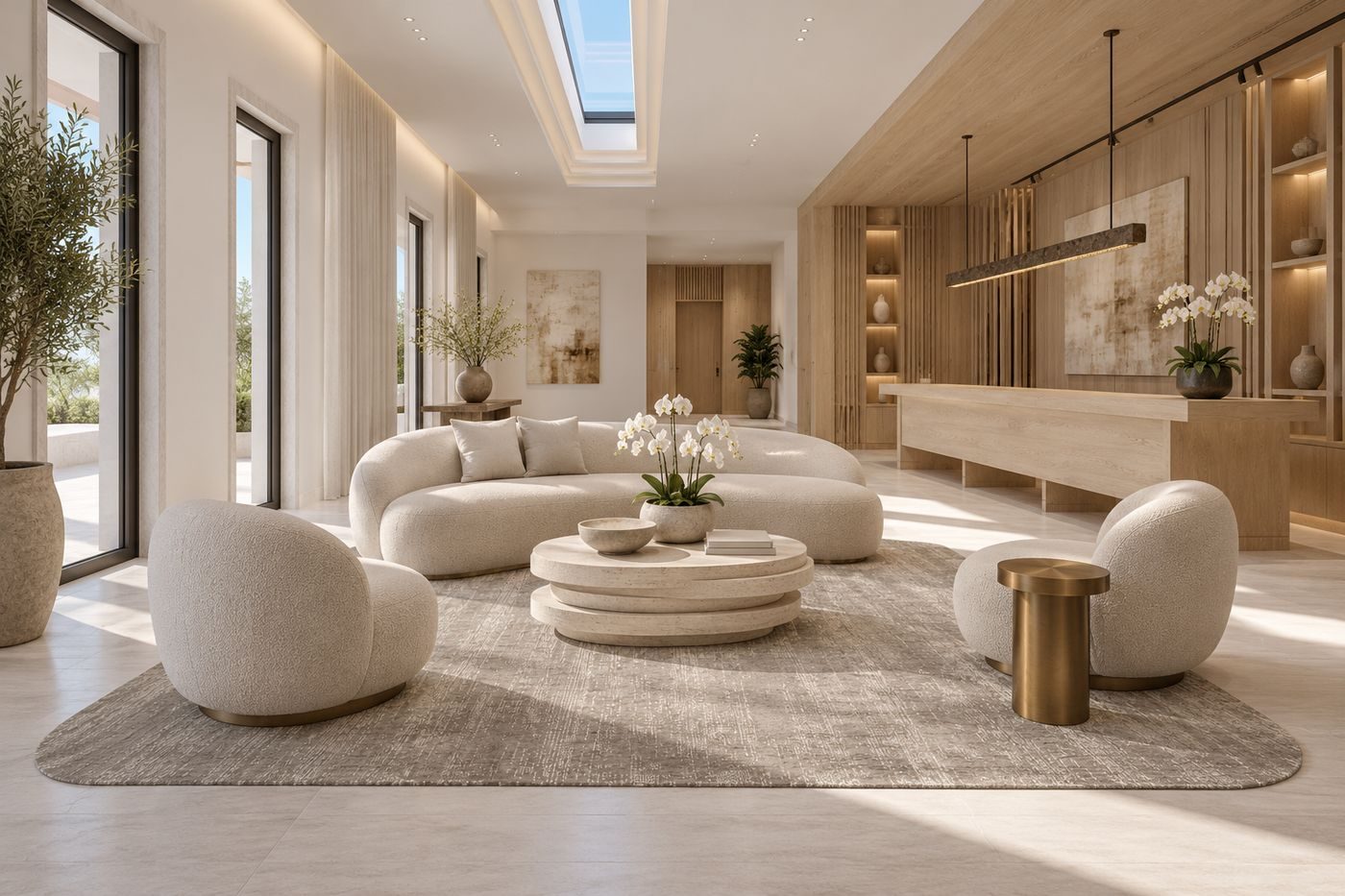
Look at the floor in a current set of hotel interior pictures and the pattern is hard to miss. In our trend report on 370 hotels and hotel projects, a rug on wood, stone or terrazzo was about four times as common as wall-to-wall carpet wherever the floor could be seen, and about four in five lobbies and lounges had one. The carpet of today's hotel interior is mostly a rug.
For a specifier that changes the question. It is less "which broadloom" and more "how large, what shape, which construction, and how does it get into the building". This article sorts out where each approach belongs, how to zone a big lobby with rugs, and what you give up in acoustics and care when the floor underneath stays hard.
01Where wall-to-wall still wins
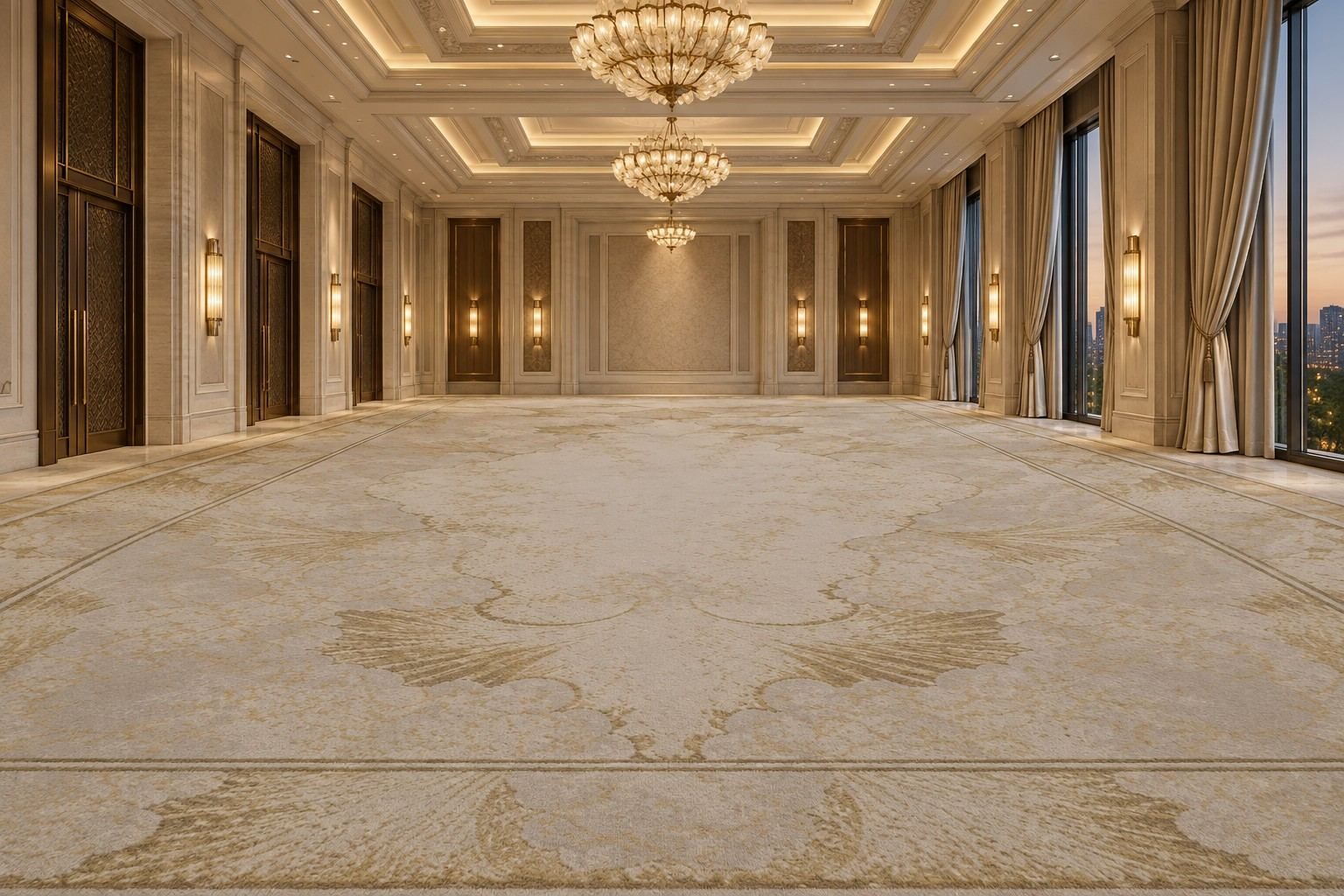
The rug has not replaced fitted carpet everywhere. In the ballrooms, meeting rooms and pre-function areas of hotels opened or renovated in 2025 and 2026, almost every visible floor is wall-to-wall carpet, while lobbies, lounges and bars rarely have it. Nearly all of it is patterned, mostly as a large, free repeat that runs over the whole room without a border or framed field. Corridors are more often zoned as a runner and tend to be darker, although most corridor pictures in the report are renderings, so that part is a direction rather than a finding.
The logic is practical. These rooms are reset again and again, so no furniture layout is final, and a large free repeat hides seams, traffic lanes and the footprints of last night's banquet. A loose rug would only be in the way. How to specify those floors is covered in our guide to ballroom and event-space carpet.
02Zoning a large lobby with rugs
A big lobby on stone or timber is an open field, and the rug is what turns it into places: a seating group, a waiting corner, a lounge island in front of the bar. The hard floor remains the ground and carries the architecture, while the rug says where to sit. That is also why the rug can afford to be the strongest graphic element in the room.
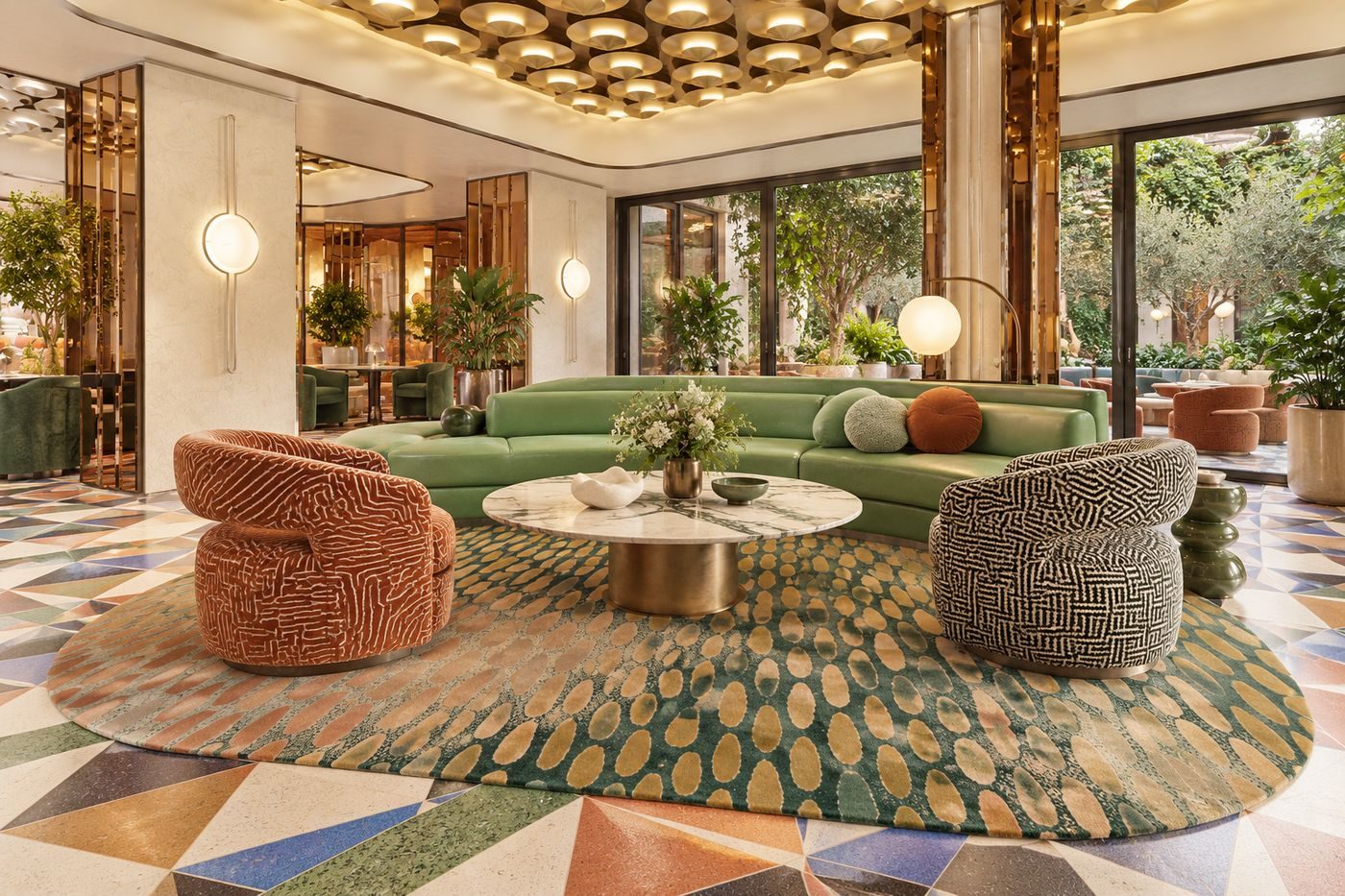
Two directions work, and the room decides between them. Where the interior is calm and timber-led, a plain rug with texture lets the pile do the work: velvet, a dense cut pile that shades as you walk, or tip-sheared, a calm cloudy lustre with a fine grain. Both are hand-tufted or hand-woven in any colour from your scheme. Where the lobby is meant to carry the design, a pattern is the better answer, and the report finds geometry leading on the floor, with chequerboards, grids and stepped fields first. The upscale hotels in the sample put their pattern in the lobby and the bar and keep the guest room calm.
A rug also removes a problem that wall-to-wall carpet has with pattern. In fitted carpet every breadth is rounded up to whole repeats, so a large repeat in an awkward room costs the most in cut loss. As a rug, the repeat hardly matters.
03Shape: let the rug follow the furniture
Curved sofas, round tables and arches shape about one interior in three, yet only about one rug in seven is round or free-form. Lobby furniture is rarely rectangular, so a rectangle under it often looks borrowed from another room. The answer is a round or oval rug, or a rectangle whose drawing picks up the curve.
Our rug shape library holds ten outlines: three corner radii, stadium, oval, round, the classic rectangle and three free-form pebbles. The library shapes come at no extra cost in printed, Axminster and hand-tufted, and every outline is available as DXF and SVG so it can go straight into the plan. The corner radius is calculated from the shorter side of the rug, so a small rug does not turn oval and a large one does not look heavy.
04Size, roll width and the route into the building
A rug that zones a large lobby can outgrow one width of roll goods. Cut from Axminster or printed carpet, a single piece stays within the standard roll width of 4 m, and cutting and binding adds about a week. A hand-tufted rug is made to size in almost any dimension, and the limit is transport rather than production. Hand-tufted Grand Royal starts from 1 m² for a defined area, and Royal is the value-conscious sibling for area rugs; the constructions are compared on our qualities page, where hand-tufted also shows the longest lead time of the three.
The library formats run up to 400 × 600 cm, and round rugs up to 400 cm in diameter. For anything larger, send the dimensions and we confirm what the construction allows. Then check the delivery route before the size is fixed. A large rug arrives rolled, so measure the path it takes, from the loading point through doors, lifts and corridors to the lobby, and not only the room it ends up in. A rug that is right on the plan and wrong for the service lift is a problem that shows up on the day of delivery.
05What you trade: acoustics and care
A hard floor with a rug is a compromise, and it is worth naming what is on each side.
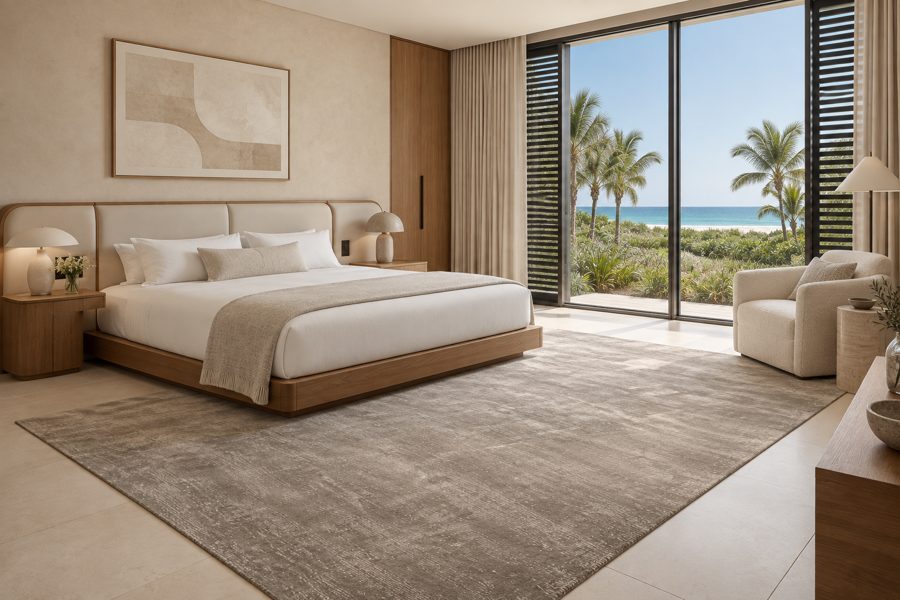
Acoustics. Two things are easily mixed up: impact sound that travels through the structure into the rooms below, and absorption of sound within the room. A rug helps with the first only where it lies, and a fitted carpet covers the whole floor. For the second, carpet is a modest absorber in the frequencies of speech, so it never makes a room quiet on its own. In guest rooms that have moved to hard floors, the usual countermeasure is a substantial rug beside the bed and on the path to the bathroom, because that is where heels strike. How much a rug adds also depends on the floor build-up beneath it, so ask for the impact figures of the whole assembly. Corridors have mostly stayed textile for acoustic reasons. The detail is in our article on carpet acoustics in hospitality.
Care and lifecycle. A hard floor is damp-mopped and the rug is vacuumed, and the rug can be replaced on its own cycle while the floor stays. In brand renovation cycles a hard surface typically outlasts soft goods, which is part of the trade-off discussed in carpet versus LVT. Soiling depends on colour as much as on fibre: on dark grounds it shows far less than on light ones, though fibre and construction also decide, and a light rug is better as a melange than as a flat tone.
06Where ligea Comes In
We make the rug side of this brief in all three constructions: printed, Axminster and hand-tufted. Plain velvet and tip-sheared rugs come in any colour from your scheme, the shape library is available at no extra cost, and any other shape is possible on request. The same design can be quoted in each construction, with size, shape and lead time shown side by side, and colour and texture are confirmed on physical samples before production. Send the room, the floor type and the delivery route, and we draw the rug to fit.
Send the room and the floor through spec to quote, or book a 15-minute spec call to plan where the rugs go.