
Carpet vs LVT in Hospitality: Where Each Wins
A buyer's guide to carpet vs LVT in hotels — acoustics, comfort, maintenance, ten-year cost, fire code and slip safety, and which finish wins in which zone.
The carpet-versus-LVT argument is usually framed as a winner-takes-all contest, and it almost never is. A hotel is not one floor; it is a stacked sequence of very different rooms with very different jobs — a guest sleeping above another guest, a housekeeper mopping a corridor, a lobby that has to survive wheeled luggage and wet shoes. Ask "carpet or LVT?" of the whole building and the honest answer is "both, in the right places." The useful question is narrower and more demanding: in this zone, against these priorities — quiet, comfort, cleaning, ten-year cost, code — which finish actually wins? Here is what the evidence says before the value engineering starts.
01Acoustics: Carpet's Most Defensible Win
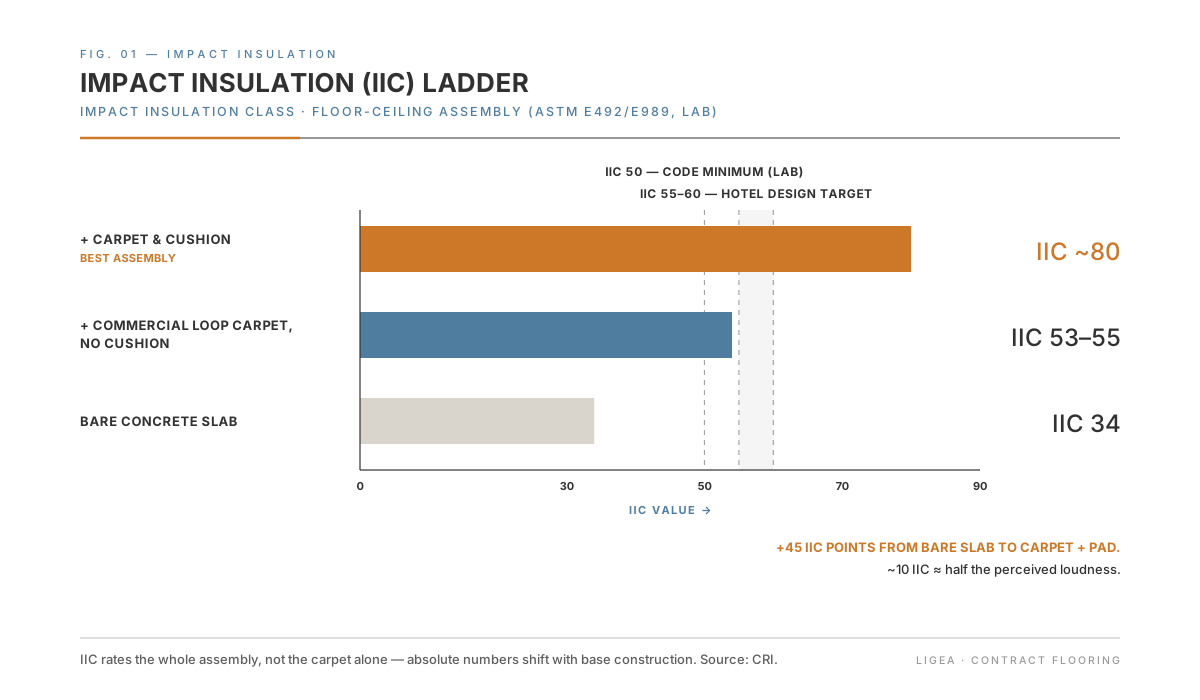
Footfall noise between stacked guestrooms is the single most common acoustic complaint in hotels, and this is where carpet's advantage is largest and best documented. The Carpet & Rug Institute's lab testing (per ASTM E492/E989) rates a bare concrete-slab floor-ceiling assembly at roughly IIC 34 for impact insulation. Add lighter-weight commercial loop carpet with no cushion and it climbs to IIC 53–55 — heavier loop weights without cushion test higher still in the same series; add a cushion and the same slab assembly can reach the high seventies to about IIC 80, a gain of around 45 points from carpet and pad over the bare slab (Carpet & Rug Institute). One thing to keep in mind reading these figures: IIC is a whole floor-ceiling assembly rating, not a property of the carpet by itself, so the absolute numbers move with the base construction. For airborne sound, those same tests put carpet's noise reduction coefficient in the 0.15–0.55 band for carpet laid directly on concrete, rising to about 0.70 for cut pile over a heavy cushion — meaningful absorption that hard surfaces simply do not offer bare.
Context matters for reading those numbers. Code typically sets a floor-ceiling minimum of IIC 50 (lab-tested per ASTM E492; the field-tested minimum is lower, around 45), while practitioners commonly target a design value of IIC 55–60 for hotels — usually understood as a lab rating, since field-measured impact ratings run several points lower. A 10-point IIC improvement roughly halves perceived loudness. The fair counter-point is that modern acoustic LVT with an attached backing genuinely narrows the gap on impact sound and can perform respectably — but bare, glue-down resilient flooring transmits footfall noise far more readily than carpet. The takeaway for a specifier: in multi-storey guestroom stacks, carpet wins outright unless LVT is paired with a proper acoustic underlayment, which practitioners treat as non-optional in that setting.
02Ten-Year Cost: LVT's Strongest Win
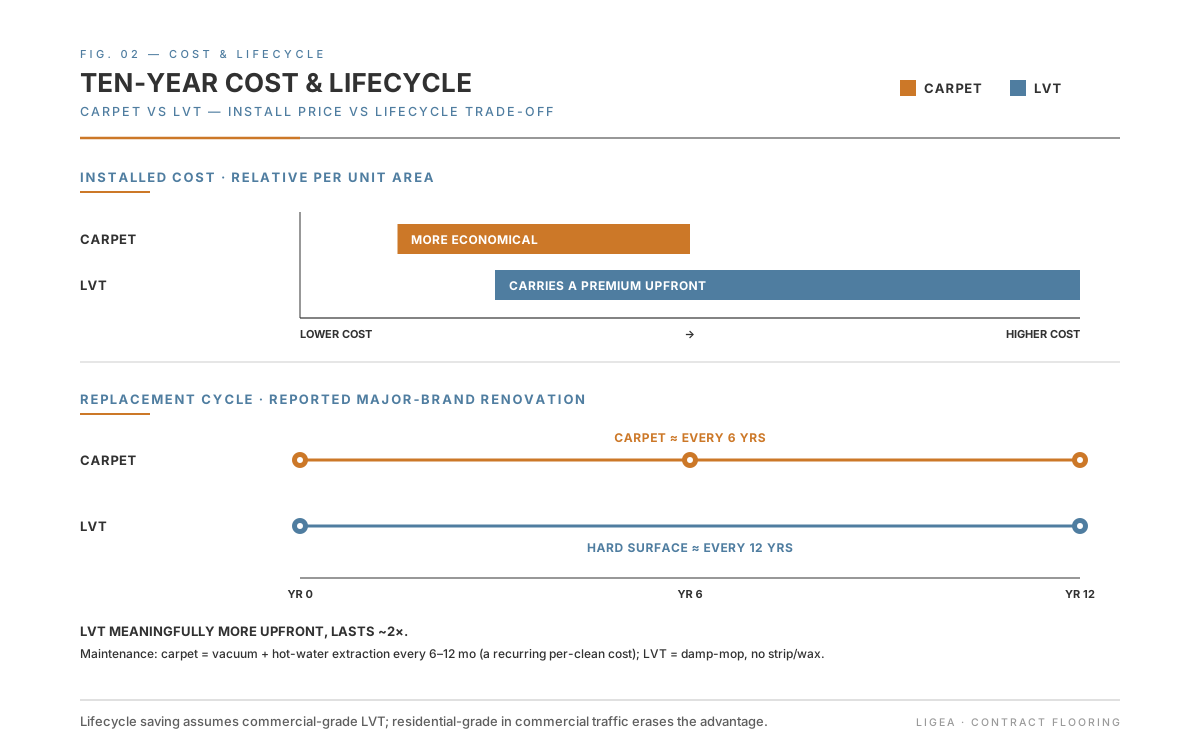
Install price flatters carpet and lifecycle cost flatters LVT, so judge on the latter. Commercial carpet generally installs more cheaply per unit area than LVT, which carries a premium upfront. The honest offset is durability. Major-brand renovation cycles have been reported as carpet replaced roughly every 6 years versus hard surface every 12 — LVT costing meaningfully more upfront but lasting about twice as long. Commercial carpet life is widely cited at 5–10 years by zone (corridors shortest), against 10–15 years for LVT.
Maintenance compounds the gap in LVT's favour on labour. Carpet asks for vacuuming several times a week plus hot-water extraction every 6–12 months, with professional cleans adding a recurring per-area cost each cycle; LVT is damp-mopped, needs no wax-buff-strip cycle, and is non-porous and easy to disinfect. Two caveats keep this honest. First, headline "save hundreds of thousands over ten years" figures circulating on trade blogs are illustrative, not audited — treat them as direction, not arithmetic. Second, LVT's long life assumes commercial-grade spec; the most common and costly specifier mistake is putting a residential-grade product into commercial traffic, where it wears out fast and erases the lifecycle advantage entirely.
03Comfort, Safety and Fire Code: Where the Brief Gets Technical
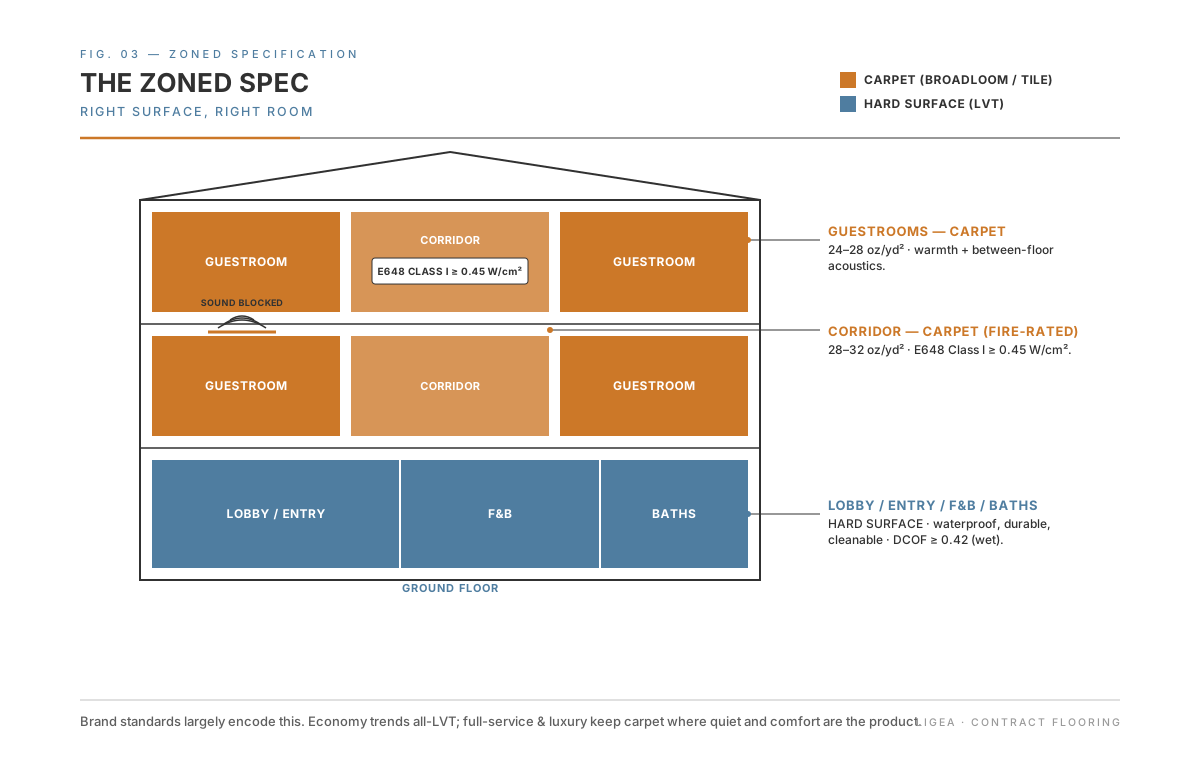
Three things pull back toward carpet, and all three matter to a procurement file. Comfort first: carpet is warmer underfoot, reads as residential and luxurious, and cushions a fall — qualities that carry weight in upscale and cold-climate properties. Slip liability second: smooth hard floors are a genuine hazard when wet, near pools, entries and F&B, and the spec to enforce on any hard surface in those zones is a wet dynamic coefficient of friction of DCOF ≥ 0.42 under ANSI A326.3 (Tile Council of North America). Carpet sidesteps that risk with inherent traction and a softer landing.
Fire code is the one designers most often overlook. In corridors and exits, floor coverings in many occupancies must meet NFPA 253 / ASTM E648 critical radiant flux — Class I ≥ 0.45 W/cm² in exits and corridors, Class II ≥ 0.22 W/cm² for general commercial (NFPA 101, via UpCodes). Carpet is the material that must be tested and rated to those thresholds; non-carpet resilient floors face only a far lower radiant-flux minimum and are generally exempt from this floor-covering flammability requirement, not being treated as an unusual fire hazard. The practical rule: a corridor carpet must carry the right E648 class on its documentation — confirm it on paper, never infer it.
04The Hygiene Question, Handled Honestly
"Carpet is unhygienic" is repeated as fact and is genuinely contested, so it deserves nuance rather than a verdict. The pro-carpet "filter" view holds that fibres trap allergens out of the breathing zone while hard floors let particles resuspend into the air. The stronger body of evidence cuts the other way: a 2018 peer-reviewed review concluded carpets act as a reservoir for pollutants, finding mite allergen several times higher in carpet than on smooth floors and associating carpeted bedrooms with elevated asthma readmission risk (IJERPH review). The reconciling factor is maintenance — the "filter" benefit only holds with rigorous, frequent extraction. Layered on top is perception: post-pandemic, guests increasingly read hard floors as cleaner, which has become a commercial driver in its own right, independent of measured air quality. The fair framing is that carpet can trap or release allergens depending on how it is maintained, and that perception now carries weight alongside the science.
05Where Each Wins: The Zoned Spec
The dominant real-world answer is not either/or but zoned, and brand standards largely encode it. Carpet — broadloom or tile — wins in guestrooms for warmth, between-floor acoustics and a residential feel, especially in upscale and cold-climate properties; corridor face weights of around 28–32 oz/yd² and guestroom weights of 24–28 oz/yd² are common reference points, with solution-dyed nylon favoured for colourfastness. Hard surface wins in corridors, lobbies, bathrooms, entries and F&B for waterproofing, durability and cleanability. The economy segment has gone furthest toward all-LVT, while full-service and luxury keep carpet where quiet and comfort are the product. One design note for 2026: warmer palettes and biophilic wood and stone looks are displacing cool greys, and mixed-material installs combining soft and hard surfaces are increasingly the default rather than the exception.
06Where ligea Comes In
A flooring spec is really three things at once — a designer's vision, a developer's budget, and a set of zones that each punish a different weakness. Our job is to read all three and put the right surface in the right room, not to defend one material. Where the brief calls for the warmth, acoustic performance and luxury read that guestrooms and signature spaces need, we specify woven Axminster in 80/20 wool-nylon or 100% wool — built to a defined pitch and rows, from guestroom weights up to airport-grade density, in up to sixteen colours, with matt-and-gloss zoning, refined edge binding, an IMO-marine version for cruise, and constructions reaching EN 13501-1 Bfl-s1 for corridors and escape routes. Where a design lives on gradient, photographic detail or a very wide colour range, we move to printed 100% nylon, working from pre-mixed colours with no pattern-repeat limit, accepting the sharpness-versus-pile trade-off knowingly. All of it comes as broadloom rolls, cut-and-bound rugs or modular tiles, with colour matched to Pantone TCX, NCS, RAL or a physical sample and proven on a strike-off before bulk.
Because we work across multiple producers rather than a single loom or print line, the brief picks the construction and the maker — not the other way round — so the soft-surface half of a zoned scheme is matched to the traffic, the light and the budget it actually has to survive. Bulk lead times typically run roughly two to eight weeks — print fastest, custom Axminster longer — after design, colour, strike-off and mockup are signed off, with AI-assisted rendering compressing the approval rounds that usually slow a project down.
---
ligea engineers contract surfaces for hospitality projects worldwide — matched to your design, your construction and your budget. When the brief is carpet, see our surfaces or book a 15-minute spec call.