
You Received a Hotel PIP. Here Is How to Read the Carpet Requirement
A Property Improvement Plan is the most predictable carpet replacement trigger in hospitality. Here is how to read the flooring line items, the 12–24 month clock, the brand standard behind them, and where waivers and substitutions actually work.
Most carpet replacement in hospitality is a judgement call: someone walks a corridor, decides it looks tired, and a budget conversation begins. A Property Improvement Plan is the opposite. It is a brand-issued document that tells you, in writing, exactly what has to be replaced, in which areas, and by when. For a procurement lead or owner's rep, that makes the PIP the single most predictable carpet trigger in the building, and also the one most often misread, because the carpet line looks like a one-word instruction and is actually a small specification packet in disguise.
This guide walks through how to read the carpet requirement inside a PIP: where it sits in the document, what the brand standard behind it actually demands, how the 12–24 month clock really works once you account for lead times, and where waivers and substitutions are genuinely available versus where they are not.
01Why a PIP Lands on Your Desk in the First Place
A PIP is not a maintenance notice. It is a franchisor instrument, and it shows up at predictable moments. The recurring triggers, across the major systems, are franchise renewal, a change of ownership or recapitalization, a conversion or rebrand, a quality-inspection result that drops a property below standard, and periodic brand-wide refresh cycles, with most brands re-issuing PIPs on roughly a six-to-seven-year cadence outside of those events. The point worth internalising is that none of these are surprises. A renewal date is known years out; a sale is negotiated; a refresh cycle is scheduled. That predictability is exactly why a PIP-driven carpet requirement can and should be planned for, not scrambled.
The volume behind this is not trivial right now. Brand-to-brand conversions hit a record high at the close of Q4 2025, reaching an estimated 1,497 projects and roughly 149,000 rooms in the pipeline, a double-digit year-over-year increase, and every one of those conversions carries a PIP. On top of that, industry commentary points to a large backlog of renovation work deferred during 2020–2022 that brands are now re-enforcing, with industry estimates putting the backlog well into the billions (treat the figure as an industry estimate rather than an audited total). The practical reading: if you operate or buy for branded hotels, a carpet-bearing PIP is less an if than a when.
02Where Carpet Sits Inside the Document
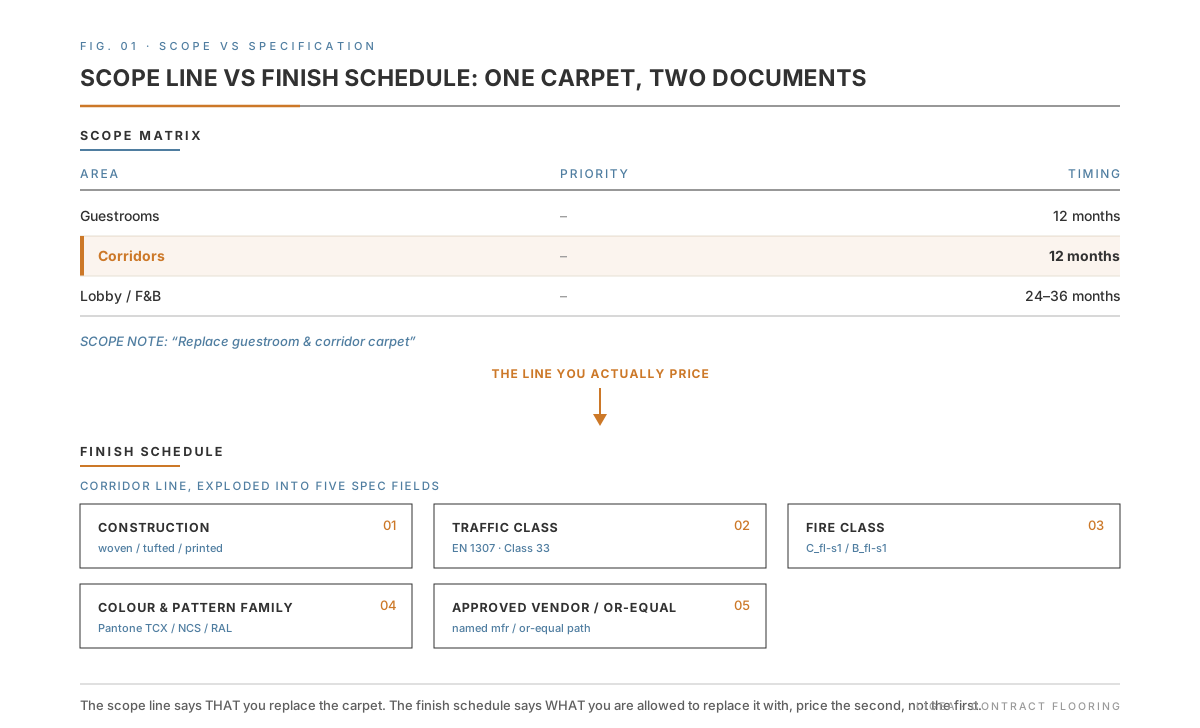
Open a PIP and you are looking at a structured packet, not a letter. A typical one is organised as a scope matrix by area (guestrooms, corridors, lobby, F&B, meeting rooms, exterior and identity, back-of-house), with each line carrying a priority and a timing band, commonly expressed as immediate / 12 months / 24–36 months. Sitting alongside the matrix are the brand standards themselves (finish schedules, FF&E specs, lighting levels), the life-safety, ADA and energy-code compliance items, and, critically, an alternates-and-variances path that tells you what can be substituted and how to ask.
Carpet appears in two places at once, and conflating them is the first mistake. It is a scope line in the matrix (e.g. "replace guestroom and corridor carpet"), and it is a specification in the brand's finish schedule, which defines the construction, fibre, fire class and often the approved colour or pattern family that the replacement must meet. The scope line tells you that you are replacing carpet; the finish schedule tells you what you are allowed to replace it with. A buyer who prices off the scope line alone, without pulling the matching finish-schedule spec, is pricing a product that may not pass brand sign-off.
It also helps to know which bucket carpet falls into, because it governs the cycle. In hospitality FF&E, carpet is a soft good, the textile-and-finish category that brands expect to refresh on a roughly five-to-seven-year cadence, distinct from the seven-to-ten-year case-goods cycle and the ten-to-fifteen-year full renovation. A guestroom soft-goods refresh carries a meaningful per-room cost, of which flooring is one component among bedding, drapery, upholstery and wallcovering. Because carpet rides the soft-goods cycle, a property approaching year six is, in effect, already on the clock before any PIP arrives.
03Reading the Specification Behind the Scope Line
The carpet entry in a finish schedule looks terse, but it is doing a lot of work. What it is really pinning down, and what you should extract before you price anything, comes down to roughly five things.
Construction and technique. The schedule will indicate whether the area expects a woven construction, a tufted construction or a printed product. This is not interchangeable: a brand standard written around a woven look will not accept a print substitute on aesthetics alone, and vice versa. Match the technique the standard expects before you shop the price.
Performance and traffic class. Corridors, lobbies and lifts are heavy-traffic zones, and a credible spec references that explicitly. The European baseline is the EN 1307 use-class system, where Class 33 (heavy commercial) is the sensible minimum for public circulation; the North American convention treats corridors and pre-function as heavy traffic above moderate-traffic guestrooms. Face weight will often appear as a minimum, and public-area minimums in the 30+ oz/yd² (roughly 1,000+ g/m²) range are common. Read weight as a floor, not a durability guarantee, since density and stitch rate drive real-world wear more than the headline number.
Fire class. This is a hard gate and corridors are escape routes. US-code projects hinge on the radiant-panel test (ASTM E648 / NFPA 253, Class I at ≥ 0.45 W/cm² for corridors and exits), while EU/EEA projects classify to [EN 13501-1](https://www.ligea.com/journal/hotel-corridor-carpet-specification-guide, commonly C_fl-s1 for public corridors and B_fl-s1 in higher-risk settings, with CE marking under EN 14041. A PIP will assume the local code; confirm the required class for your jurisdiction and occupancy rather than assuming the incumbent carpet's certificate still applies.
Colour and pattern family. Many brands publish a Prototype Interior Design or "design book" that dictates acceptable finishes, colours and sometimes specific palettes. The replacement carpet usually has to land inside that family, which is why a custom shade has to be matched to a defined reference (a Pantone TCX, NCS or RAL value, or a physical sample) and confirmed on a strike-off before bulk.
Approved vendors and equivalence. Branded FF&E is tightly controlled, and some standards name approved manufacturers or require products drawn from a brand specification book, with samples submitted for brand-manager approval before mass production. Where a standard is written as a named product, it is worth checking whether an "or-equal" equivalence path exists, because that is where most of the procurement freedom lives.
04The 12–24 Month Clock Is Shorter Than It Looks
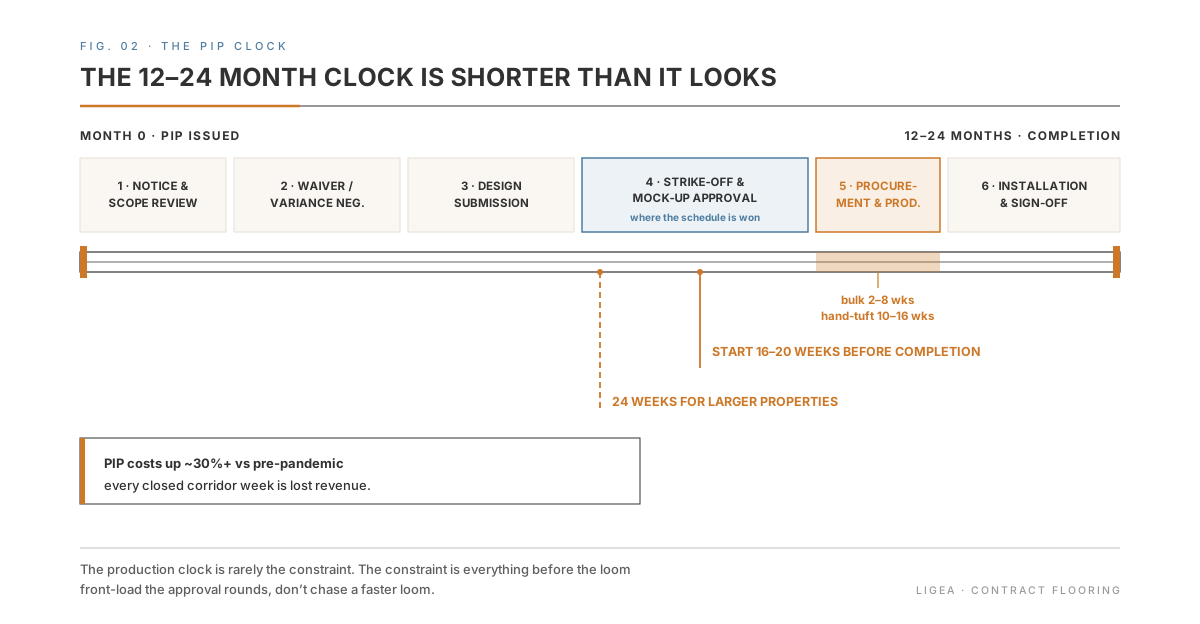
The headline timeline most brands attach to a PIP is 12 to 24 months to completion. Read on its own, that sounds generous for a carpet order. It is not, because the clock does not belong to production. It belongs to the whole sequence: notice and scope review, waiver negotiation, design submission, mock-up approval, procurement and production, then installation and sign-off.
Lay the real durations against that. Bulk production for contract carpet is comparatively short but varies by construction: printed constructions commonly run 2–4 weeks and woven Axminster 4–8 weeks once everything is signed off, while hand-tufted custom carpet typically takes longer, 10–16 weeks. The production clock, in other words, is rarely the constraint for print and Axminster. The constraint is everything before the loom: brand approval rounds, strike-off and mock-up sign-off, and the back-and-forth that procurement guidance says should start at least 16–20 weeks before the target completion date, or 24 weeks for larger properties.
There is also a cost dimension to the clock. PIP costs are reported to have risen roughly 30% or more versus pre-pandemic levels, and the hidden line items (out-of-service rooms, storage, brand-required consultants and delayed approvals) punish a slipped schedule far more than the carpet itself costs. Every week a corridor sits closed for installation is revenue, which is why front-loading the approval cycle, not chasing a faster loom, is where the schedule is actually won. The earlier a proposed scheme can be visualised and signed off, the earlier the production clock can start.
05Where Waivers and Substitutions Actually Work
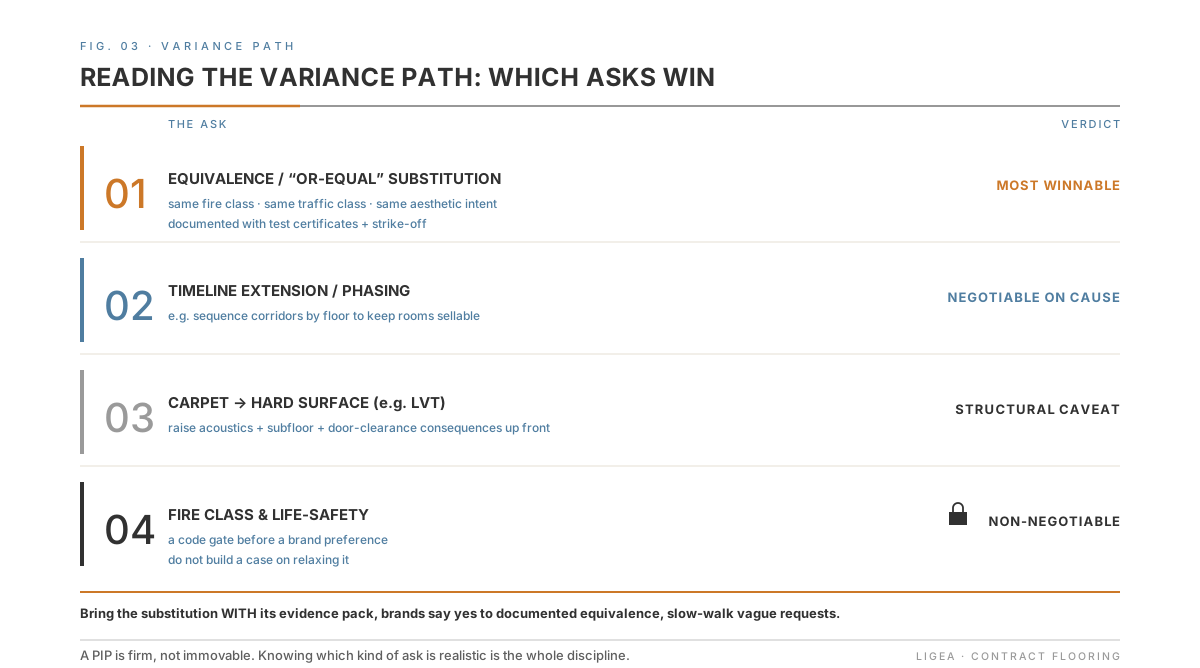
A PIP is firm but it is not immovable, and the variances path is a real tool rather than a courtesy. Owners can request waivers, variances, substitutions or timeline extensions, and brands will often accept alternate materials where equivalence is demonstrated. The discipline is knowing which kind of ask is realistic.
- Equivalence substitutions are the most winnable. If a standard names a product or a construction, an "or-equal" carpet that meets the same fire class, traffic class and aesthetic intent, documented with test certificates and a strike-off, is a defensible substitution. This is where holding the spec to its requirements rather than its named brand pays off.
- Timeline extensions and phasing are negotiable on cause. Brands will consider deferral or phasing when an owner can justify it, for example by sequencing corridors by floor to keep rooms sellable.
- Fire class and life-safety items are essentially non-negotiable. A corridor carpet's fire classification is a code gate before it is a brand preference; do not build a substitution case around relaxing it.
- One structural caveat worth flagging early: across several brands the prevailing direction of travel is to replace carpet with hard-surface flooring such as LVT in some guestroom and corridor settings, driven by cleanliness perception and maintenance cost. Where that applies, the question may not be "which carpet" but "carpet or hard surface", and that choice has acoustic and subfloor consequences (sound transmission, door clearances) that belong in the conversation up front, not after a carpet is ordered.
A practitioner truth to carry into the variance conversation: do not ask permission in the abstract. Bring the substitution with its evidence pack, meaning fire and emissions certificates, a traffic-class rating and a physical strike-off in the approved colour family. Brands say yes to documented equivalence and slow-walk vague requests.
06Where ligea Comes In
A PIP carpet line usually reaches us as a finish-schedule spec with a deadline attached, and the most useful early step is to build the or-equal case. We match the construction the standard expects, such as Axminster by pitch and rows, a Royal hand-tuft or print, colour-match it to the brand palette in Pantone TCX, NCS or RAL, and prove it on a physical strike-off you can put in front of the brand manager. Fire performance is documented to the class your jurisdiction demands, with EN 13501-1 achievable up to B_fl-s1. Because we work with several producers, we can usually start production as soon as the strike-off is approved: 2–4 weeks for print, 4–8 for Axminster and 10–16 for hand-tuft, with freight depending on the route.
Working a live PIP? See our surfaces, or book a 15-minute spec call.