
Guestroom Carpet: Comfort, Cleanability and Cost at Scale
How to specify hotel guestroom carpet: traffic class, density vs face weight, acoustics, fibre and cleanability, and what changes when you multiply it across hundreds of keys.
The guestroom floor is the one surface every guest spends eight hours next to barefoot, and the one a procurement team has to buy a few hundred times over. Those two facts pull in opposite directions. The designer wants warmth and a soft hand at the bedside; the owner wants a number that survives multiplication by 300 keys; the operations team, the people who actually live with the floor, wants something that does not look tired after a year of rolling luggage and red wine. The good news is that a guestroom is a genuinely different brief from a corridor, and specifying it as such is where the money and the comfort both live. Here is what holds true across the industry, before any one supplier is in the room.
01A Guestroom Is a "Moderate" Traffic Class, So Spec It That Way
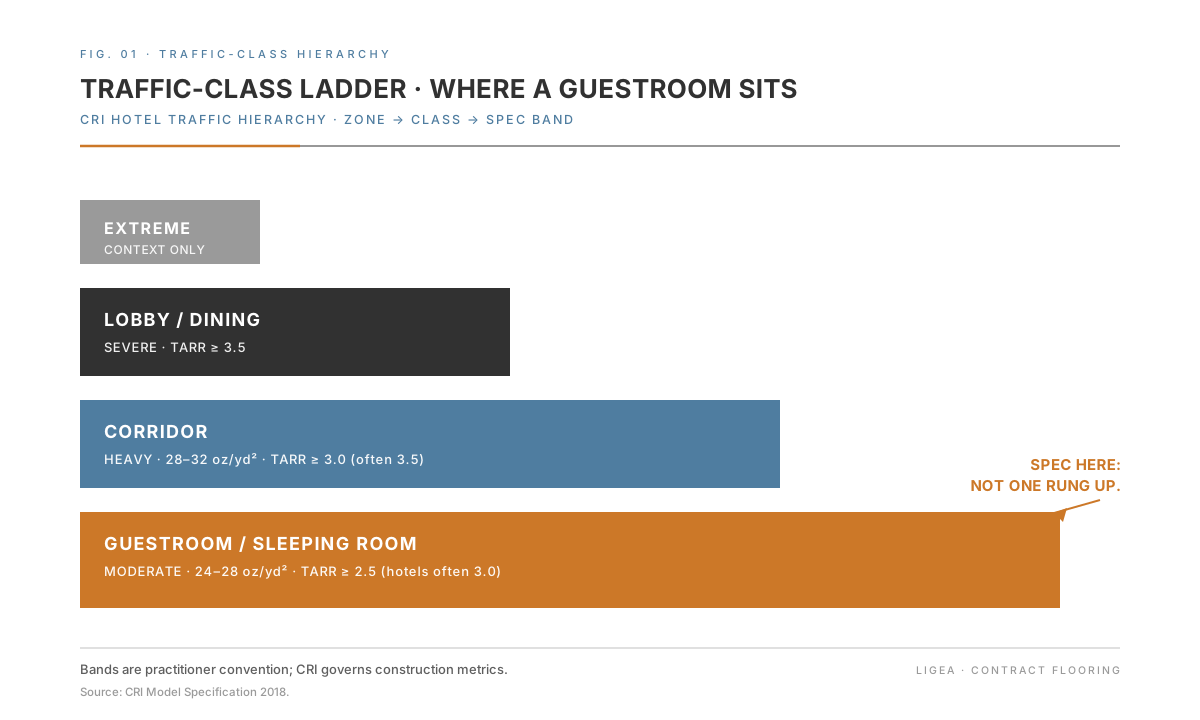
The most useful single idea in guestroom carpet is that it does not need corridor-grade construction. The Carpet & Rug Institute's Model Specification for Commercial Carpet sorts end uses into Moderate, Heavy, Severe and Extreme traffic, and it explicitly lists sleeping rooms as Moderate, while corridors and congregation areas sit at Heavy and lobbies and dining at Severe (CRI Model Specification, 2018). In practice that lines up with a face-weight split many specifiers use as a rough rule of thumb: roughly 24–28 oz/yd² in guestrooms against 28–32 oz/yd² in corridors, which carry far more abrasion. These bands are practitioner convention rather than a codified figure. The exact numbers vary by source, and the CRI spec itself governs construction metrics like density, stitch rate and tuft bind rather than zone-specific face weights.
That distinction has a real budget consequence. The tempting move (one carpet for rooms and corridors to simplify procurement) quietly forces guestrooms up to a Heavy/Severe construction they don't need, multiplied across every key. Matching the spec to the actual traffic class is the difference between paying for performance and paying for waste.
The performance bar still has to be met, and it is well defined. The CRI Model Specification sets minimums worth carrying into any tender: tuft bind of 3.0 lb minimum average value for cut pile (ASTM D-1335), delamination of the secondary backing of at least 2.5 lb/in where applicable (ASTM D-3936), colourfastness to crocking at Class 4 wet and dry (AATCC 165), and lightfastness of Grade 4 after 40 AFU (AATCC 16, Option 3). Appearance retention is graded by the Texture Appearance Retention Rating (TARR), run on the ASTM D-5252 Hexapod drum and classified per ASTM D-7330. The CRI tiers run Moderate ≥ 2.5, Heavy ≥ 3.0 and Severe ≥ 3.5, so a guestroom (Moderate) clears at ≥ 2.5, while corridors sit in the Heavy band at ≥ 3.0. Because hotel corridors funnel all guest traffic, many hospitality specifiers set a more conservative floor (TARR ≥ 3.0 in guestrooms and ≥ 3.5 in corridors) to buy headroom against real-world wear.
02Density, Not Face Weight, Drives Durability
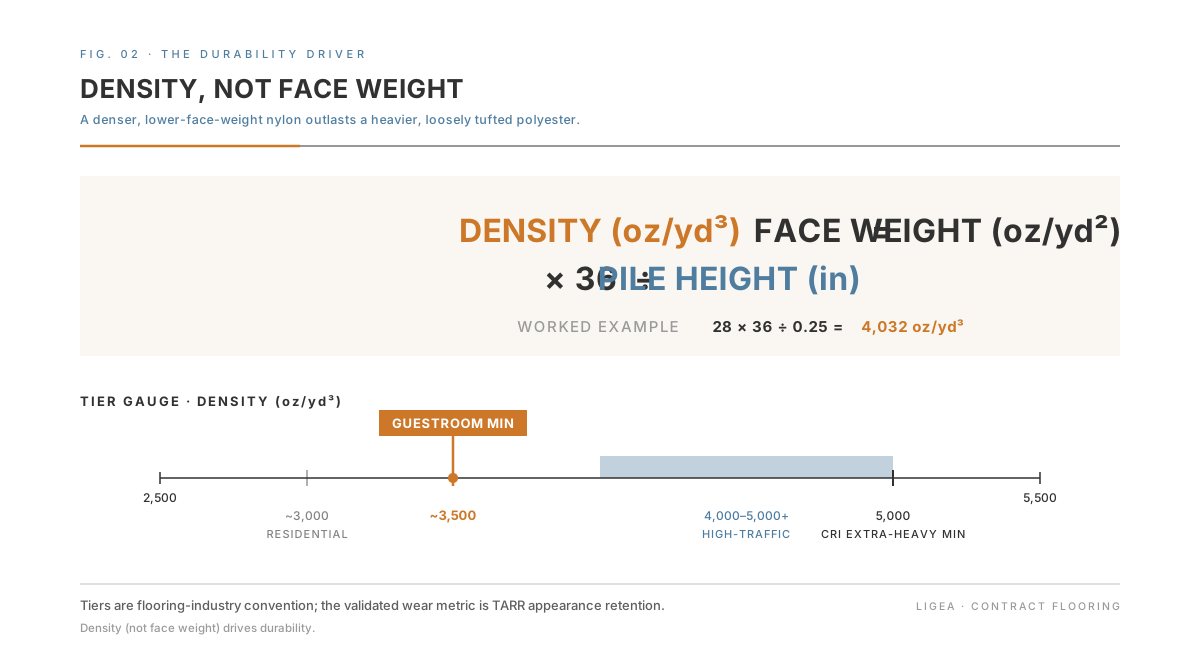
The most persistent myth in carpet specification is that a higher face weight means a more durable floor. It doesn't, on its own. What resists the crushing and matting that rolling luggage inflicts is density, meaning how tightly the yarn is packed, and a denser, lower-face-weight nylon can outlast a heavier, loosely tufted polyester. Density is a build-quality signal rather than a validated wear metric in its own right (the industry's empirical durability test is the TARR appearance-retention rating above), but as a quick proxy it beats face weight comfortably.
It is a number you can calculate, so ask for it:
Density (oz/yd³) = Face Weight (oz/yd²) × 36 ÷ Pile Height (in)
For guestrooms, a common practitioner rule of thumb is a minimum of around 3,500 oz/yd³, against roughly 3,000 for general residential and 4,000–5,000+ for high-traffic zones. These density tiers come from flooring-industry convention rather than a CRI table. CRI's own published density figure is a minimum of 5,000 oz/yd³ for extra-heavy-traffic commercial use, and it otherwise specifies by traffic class and appearance retention (CRI, Finding the Right Carpet). Spec the density alongside the face weight and the traffic class, and you have closed the gap most "looked great, ugly in a year" stories fall through.
03Acoustics: Carpet Owns the Floor, but Not the Wall
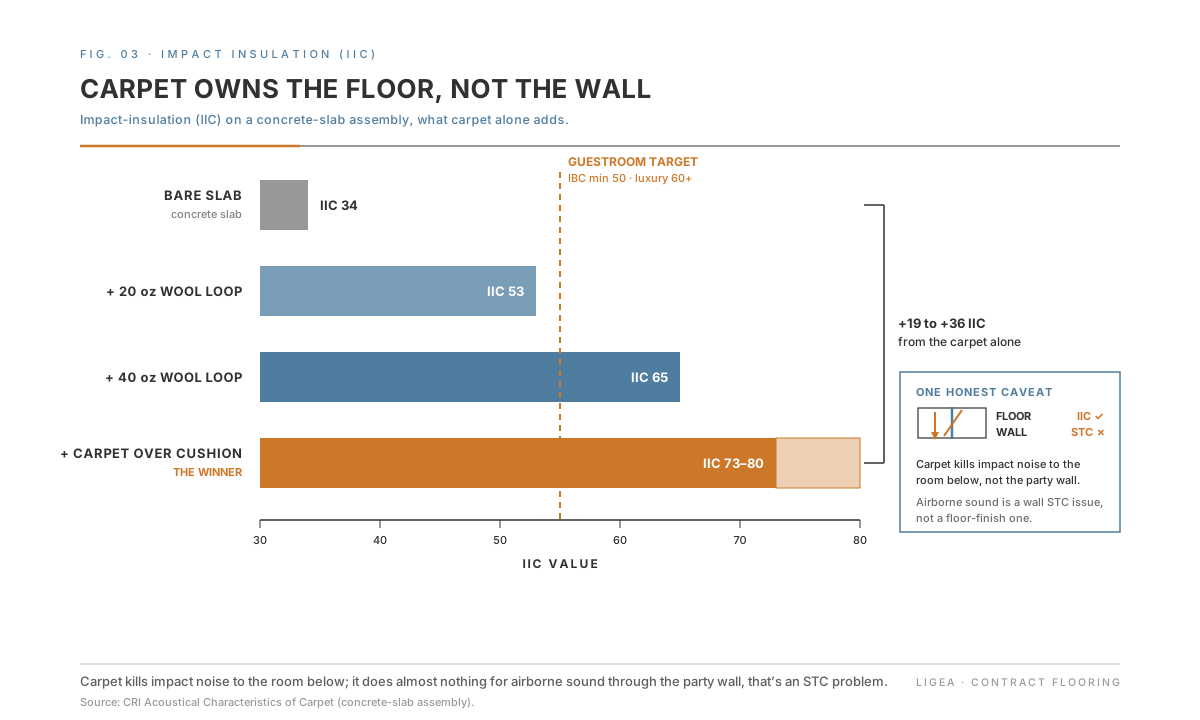
Impact noise (footfall, the suitcase wheel at 2 a.m.) is the number-one acoustic complaint in hotels, and on the floor-to-ceiling path carpet is decisively effective. The CRI's acoustical data, measured on a concrete-slab assembly, is the most quotable evidence here: a bare slab rates IIC 34; add a 20 oz wool loop and it jumps to 53; a 40 oz wool loop reaches 65; and carpet over a cushion pushes to IIC 73–80 depending on the pad (CRI Acoustical Characteristics of Carpet). That is a 19-to-36-point swing from the carpet alone, and it matters even more on wood-joist construction, where a bare floor starts at only IIC 32.
Set against industry targets of IIC 55+ and STC 55+ for guestroom assemblies, carpet plus a cushion reaches that range without extra underlayment, whereas hard surfaces generally need an acoustic mat to compete. Luxury brands push IIC 60+, and the IBC code minimum sits at 50.
One honest caveat protects you from a common, expensive conflation: carpet kills impact noise to the room below, but it does little for airborne sound passing through the party wall between two adjacent rooms. That is an STC problem for the wall assembly, not something any floor finish will solve. Solving "noisy neighbours" with a plusher carpet is solving the wrong axis.
04Cleanability and Fibre: Unpack the Polyester Myth
Polyester rarely shows up in woven Axminster or broadloom construction for guestrooms. Where it earns its keep is in tufted and printed products, a different production route entirely. But the fibre-chemistry comparison still gets raised at spec stage, so it is worth unpacking. "Polyester is more stain-resistant than nylon" is true only for a subset of spills. PET/polyester is naturally hydrophobic, so it shrugs off water-based stains (coffee, wine, soda, the common guestroom culprits) without topical treatment because it has no open dye sites. But the same chemistry means PET absorbs oil and grease, holds soil, and crushes faster than nylon. Nylon stains more readily, yet modern acid-dye-blocker and solution-dyed nylon close most of that gap and win decisively on resilience and appearance retention.
The colourfastness benchmark in either fibre is solution-dyeing, where pigment is locked into the fibre before extrusion and leaves no external dye sites. It gives superior fade and bleach resistance, the property a housekeeping team's cleaning chemistry depends on. For the spill-and-odour problem specific to a bedroom floor, a moisture-barrier backing keeps liquid on the surface and stops it reaching the subfloor or wicking back up from it, and antimicrobial treatment can be built into the fibre or the backing.
Two operational truths sit underneath all of this and belong in any spec conversation. First, over-wetting is the silent killer: hot-water extraction that oversaturates can take days to dry and invites mildew, which is why low-moisture encapsulation has become the occupied-hotel default. Second, colour fights maintenance: a very light or very saturated carpet will show soiling sooner, a real tension between the moodboard and the housekeeping cart. And for the bedside hand itself, the upscale default remains an 80/20 wool-nylon blend: wool's warmth and softness, nylon's resilience.
05Cost at Scale: Where Small Decisions Multiply
Per square unit the numbers look modest: broadloom is the more economical option and carpet tile carries a premium over it. Across a property they stop looking modest: a midscale recarpet is a major capital line item, plus the often-underestimated cost of rooms out of service during the work. For context, guestroom FF&E is typically one of the larger renovation line items, on the order of 25–40% of a renovation budget. Quality guestroom carpet tends to hold for 7–10 years versus 5–7 in corridors.
The recurring at-scale decision is broadloom versus tile. Broadloom is cheaper upfront, seamless and plusher underfoot, which is why it stays the guestroom favourite. Tile costs more initially but lets a stained or damaged unit be swapped out individually, lowering lifecycle cost in heavily abused, high-repair zones. The pragmatic answer many operators reach is hybrid: a hard surface at the entry and wet zones where spills land, carpet at the sleeping zone where warmth and quiet earn their keep.
A final note that sinks budgets quietly: with patterned goods, pattern repeat and seam placement drive waste, and phased multi-wing renovations need dye-lot control or you get visible mismatches between floors. None of that shows up in the per-yard price, but all of it shows up in the invoice.
06Where ligea Comes In
For guestrooms we suggest a different construction from the corridors wherever the brief allows, because carrying the corridor spec through every key pays for wear the room never sees. For the room itself we usually work in Axminster at 7×7 to 7×8, in 80/20 wool-nylon as the rule or 100% wool where the brief asks for it. Royal, one of our hand-tuft qualities, sits only slightly above Axminster in cost and gives the bedside a fuller surface with sharper contours and relief. Every shade is matched to your Pantone TCX, NCS or RAL reference, or to a physical sample, and confirmed on a strike-off before production. Because we work with several producers, we can usually start production as soon as that strike-off is approved, and Axminster then takes 4–8 weeks.
---
ligea makes contract carpet for hotel projects worldwide, from the first guestroom mock-up to the last key. See our surfaces or book a 15-minute spec call.