
How Long Does Hotel Carpet Last? Lifecycle and Replacement
Realistic service life for hotel carpet by construction and traffic, the maintenance multiplier, brand-mandated refurbishment cycles and total cost of ownership: an owner and asset view with the real numbers.
Ask three people how long hotel carpet lasts and you will get three different answers, because they are measuring three different things. The mill is talking about when the fibre physically wears out. The general manager is talking about when the carpet stops looking acceptable to a guest. The asset manager is talking about when the brand standard forces a replacement, regardless of either. All three are right, and the gap between them is where money is won or lost. This guide separates the numbers so an owner can plan capital, not just react to a tired-looking corridor.
01The Real Service-Life Numbers, by Construction and Traffic
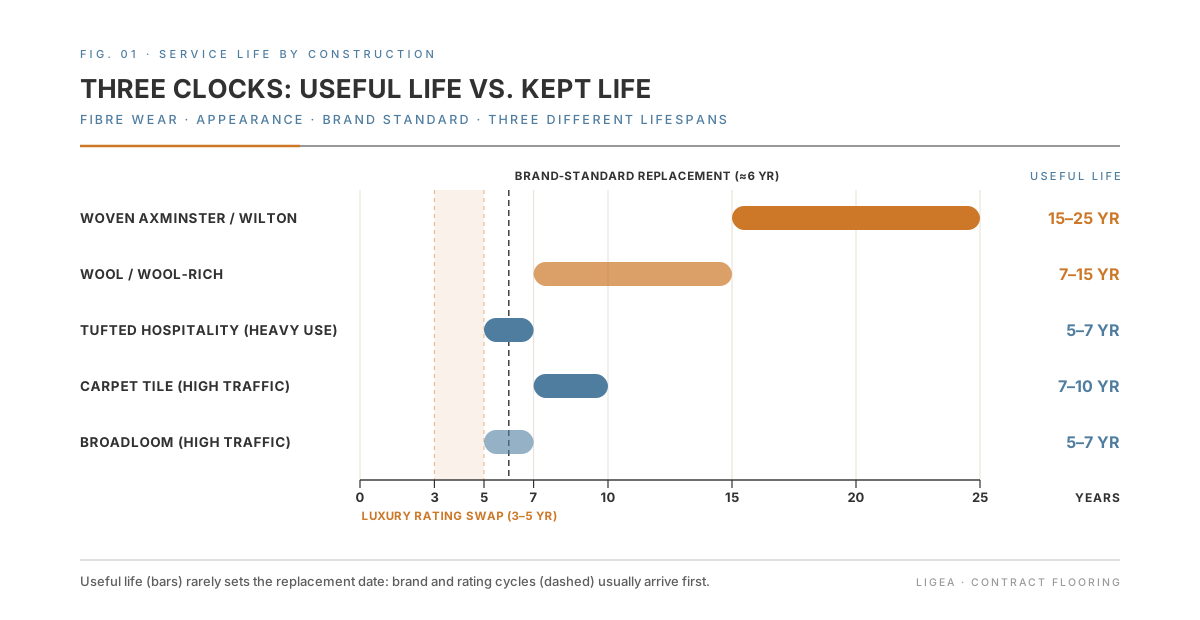
Commercial carpet as a category lasts roughly 5 to 15 years, and quality nylon or wool with disciplined maintenance can run beyond the top of that band. As a widely repeated industry rule of thumb rather than a figure from a standards body, the spread inside the band tracks construction and traffic: low-traffic areas tend toward 10–15 years, medium traffic 7–10, and heavy traffic 5–7. Treat these as practitioner estimates; actual life varies heavily with fibre, quality, underlay and maintenance.
Construction sharpens the picture. Woven Axminster and Wilton carpets are generally credited with markedly longer service lives: as a trade rule of thumb, a woven 80/20 Axminster runs roughly 15–25 years physically, and up to around 30 with very careful maintenance in lighter-traffic areas, though published figures vary by source and traffic level. Wool and wool-rich blends are commonly cited at 7–15 years depending on area (a conservative band, since wool in lighter-traffic guestrooms often lasts considerably longer), and tufted hospitality-grade goods at 5–7 years in heavy use. The durability advantage of woven goods is structural: each tuft is woven in and locked by the backing shots, so there is no adhesive bond to age or fail at all. Delamination, the tufted-goods failure mode where that backing bond lets go, is largely a cheap-production and moisture issue today rather than a routine end-of-life path: quality latex compounds and proper curing keep it rare and specifiable (ASTM D3936 delamination strength), and most tufted carpet is in practice retired for appearance loss long before the backing bond becomes the limiting factor.
Format matters too. In high-traffic zones, carpet tile tends to outlast broadloom: by common industry estimates roughly 7–10 years versus 5–7, though these are vendor rules of thumb rather than standards-body figures. That is not because the tile is inherently tougher, but because individual worn squares can be swapped out instead of replacing an entire field. Wear is rarely even: a relatively small share of any floor (the entrances, pivot points and corridor pinch points, where roughly a fifth of the area can absorb the bulk of the foot traffic) wears fastest, so replacing just those tiles extends the life of the whole installation.
One honest caveat on fibre: the "wool always outlasts nylon" rule is contested. Wool is superb for guestroom resilience and colour depth, but solution-dyed nylon often outperforms wool in corridors under rolling traffic and tolerates harsher cleaning chemistry, because its colour pigment is locked into the polymer before extrusion. Durability is rarely about fibre alone: density, weave and installation drive lifespan as much as fibre choice, with pile-yarn density generally a stronger predictor of wear than face weight by itself.
02Specify by the Right Class, Not by Habit
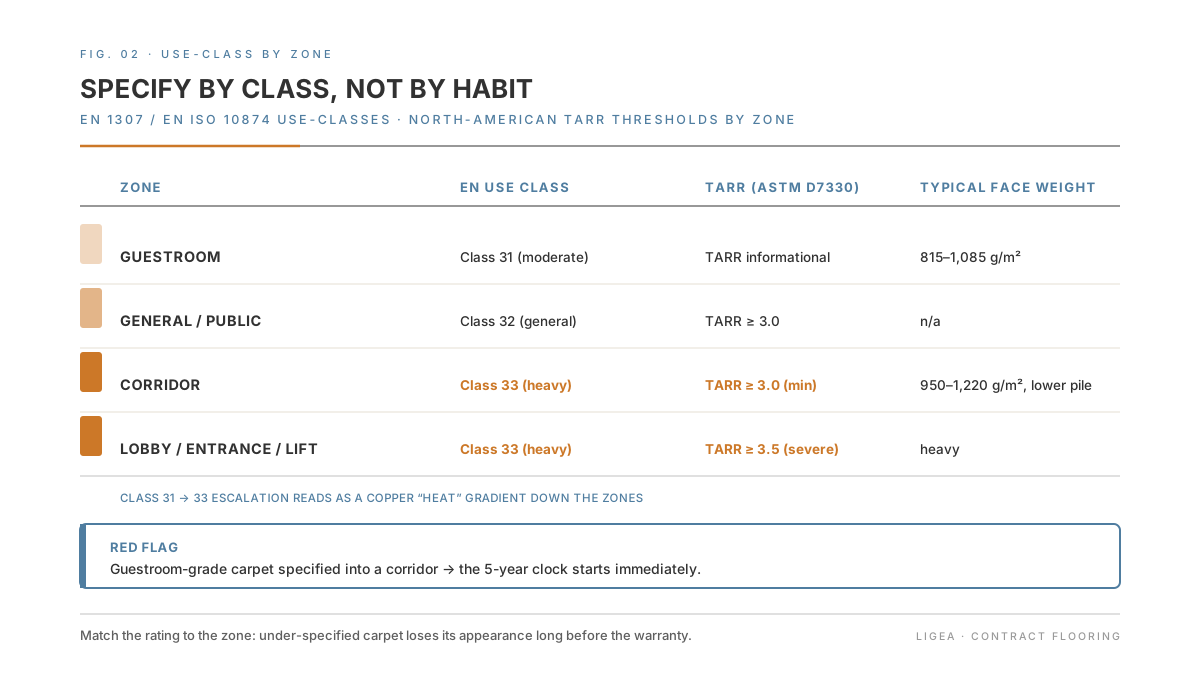
Service-life numbers only hold if the carpet was rated for the zone in the first place. Two systems govern this. In Europe, EN 1307 (with the use-area classification now carried by EN ISO 10874, which superseded EN 685) sorts contract carpet into use classes: Class 31 for moderate (light) commercial use such as hotel rooms, 32 for general (medium) commercial use, and Class 33 for heavy commercial use: lobbies, entrances, lifts and other intensive public areas (ISO 10874).
In North America the relevant measure is TARR (Texture Appearance Retention Rating), scored under ASTM D7330 after a 12,000-cycle hexapod exposure on a 1–5 scale. The practical thresholds are heavy traffic ≥ 3.0 and severe traffic ≥ 3.5, with hotel corridors generally requiring a minimum of 3.0 and high-traffic public and entrance areas warranting 3.5. Specify a guestroom-grade product into a corridor and the 5-year clock starts ticking immediately, a classic mistake, with under-rated corridor carpet often losing its appearance within months.
For reference, typical hospitality construction runs to face weights of roughly 815–1,085 g/m² in guestrooms and 950–1,220 g/m² in corridors, with lower pile height in corridors to reduce trip risk and speed cleaning.
03Maintenance Is the Single Biggest Multiplier
Of every factor that decides how long carpet survives, maintenance is the one most under an owner's control, and also the most under-resourced. The Carpet and Rug Institute is blunt about it: regular cleaning extends the life of carpet, and carpet that is not properly maintained is routinely retired well before the end of its design life, where a disciplined programme keeps a floor in service substantially longer (Carpet and Rug Institute).
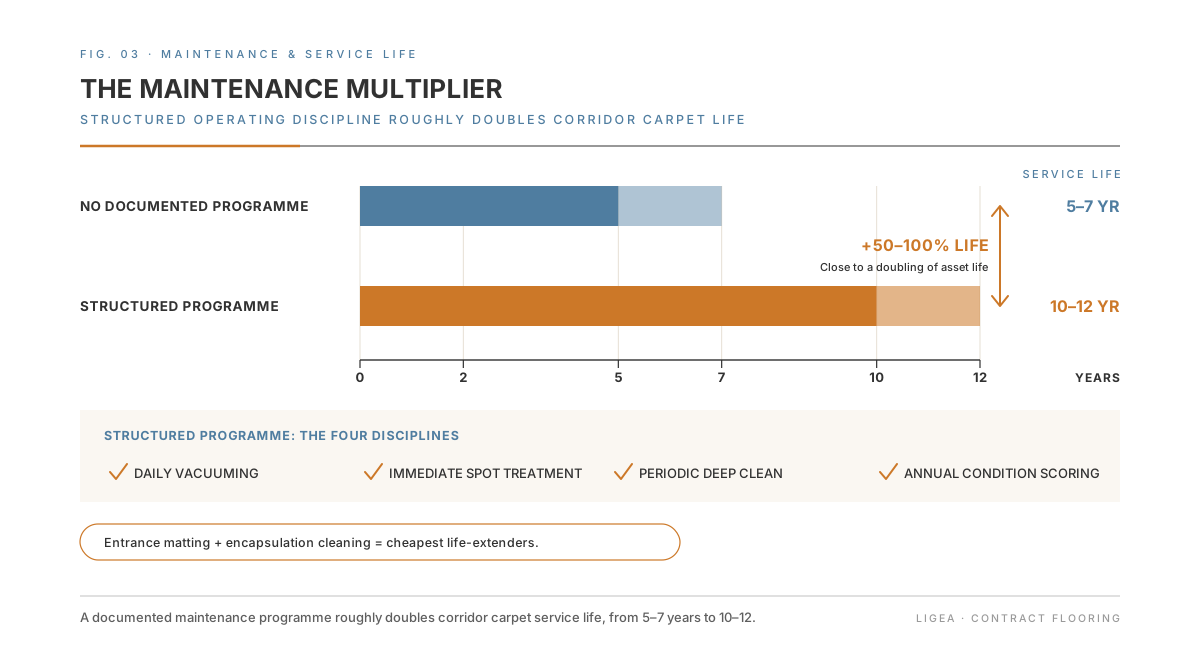
The mechanism is visible in the field data. Properties without a documented maintenance programme replace corridor carpet at 5–7 years, while a structured programme (daily vacuuming, immediate spot treatment, periodic deep cleaning and annual condition scoring) can push a full-service hotel corridor to a 10–12 year lifecycle. That is close to a doubling of asset life from operating discipline alone.
Two practical levers reward attention. Entrance matting is the cheapest life-extender there is: good walk-off matting captures a large share of incoming soil and moisture before it reaches the field. And cleaning method matters: over-aggressive hot-water extraction over-wets the carpet and needs hours to dry, whereas encapsulation returns the floor to service quickly, reducing the temptation to skip cleans because a corridor cannot be taken offline.
04Carpet Usually Fails on Looks, Not on Wear
Here is the asset insight that reframes the whole question: hotel carpet is rarely replaced because the fibre is gone. It is replaced because it stops looking right. "Loss of appearance and shape is the predominant reason for carpet replacement": matting, fraying and visible traffic lanes. Running a close second is permanent staining and odour at pinch points such as lift landings that no deep clean can resolve, a hygiene and brand-perception driver distinct from physical wear.
This has a hard warranty consequence that catches buyers out. A 10-year wear warranty is not a 10-year good-looks guarantee: wear warranties typically cover only a small percentage of fibre loss (commonly around 10%), so carpet can look thoroughly tired without ever qualifying for a claim. Appearance is measured separately, through appearance-retention testing and the EN 1307 durability class, which is why specifiers should buy on appearance class, not on warranty length.
The other clock is set by the brand. Soft goods including carpet are commonly replaced every 5–7 years, with some major-flag standards calling for carpet replacement around every 6 years, and full Property Improvement Plan cycles landing every 5–7 years for franchises and 7–10 years for major renovations. At the luxury end, carpet may be swapped at 3–5 years purely to protect a rating, long before it is worn out. "Useful life" and "kept life" are not the same number.
05Plan the Whole Cost, Not the Sticker Price
Buying carpet on first cost is how owners overspend over a decade. Across a carpet's life, maintenance and cleaning typically dominate the lifetime cost, so the purchase price is a minority share of true spend. The cleaner way to compare options is a life-cycle cost analysis: initial cost plus removal, installation, business disruption, disposal, maintenance and cleaning, divided by years of use (Carpet and Rug Institute). On that basis, replacing a cheaper carpet every five years frequently costs more than a woven product that runs twelve.
For capital planning, the figure to know is the FF&E reserve. The industry standard is roughly 4% of total revenue per year, with ramping properties starting nearer 2% and rising to 4% by year three, and older pre-PIP assets often needing 5%+; management agreements commonly state 3–6% of gross revenue. The discipline that matters: align the carpet's expected service life with the renovation and PIP calendar, so you are not paying to rip out serviceable carpet, or limping a worn corridor to the next cycle. And when replacement is phased across a renovation, dye-lot continuity across phases needs planning up front, or adjacent floors will not match.
06Where ligea Comes In
We specify for the clock that actually ends a floor's life in a given zone. Where corridors and rolling loads need structural durability, that is woven Axminster, set by pitch and rows (7×9 or higher in corridors, 7×7 to 7×8 in guestrooms); where a soft design carries the scheme and the brand cycle will retire the carpet first, print is the economical answer. Because we work with several producers, each zone can get its own construction, weight and class, and every colour is confirmed on a strike-off before production.
Explore our surfaces and constructions, or talk to us about a project.