
What Drives the Price of Hospitality Carpet per m²
An honest buyer's guide to what sits behind a hospitality carpet quote (fibre, weight and density, construction, colour count, certifications, freight, Incoterms and MOQ), so you can read a price properly.
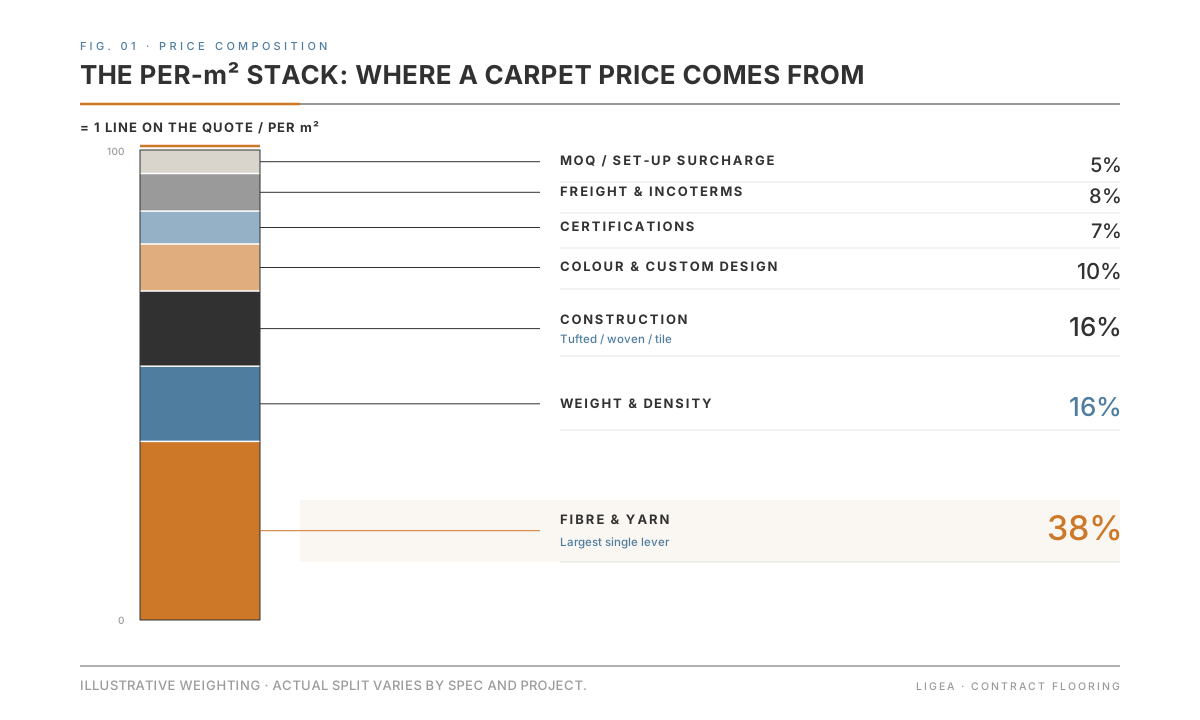
A carpet quote is one of the more opaque numbers in an FF&E package. Two suppliers can look at the same guestroom and corridor schedule and come back with figures that differ by a factor of three, and neither is necessarily wrong. The gap is not mischief; it is the sum of a dozen decisions buried inside a single per-square-metre line: what the yarn is, how much of it there is, how the carpet is made, how many colours the design carries, which certificates it must hold, and how it travels to site. Once you can see those drivers individually, a quote stops being a take-it-or-leave-it number and becomes something you can interrogate, value-engineer, and compare like for like. Here is what actually moves the price.
01Fibre and Yarn: The Single Biggest Lever
More yarn, and better yarn, is more money: that is the blunt first rule, and most of a carpet's material cost lives here. There is no single hospitality "default" fibre; the choice splits by construction more than by area. For woven Axminster, the long-standing benchmark is an 80% wool / 20% nylon blend across public areas and guestrooms alike. The wool brings natural resilience and inherent flame resistance, and it is row density (pitch and construction grade), not the fibre, that separates a lobby-grade cloth from a guestroom-grade one. That ratio is a well-established practitioner convention rather than a codified industry standard. For tufted broadloom in the wider volume market, 100% solution-dyed nylon is just as often the specified fibre, valued for stain and fade resistance and heavy-traffic wear. Move to 100% wool and you are paying a genuine premium: installed wool sits among the most expensive of the common hospitality fibres, with premium patterned or shag goods higher still. Drop to 100% nylon and you trade some of the luxury feel for durability at a lower entry cost; nylon is widely regarded as the toughness and resilience benchmark among the common synthetic carpet fibres, with a long service life when specified well.
Two sub-levers matter. First, the yarn form: bulked continuous filament (BCF) nylon resists shedding and pilling better than staple fibre and tends to be priced higher at retail, though staple can be cheaper and, by most accounts, holds up at least as well against abrasion, so it is not a clean "more expensive but better" trade. Polyester and polypropylene sit cheaper still, with lower durability and resilience expectations (though both can match nylon on colourfastness and fade resistance). Second, solution-dyed yarn, where colour runs through the whole fibre cross-section rather than sitting on the surface, resists fading in sunlight and survives aggressive cleaning, which is why it earns its premium in corridors and pool surrounds.
It is also worth knowing that raw-material prices are volatile, not fixed. Nylon and its caprolactam feedstock have swung sharply in recent years, and carpet-grade wool follows its own long market cycle. A quote is a snapshot of those inputs on the day it is written.
02Weight and Density: Read Both, Not One
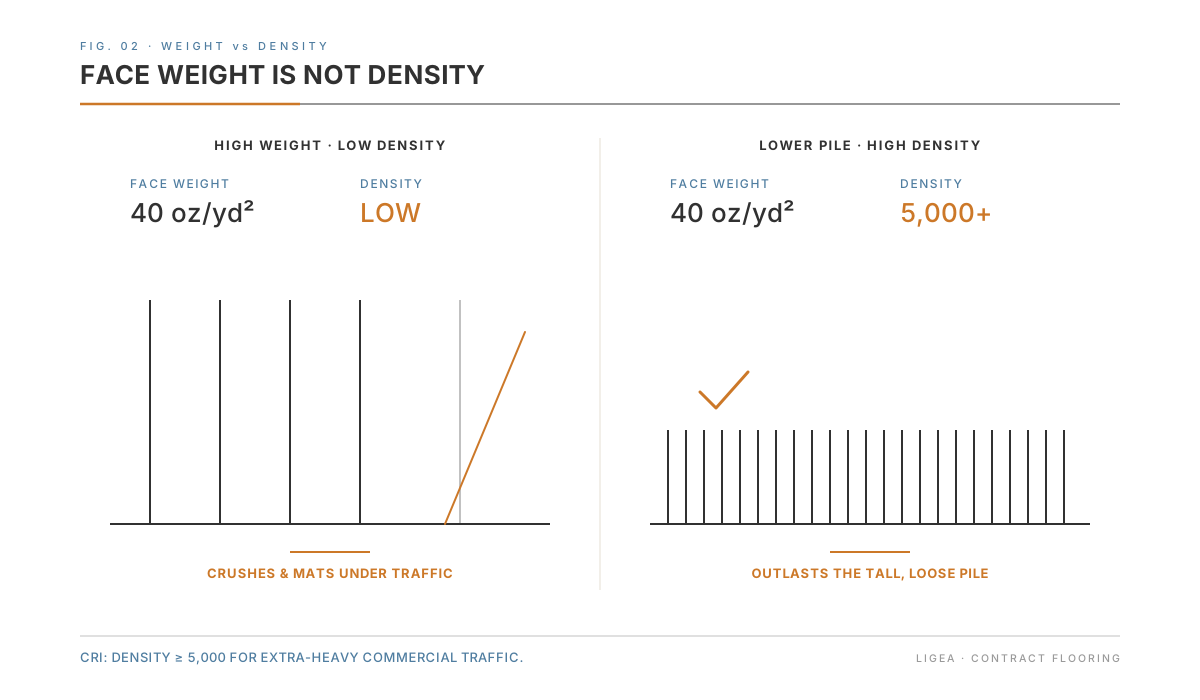
Carpet is often sold on face weight, the ounces of pile yarn per square yard. It is the most quoted spec, and widely marketed as a durability proxy, but density is the truer measure, which makes face weight the most misused number on the page. The mistake that practitioners warn about most is specifying on face weight alone, because a high weight with low density simply means tall, loosely packed fibres that crush and mat under traffic.
Density is the truer signal of how a carpet will wear. The Carpet and Rug Institute states a density of 5,000 or higher for extra-heavy commercial traffic; a residential figure of around 3,000 is widely cited too, though that one appears more in retailer guides than in CRI's own publications. A short, tightly packed pile will routinely outlast a tall, loose pile of the same weight. There is also a quoting trap to watch: a total weight that includes the backing being presented as if it were the face weight, which makes cheaper goods sound premium.
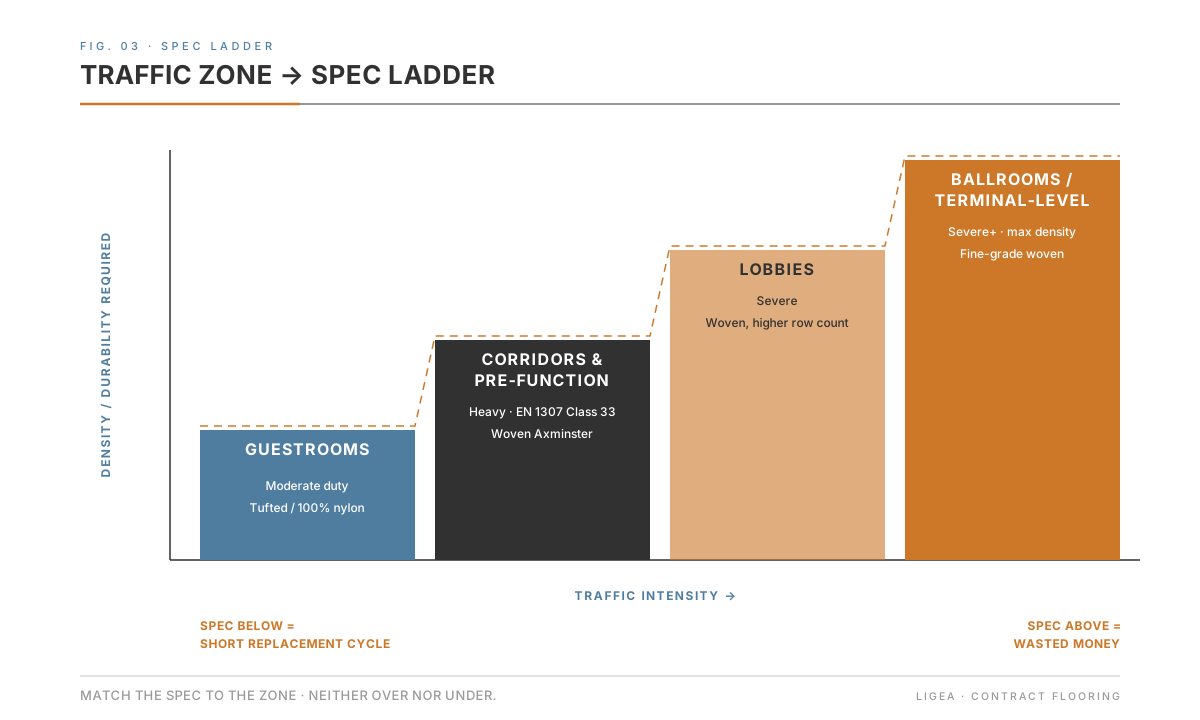
The practical takeaway for budgeting is that a complete spec is pile height plus face weight plus density plus stitch rate, matched to the traffic zone: guestrooms are moderate duty, corridors and pre-function areas are heavy, lobbies and ballrooms are severe. This maps onto EN 1307 use classes, where Class 33 (heavy) covers hotel entrances, lobbies and transport terminals. Specifying above the zone you need is wasted money; specifying below it is a short replacement cycle.
03Construction: Woven, Tufted, Tile
How the carpet is built is the next big fork. Tufted carpet accounts for the great majority of commercial hospitality flooring, because it is faster to produce and sits at a lower price point. Woven Axminster integrates the pattern into the structure of the carpet, which resists crushing and pattern distortion under rolling loads, and is the traditional choice for corridors, ballrooms and other severe-duty areas. That durability and design depth is precisely why woven carpet generally costs more: woven Axminster carries a clear premium over tufted goods, before site costs are even added.
Axminster is also priced by construction grade, measured in rows, with higher row counts giving finer, denser, more expensive cloth. So "Axminster" is not one price; a coarser grade for a guestroom and a fine grade for a signature corridor are different numbers.
Then there is the broadloom-versus-tile question. Broadloom rolls usually win on a seamless luxury look but waste more material on cut (as a trade rule of thumb, commonly 10–20%, more in small rooms or with large repeats), whereas modular tiles waste far less (often 1–5%) and let you swap a damaged square rather than reseam a run. The honest framing is total cost of ownership, not the line item: waste, labour, downtime and repair often decide which is cheaper over the floor's life.
04Colour, Pattern and Custom Design
What a pattern costs depends on the construction; there is no flat "pattern premium". In Axminster, the price is driven by the number of colours and the density; the pattern itself barely moves it, because more colours means more frames on the loom, and more rows per inch means more yarn and loom time. In hand-tufting, complexity genuinely costs: a plain field is far less work than gradients or an intricate multi-colour drawing. Printed constructions behave differently again: colour comes from a set of pre-mixed inks, so an elaborate design costs little more than a simple one, and the trade is some pile depth for that freedom.
Custom design also brings strike-offs: physical sample weavings or prints made before bulk production. These are a genuine line item in both money and time, typically a couple of weeks, and they are where colour gets locked to a reference such as a Pantone, NCS or RAL value. The encouraging shift is that modern dye-injection and digital approval methods have made custom faster and more cost-effective than it once was, softening the old assumption that bespoke is always punishingly expensive.
05Certifications, Freight and MOQ: The Costs Buyers Forget
Three drivers routinely get under-budgeted.
Certifications. Brand-standard hotels and LEED projects often mandate specific test thresholds, and meeting them costs money in testing fees and constrained material choices. For corridors, flammability is typically governed by critical radiant flux (ASTM E648 / NFPA 253): general commercial spaces commonly require Class II (0.22 W/cm²), while corridors and exits often require the stricter Class I (≥0.45 W/cm²). In Europe the commercial benchmark is the Cfl-s1 fire class. Indoor-air-quality and sustainability marks such as CRI Green Label Plus and NSF/ANSI 140 add further testing requirements. None of these are optional once a brand standard names them.
Freight and Incoterms. Ocean freight is volatile and easy to forget. Benchmark container-freight indices move constantly, with individual lane rates well above the headline figure; a swing of a substantial sum per container is normal, not exceptional, and easily enough to overturn a tight comparison. Just as important is the Incoterm: under any non-DDP term (FOB, CIF and others), the buyer imports in its own name and carries the freight and duty exposure from the origin port, while under DDP the seller delivers duty-paid to the door. A "cheap" non-DDP number can be quietly overtaken by freight and duty, so comparing a DDP quote against a non-DDP quote is not like for like. Insisting that competing quotes use the same Incoterm is one of the simplest ways to make a comparison honest.
Minimum order quantity. MOQ depends on the construction. Printed and woven runs carry a real minimum (the threshold varies by mill), and orders below it are priced at a surcharge or pushed to stock patterns. Hand-tufted work has practically no minimum, though small pieces price well above the volume rate per square metre. The deeper economic truth: developing a custom design and running strike-off rounds only pays off with volume behind it: in practice, when the large areas of a hotel are in the package, the small areas ride along as custom too. Custom production lead times generally run about 4–8 weeks after the design, colour and strike-off are signed off, with stock programmes far quicker.
06Where ligea Comes In
We quote with the drivers above visible: construction, density, colour count, strike-off stage, MOQ and Incoterm each appear as their own line rather than being buried in one price. Because we work with several producers and are not tied to one loom or print line, the construction follows the area: Axminster in 80/20 wool-nylon or 100% wool by pitch and rows for corridors and ballrooms, print where the design wants soft gradients, hand-tuft from the Royal family for signature pieces at only a small step above Axminster. Colour is matched to Pantone TCX, NCS, RAL or a physical sample and confirmed on a strike-off. Bulk production then runs 2–4 weeks for print, 4–8 for Axminster and 10–16 for hand-tuft, with freight quoted per route.
Explore our surfaces and constructions, or talk to us about a live project.