
The Cert Pack by Region: What a Hospitality Carpet Tender Requires
A region-by-region map of the certificates a hospitality carpet tender actually requires: EU EN 13501-1 and CE, US ASTM E648 and the pill test, marine IMO, aviation FAR 25.853, and the sustainability labels behind LEED and BREEAM.
A hospitality carpet tender almost never fails on colour. It fails on a missing certificate: a test report that was issued to the wrong standard, a fire class one band too low for the jurisdiction, a sustainability label the green-building consultant needed and nobody asked for until the submittal deadline. The aesthetics are the part everyone enjoys arguing about. The cert pack is the part that quietly removes a product from the table before anyone gets to argue.
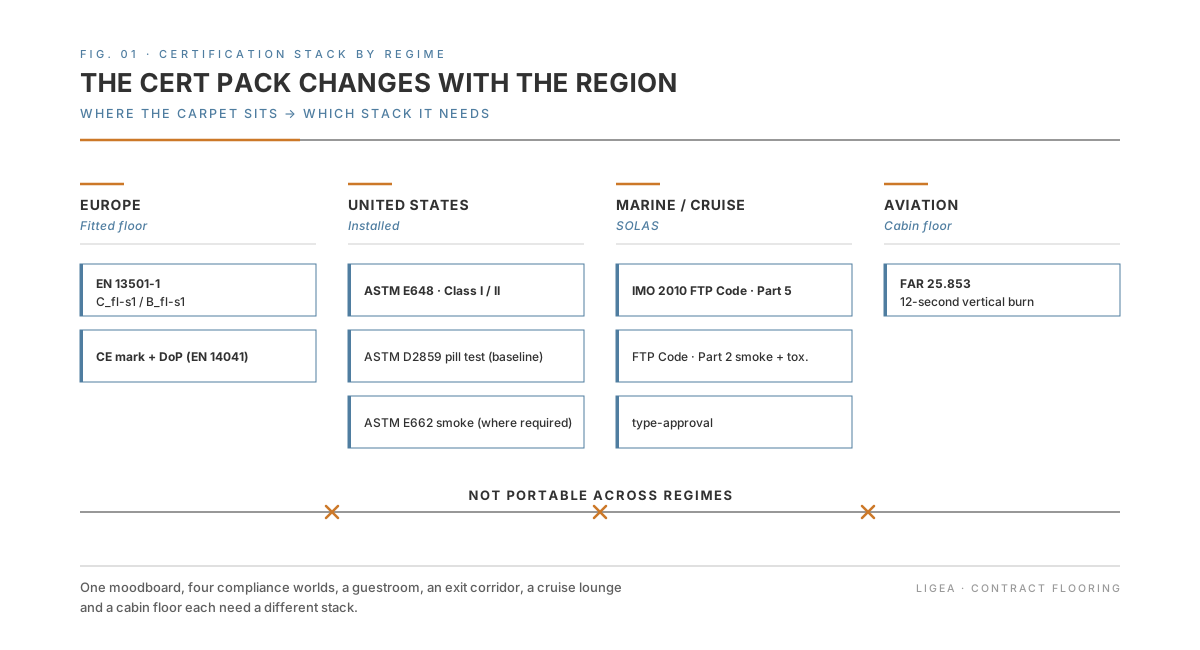
The trouble is that there is no single "carpet certificate." What a tender requires is a stack, and the stack changes with the region, the building code, and where the carpet physically sits. A guestroom in a German resort, an exit corridor in a US convention hotel, a lounge on a cruise ship and a first-class cabin floor are four different compliance worlds, even if they all read as "hotel carpet" on a moodboard. This guide maps the stack region by region, so you know which documents the submittal actually needs before the loom or the print line is ever booked.
It is the companion to our flammability piece: that one goes deep on a single area; this one goes wide across every regulatory regime a project might touch.
01Europe: EN 13501-1, the CE Mark, and the Document That Makes It Legal
In the EU and EEA, reaction-to-fire is classified under EN 13501-1, which sorts floor coverings from A_fl (effectively non-combustible) down to F_fl, with a smoke sub-class of s1 (low) or s2. For textile floor coverings the class is derived chiefly from two underlying tests: the radiant-panel method EN ISO 9239-1, which measures the critical heat flux at which a flame stops advancing, and the small-flame ignitability test EN ISO 11925-2.
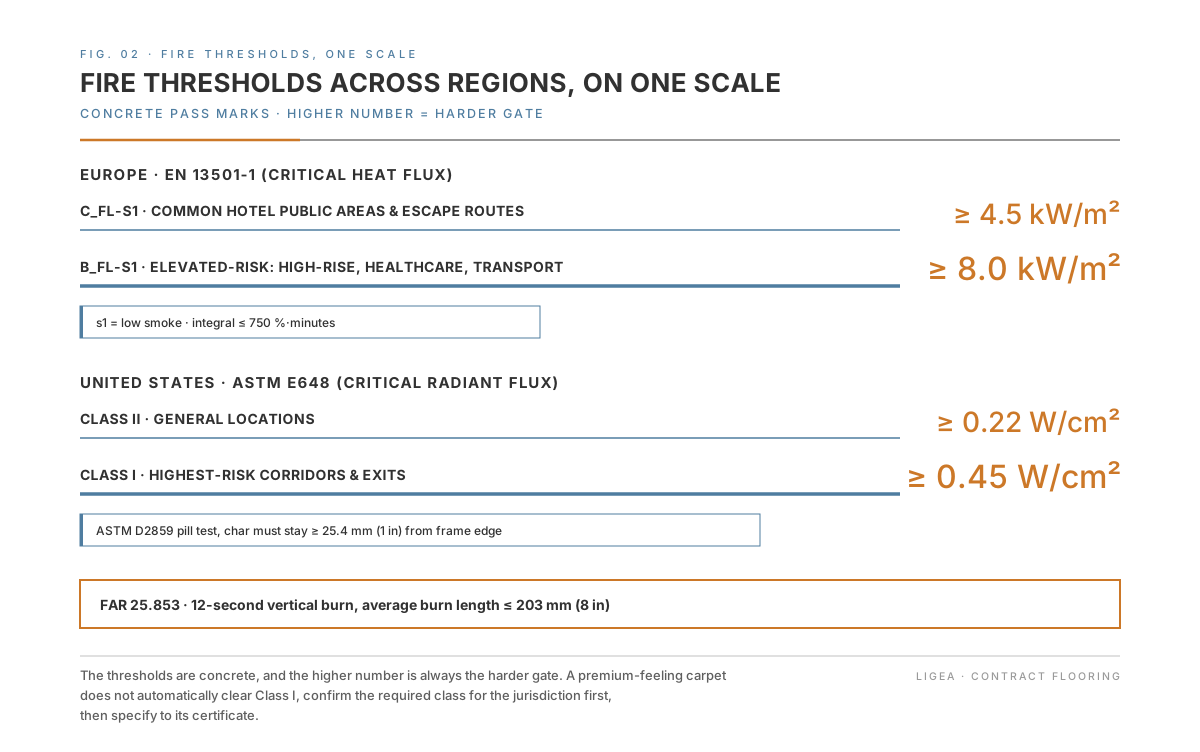
The two classes that do almost all the work in hospitality are C_fl-s1 and B_fl-s1. The thresholds are concrete: C_fl requires a critical heat flux of ≥ 4.5 kW/m², while the more demanding B_fl requires ≥ 8.0 kW/m², with s1 capping smoke obscuration at the low end (the integral must not exceed 750 %·minutes). One point worth holding onto: EN 13501-1 only defines the classes. It is each member state's national building code that says which class a given location demands, and the national codes genuinely diverge. In Germany and codes modelled on it, C_fl-s1 is the working floor for hotel public areas and escape routes, with B_fl-s1 stepped up for elevated-risk settings such as high-rises, healthcare and transport interchanges. France still runs its own M-classification (M0–M4) for ERP buildings such as hotels, with only a partial equivalence table to the Euroclasses, and the UK's Approved Document B calls up floor-covering classes only in defined circumstances, tiered by building height and risk. The practical consequence: the fire class is a per-jurisdiction question, not an EU-wide default, so check the national code before assuming C_fl-s1 is the answer.
Fire class is only half of the European picture, and this is where tenders most often come up short on paperwork. A floor covering placed on the EU market is a construction product, so it must carry a CE mark under the harmonised standard EN 14041. The CE mark is not a sticker; it is backed by a Declaration of Performance (DoP), the legal document required by the Construction Products Regulation (since January 2026 the new CPR (EU) 2024/3110, which repealed the familiar EU 305/2011 while keeping existing DoPs, CE markings and harmonised standards valid under transitional provisions). The paperwork a tender sees is unchanged; the regulation behind it has a new number. The DoP declares the product's performance against the standard's essential characteristics: reaction to fire, slipperiness/slip resistance, and, where the application calls for it, electrical/anti-static behaviour. A submittal that includes a fire-test report but no DoP is incomplete, and a diligent project reviewer will catch it. One scoping nuance: the CE/DoP route covers fitted floor coverings; loose-laid rugs sit outside its formal scope, though they are routinely specified to the same fire class anyway.
02United States: Two Different Fire Tests, and the One People Forget
US projects run on two distinct fire tests that are not interchangeable, and confusing them is a common documentation error on transatlantic specs.
The first is the methenamine pill test, ASTM D2859, the test method behind the federal DOC FF 1-70 / FF 2-70 rules codified in 16 CFR 1630/1631. A methenamine tablet is ignited on the carpet surface (roughly simulating a dropped cigarette), and the specimen passes only if the char does not reach within 25.4 mm (1 in) of the edge of the hole in the flattening frame. This is the mandatory federal baseline for carpet sold in the US. The large-carpet rule (FF 1-70) bites at any product over 6 ft in one dimension and over 24 sq ft in area: everything in that category, wall-to-wall included, must pass, full stop. Smaller rugs fall under FF 2-70 and are tested the same way, with the narrow relief that a small rug which fails can still be sold if it is permanently labelled flammable. No hospitality spec ever uses that escape hatch.
The pill test, though, is the baseline, not the gate that a hotel corridor actually turns on. That gate is the radiant-panel test, ASTM E648 (technically equivalent to NFPA 253), which measures critical radiant flux on an installed floor-covering system. Building codes (IBC and NFPA 101) require it for floor finishes in corridors and exit enclosures, with two classes: Class I (CRF ≥ 0.45 W/cm²) in the highest-risk locations and Class II (CRF ≥ 0.22 W/cm²) elsewhere. As UpCodes and CRI guidance describe, institutional occupancies such as healthcare typically demand Class I in corridors and exits, while general commercial construction works to the Class II floor. One lever changes everything here: sprinklers. Under the IBC, a fully sprinklered building is permitted Class II where Class I would otherwise be required, and since new hotel construction is almost universally sprinklered, the class a project actually needs is often one band lower than the occupancy table suggests. The practical rule: confirm the required class for the jurisdiction, occupancy and sprinkler status first, then specify a product whose certificate clears it. A premium-feeling carpet does not automatically meet Class I.
The third US document is smoke. Where codes or operator standards reach beyond flame spread (common in assembly spaces, atria and high-occupancy public areas), they call up ASTM E662 (the method formerly also maintained as NFPA 258, since withdrawn), the specific optical density of smoke test. It reports a maximum optical density (D_s) under both flaming and non-flaming conditions. Many operator brand standards specify an E662 ceiling explicitly, so it is worth checking the brand manual rather than assuming the building code is the whole story.
03Marine and Cruise: A Separate Universe Called the FTP Code
Cruise and ferry interiors are not "hospitality carpet that happens to float." SOLAS-regulated passenger vessels fall under the IMO 2010 FTP Code (the International Code for Application of Fire Test Procedures), and a land-based hotel cert pack does not transfer to it at all.
For floor coverings, two parts of the FTP Code matter, and both list "floor coverings" and "primary deck coverings" explicitly. Part 5 is the surface-flammability test: flame spread, sustained burning and heat release on the covering's surface. Part 2 is the smoke-and-toxicity test, with limits on smoke obscuration and on toxic-gas concentrations such as carbon monoxide, hydrogen chloride and hydrogen cyanide. Crucially, a product can only be used on a SOLAS vessel once the relevant FTP parts have been passed at a recognised laboratory and the product carries the appropriate type-approval, frequently expressed through the EU Marine Equipment Directive "wheelmark" for European-flagged or EU-market vessels. The takeaway for any designer pulled into a cruise refit: budget for marine-specific testing and type-approval from the outset, and never assume an EN 13501-1 or ASTM E648 report carries over. It does not.
04Aviation: FAR 25.853 and the 12-Second Vertical Burn
Branded-residence and lounge work occasionally drifts into aircraft interiors: private cabins, VIP completions, airline lounges that mirror cabin finishes. Cabin floor covering is governed by 14 CFR 25.853 (FAR 25.853), and the relevant method is the vertical Bunsen-burner test.
Carpet sits in the category exposed to a 12-second flame application (the same group as upholstery, curtains and seat dress covers), as distinct from the 60-second exposure used for composite wall and ceiling panels. To pass the 12-second vertical test, the FAA criteria require an average burn length not exceeding 8 in (203 mm), an average flame time not exceeding 15 seconds after the burner is removed, and an average drip-extinguishing time not exceeding 5 seconds. These are tight, material-level thresholds; aviation carpet is a specialised product class, and it is worth flagging early in any brief that strays toward a cabin floor rather than discovering the requirement at submittal.
05Sustainability: One Well-Chosen Label Can Clear Several Ratings
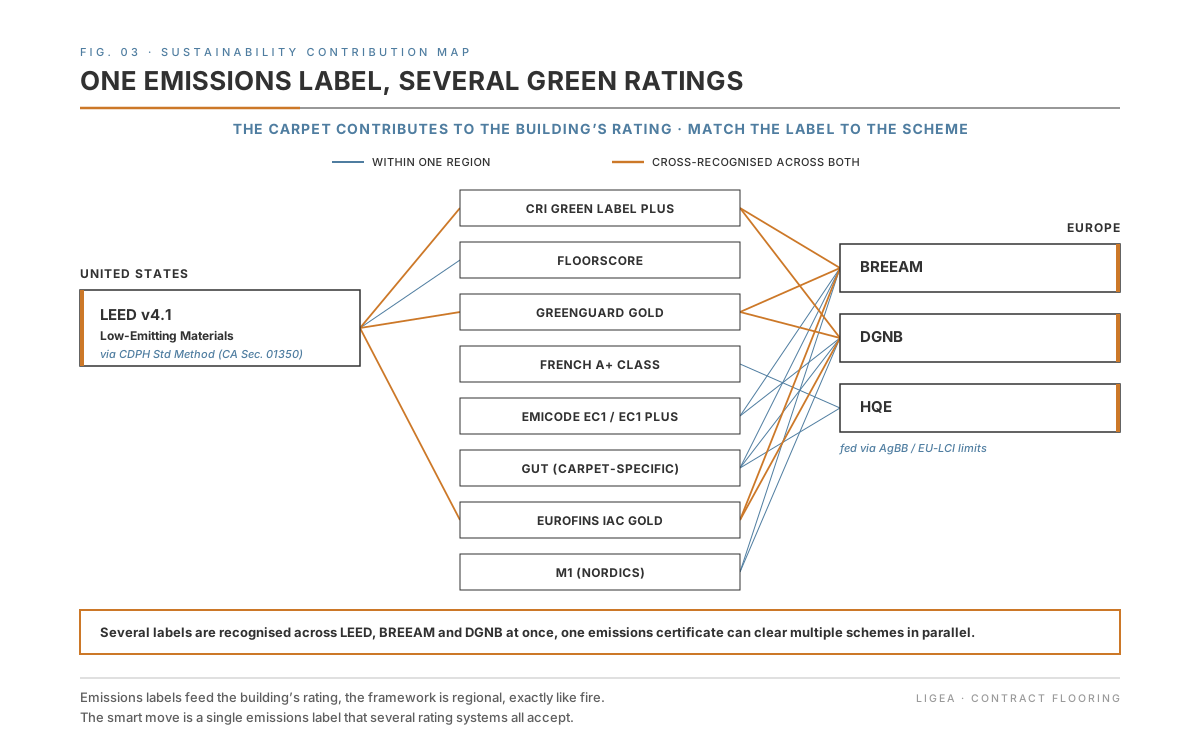
Sustainability is where a smart certificate choice pays off most. Product-level certifications such as Cradle to Cradle and the EU Ecolabel speak to a product's own circularity and lifecycle profile, but what a green-building tender checks is the carpet's contribution to the building's rating, demonstrated through emissions labels. And exactly like fire, that framework is regional: the label has to match the rating system the project is chasing.
For US and international LEED projects, the relevant credit is LEED v4.1 Low-Emitting Materials, satisfied via the CDPH Standard Method (California Section 01350), the VOC-emissions protocol that tests against a defined list of target compounds including formaldehyde. Three product labels demonstrate compliance: FloorScore, GREENGUARD Gold and, most relevant to soft flooring, CRI Green Label Plus, which layers additional allowable VOC limits on top of the CDPH target list. A practical division of labour worth knowing: FloorScore is the dominant label for hard surface flooring, while carpet is most commonly certified under CRI Green Label Plus. LEED v4.1 also asks that 90 % of flooring, by cost or surface area, comply for the credit, so on a scheme where carpet is a large share of the floor, a single non-compliant product can push the project under the threshold and cost the credit.
In Europe, the rating systems are BREEAM, DGNB and HQE, and the product-level evidence comes from a different set of labels: the French A+ VOC class (Émissions dans l'air intérieur), the German AgBB scheme, EMICODE EC1 / EC1 Plus, the carpet-specific GUT label, and Eurofins Indoor Air Comfort Gold (with M1 common in the Nordics). These are not all equivalent: only the stricter labels (GUT, Indoor Air Comfort Gold and TÜV Proficert Premium) meet the tighter AgBB and EU-LCI limits, per Eurofins guidance. The useful news is overlap: several of these labels are recognised across LEED, BREEAM and DGNB at once, so a well-chosen emissions certificate can satisfy multiple rating systems in parallel rather than forcing a separate test per scheme.
06The Stack, on One Page
A way to hold it together, by region and application:
| Region / application | Fire pack | Smoke / extras | Sustainability route |
|---|---|---|---|
| EU public areas & escape routes (fitted) | EN 13501-1 C_fl-s1 + CE/DoP (EN 14041) | s1 smoke built into class | A+ / EMICODE EC1 / GUT → BREEAM / DGNB / HQE |
| EU elevated-risk (high-rise, healthcare, transport) | EN 13501-1 B_fl-s1 + CE/DoP | s1 smoke | as specified |
| US corridors & exits (installed) | ASTM E648 Class I or II (radiant panel) | ASTM E662 where required by code/brand | CDPH → LEED (CRI Green Label Plus / FloorScore / GREENGUARD Gold) |
| US carpet & rugs (general baseline) | ASTM D2859 pill test (DOC FF 1-70 / FF 2-70) | n/a | as specified |
| Marine / cruise (SOLAS) | IMO 2010 FTP Code Parts 2 & 5 + type-approval | toxic-gas limits within FTP Part 2 | as specified |
| Aviation cabin floor | FAR 25.853 12-second vertical burn | n/a | as specified |
A few things are worth saying plainly. The stack is cumulative within a project but not portable across regimes: a US hotel needs both the pill test and (in corridors) ASTM E648, and a cruise refit needs the FTP Code regardless of what land-based reports already exist. Operator brand standards frequently sit above the building code (specifying a tighter fire class, a named smoke ceiling or a particular sustainability label), so the brand manual is part of the cert pack, not separate from it. And the sustainability labels are the one place where smart selection buys cross-recognition, because a single emissions certificate can clear several rating systems at once.
07Where Specs Quietly Go Wrong on Certificates
Three failure modes account for most of the cert-pack problems we see, and none of them are quality problems:
- A report issued to the wrong standard. An EN 13501-1 classification on a US project, or an ASTM E648 report where the operator brand standard quietly required an E662 smoke ceiling too. The product may be excellent; the document is simply the wrong key for the lock.
- The missing companion document. A fire-test report with no CE Declaration of Performance on an EU project; a marine job assuming a hotel report transfers; a LEED scheme where one non-compliant carpet sinks the whole low-emitting-materials credit.
- The cert discovered late. Aviation FAR 25.853 or marine FTP requirements that surface at submittal rather than at brief, by which point the specified product may have no path to the certificate it now needs.
These are fit-and-paperwork problems, and they are the ones that derail a tender before the carpet itself is ever judged.
08Where ligea Comes In
We start a tender from the stack, not from the product: region, building code, where each carpet sits and the operator standard above it.
For European projects that means EN 13501-1 up to B_fl-s1 with CE and DoP documentation; for US specs, ASTM E648 radiant-panel performance and the pill-test baseline; for marine refits, IMO-certified Axminster or hand-tuft. Because we work with several producers, the certificate follows the project rather than one factory's library, and we confirm the required documents with you before the strike-off, not at submittal.
Explore our surfaces and constructions, or talk to us about a live tender.