
Where Hand-Knotted Belongs in a Hotel (and Where It Doesn't)
Hand-knotted carpet is genuine, glue-free craft, but it isn't a wall-to-wall hospitality product. What it's actually built for, why a record-breaking mosque carpet proves the limit is economic rather than technical, and where it earns its place in a hotel.
Show a client a genuine hand-knotted rug (the depth of colour, the density of the knots, the sense that no two will ever be quite alike) and the question comes almost immediately: can we have this everywhere? Every corridor, every guestroom, the whole property knotted by hand? It is a seductive question, because the surface really is extraordinary. The honest answer is that hand-knotted absolutely belongs in a hotel, just not stretched wall-to-wall across it. And the reason is not that it can't be done. It's that it can't be done at hospitality scale for anything close to a sane cost, timeline or workforce.
That distinction, economically unworkable rather than technically impossible, is worth holding onto, because it changes how you brief it, not just whether you spec it.
01Two very different ways to put pile on a floor
The two techniques get confused constantly in sales conversations. Both are genuinely "made by hand," both can look rich in a photograph, but the construction underneath is not close.
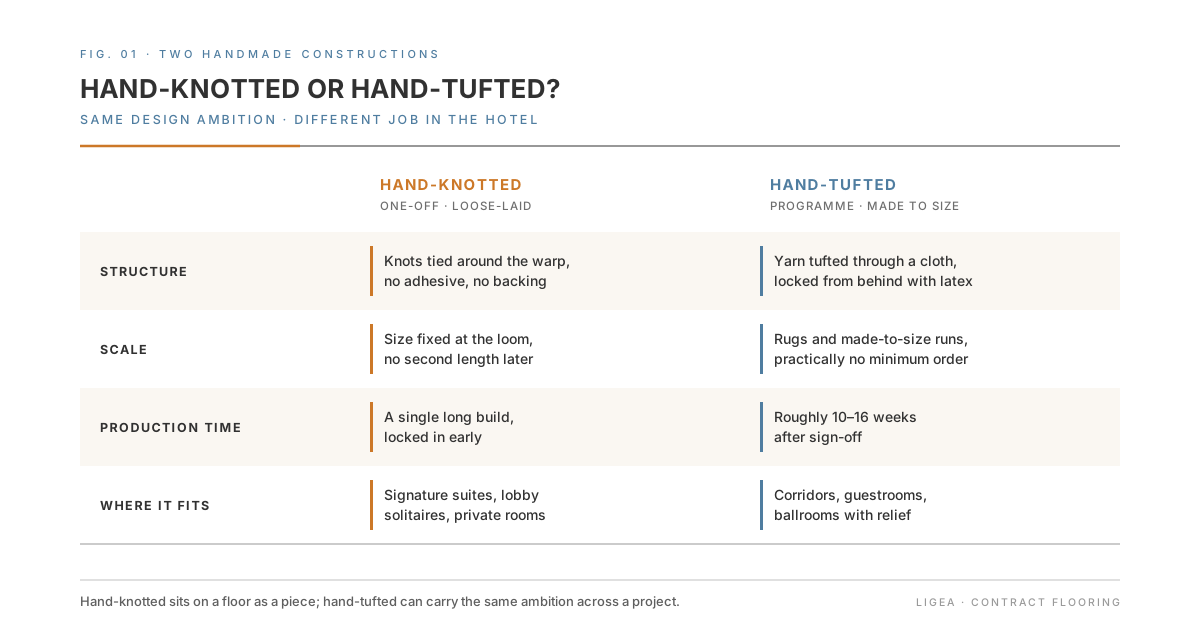
Hand-knotted is exactly what the name says: a craftsperson ties each knot by hand around the warp threads, row after row, with no adhesive anywhere in the structure. There is no backing to speak of: the knots themselves, tensioned against the warp and weft, are what holds the rug together. A piece is built to one fixed size from the outset; when it's finished, that is the only size it will ever be. That is also why hand-knotted rugs are loose-laid: set on top of a floor as an object, not stretched and fitted wall-to-wall as the floor itself.
Hand-tufted, by contrast, is the technique ligea and most hospitality producers actually use for bespoke, freely shaped rugs and broadloom-scale runs. A craftsperson uses a hand-held tufting gun to punch yarn through a stretched primary backing (the tufting cloth), tracing a pattern beneath it; the back is then locked with a coat of latex adhesive and a secondary backing, typically cotton, jute or felt, is bonded on for stability (Carpet & Rug Institute). That backing is doing real work: it is what lets a hand-tufted piece be produced to size, at scale, on a schedule a hotel opening can actually plan around. That back-side bond is where production quality shows: with quality latex and proper curing it holds for decades, and on cheap production it is where things can eventually go wrong, a durability conversation for a different piece, not a reason to avoid the technique here.
Being precise about which one you're actually buying protects both the budget and the calendar. They are not two grades of the same thing.
02The carpet that proves the ceiling isn't technical
If there is still any doubt that hand-knotted construction can, in principle, fill an entire room, there is a record-holding example that settles it. The Guinness World Records-certified largest hand-made carpet, the main prayer hall carpet at the Sheikh Zayed Grand Mosque in Abu Dhabi, measures roughly 5,630 m² (Guinness World Records). It was hand-knotted, widely reported at around 1,200 knotters working over roughly two years, and, tellingly, it wasn't produced as one continuous piece. It was knotted in nine separate sections and stitched together on site.
That last detail is the one worth sitting with. Even a project built specifically to demonstrate that hand-knotted work can fill a room the size of a hotel's entire public floor still had to be split into sections and assembled after the fact, because no single loom or workforce could produce it whole. The mosque carpet doesn't argue that hand-knotted broadloom is impossible for hospitality; it argues the opposite, that it's achievable if you throw a four-figure skilled workforce and a multi-year build at one room. Which is exactly why nobody does that for a hotel corridor. Scale that logic to a few hundred guestrooms and several floors of corridor, on a construction calendar measured in weeks rather than years, and the limiting factor was never the knot. It's the cost (a multiple of even a bespoke hand-tufted programme), the fabrication time, and a finite pool of skilled knotters that no contract carpet order can realistically reserve.
03Where hand-knotted earns its place in a hotel
Reserved for the right footprint, hand-knotted is not a compromise version of hospitality carpet; it's a different category of object, and hotels reach for it precisely where a floor is meant to be looked at, not just walked across.
- Signature suites. A single commissioned hand-knotted rug, loose-laid over a hard floor or set atop the room's fitted carpet, gives the top-tier room something no other key in the property has: a genuine one-off, not a repeatable line item.
- Lobby solitaires. One statement piece positioned beneath a seating group or a reception desk reads as furniture-grade craft rather than flooring, the kind of object a guest notices and photographs.
- Art-character placements. Private dining rooms, executive lounges, galleries: spaces small enough that a bespoke commission's cost and build time stay sane, and where the individuality of knot-by-knot work is exactly the point.
The thread running through all three is the same: hand-knotted sits on a floor as a piece, not as the floor.
04Buying a one-off: what procurement actually looks like
Specifying hand-knotted is closer to commissioning an artwork than ordering carpet, and the procurement logic changes accordingly. There is no loom holding a pattern in reserve for a top-up order later, so order the exact size needed, because there is no "cut another length" fallback the way there is with roll goods. The build itself is close to a single long production run from day one rather than a sampling-then-bulk sequence, so it needs to be locked into the project calendar early and left undisturbed; there isn't a faster tier to fall back on if the date slips.
Care belongs in the same early conversation. A hand-knotted piece usually needs specialist rug cleaning rather than the property's standard commercial carpet-care contract, so it is worth agreeing the care plan with housekeeping and maintenance before the piece is specified, not after.
05The pragmatic bridge: what hand-tufted actually covers
For everything hand-knotted can't reach economically (corridor runs, guestroom programmes, a ballroom that still wants sculpted, non-repeating pattern), hand-tufted is the construction built for exactly that gap. It shares the same design freedom hand-knotted is prized for: no loom grid dictating the shape, organic contours and three-dimensional relief a woven floor cannot produce. What it adds is a production method (tufting gun, latex, backing) that scales to genuine broadloom and made-to-size runs on a hospitality-viable clock: roughly 3–6 weeks for sampling and approval, then roughly 10–16 weeks for bulk production. It won't replicate the exact hand and structure of a knotted pile. What it does deliver is that same free-form design language, at the scale and on the calendar an actual hotel opening has to work with.
That is the honest bridge: hand-knotted for the one-off, hand-tufted for everything that needs the same design freedom multiplied across a property.
06Where ligea comes in
We help decide early which pieces of a project deserve a one-off and which need the same design ambition delivered another way. For the second group we specify hand-tuft from our Royal family, with Grand Royal as the densest quality: it carries much of hand-knotted's organic, sculpted freedom, has practically no minimum order, and runs on a production time of roughly 10–16 weeks that a hospitality programme can plan around. Colour is matched to Pantone TCX, NCS, RAL or a physical sample and confirmed on a strike-off before production.
Explore our surfaces and constructions, or book a 15-minute spec call to map which zones deserve a one-off.