
From 16 Weeks to 4: Lead Time and Turnaround in Contract Carpet
What actually drives contract carpet lead time: construction, custom design, sampling and freight. The realistic week bands by build, and how a print-broadloom route reaches roughly four weeks.
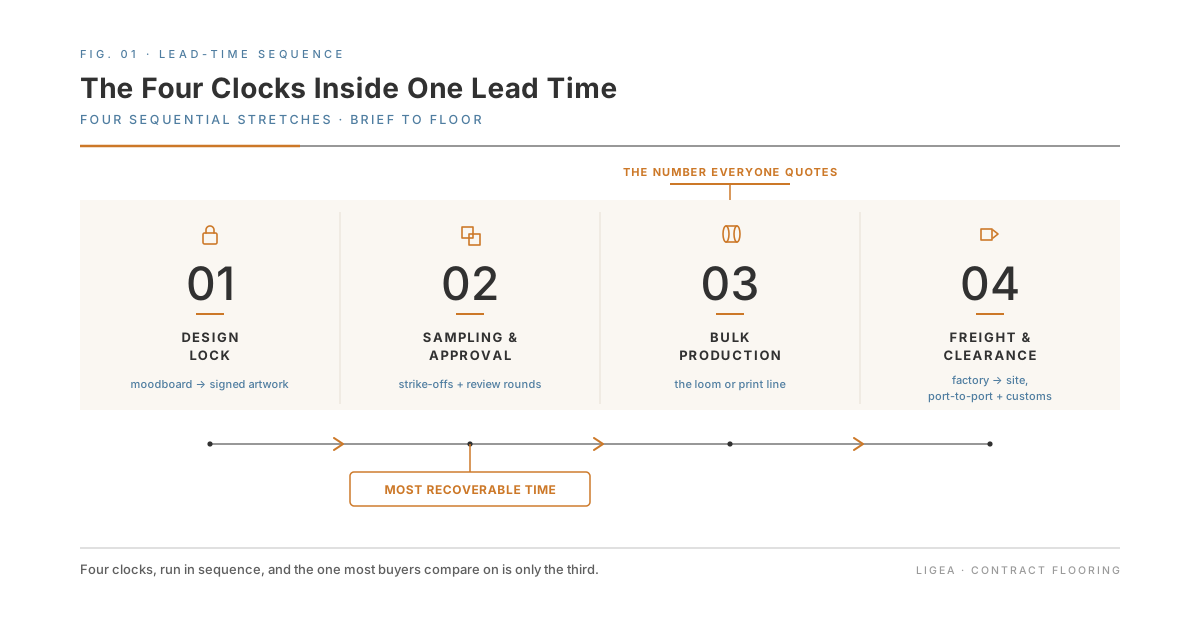
Ask three suppliers how long a custom hospitality carpet takes and you will get three answers: six weeks, twelve weeks, sixteen weeks. All of them technically correct, none of them comparable. The reason is that almost nobody is measuring the same clock. One supplier is quoting the loom; another is quoting the loom plus the ocean; a third is quoting from the day you first send a moodboard. The number that lands an opening on time is not the headline figure on the quote. It is the sum of four distinct stretches, only one of which is actually "making the carpet."
This guide breaks the lead time into those four stretches (construction, custom design, sampling and freight), gives the realistic week bands for each, and shows where the compression actually lives. Because the headline most buyers chase ("2–8 weeks production") is real, but it is also the smallest of the four numbers, and fixating on it is exactly how schedules slip.
01The Four Clocks Inside One Lead Time
A contract carpet schedule, brief to floor, runs through four sequential stretches:
- 1. Design lock: moodboard to a signed, technically resolved artwork.
- 2. Sampling and approval: strike-offs and mock-ups, with their review rounds.
- 3. Bulk production: the loom or print line, the number everyone quotes.
- 4. Freight and clearance: factory to site, including the port-to-port leg and customs.
The trap is that buyers compare suppliers on number three and ignore one, two and four, which is where most of the calendar actually sits. A custom Axminster project to an overseas site, for instance, is roughly 3–4 weeks of design and sampling, 4–8 weeks of weaving, and another 2–9 weeks of ocean freight (highly route-dependent) stacked on top, which is exactly how a buyer who heard only the production figure ends up explaining a missed handover. Treat the four clocks separately and the planning gets honest fast.
02Clocks 1 and 3: What Construction Actually Costs You in Time
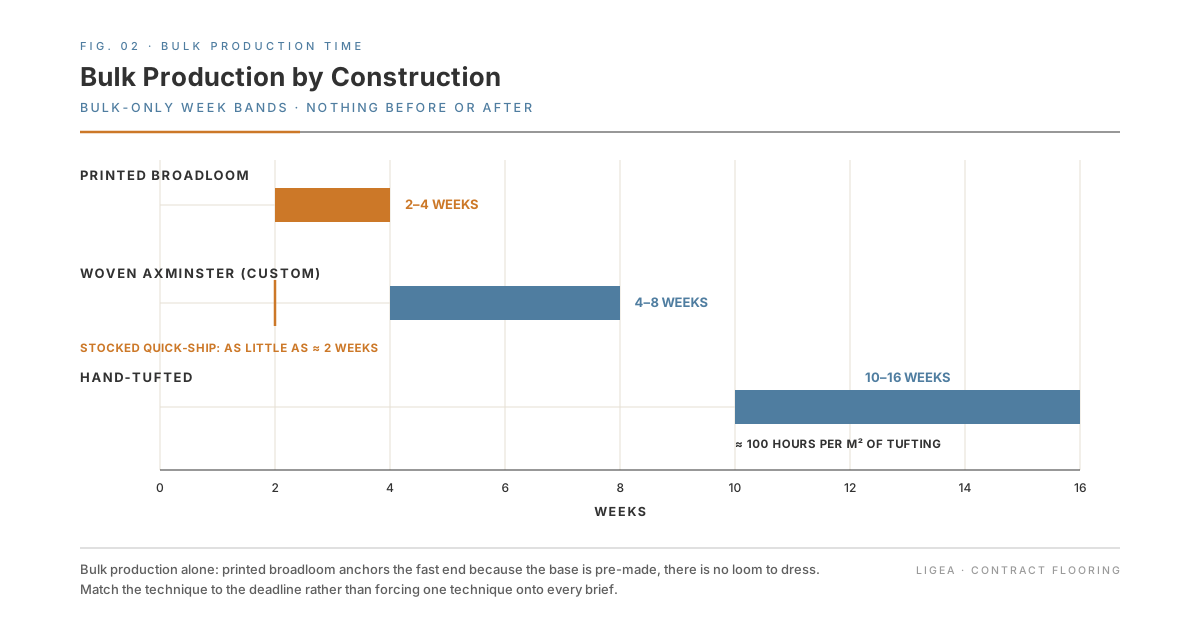
Bulk production time is driven by the build, and the bands below are bulk-only: the loom or line, nothing before or after. Read across the contract field, the realistic gradient looks like this:
- Printed broadloom: roughly 2–4 weeks. A dye-injection line lays colour onto a greige (pre-made, undyed) base, so there is no loom to dress and no weaving to schedule; the base is effectively pre-built and waiting.
- Woven Axminster: roughly 4–8 weeks for a custom order, and as little as roughly two weeks on a stocked-design quick-ship programme. The spread is the loom: a fully custom design has to be set up and the frame dressed, and a complex multi-colour pattern takes longer to weave than a simple one; a stocked design skips most of that. The two machine-broadloom routes start in the same window (print's 2–4 weeks and Axminster's fast end sit close together around four weeks), but Axminster's custom range stretches considerably further, so the build choice matters more once a project needs a fully bespoke design.
- Hand-tufted: roughly 10–16 weeks, with a floor of about four weeks even on the smallest piece, and correctly reserved for signature pieces, not floor area. A bespoke hand-tufted rug is genuinely artisanal: by industry estimates the tufting alone can run on the order of a hundred hours per square metre once a sample is approved, which is why the number does not compress the way a machine route does. It is worth saying plainly, because buyers often assume the opposite: hand-tuft is normally the longest of the three routes, not the shortest. A busy weaving mill can occasionally close the gap, but the default ordering is print fastest, Axminster in the middle, hand-tuft slowest.
The first lever, then, is the most obvious and the most often ignored: match the technique to the deadline rather than forcing one technique onto every brief. A corridor that wants soft gradients or a large-scale motif does not need a hand-tufted timeline; a lobby centrepiece that wants sculpted relief cannot be printed. The construction decision is a schedule decision before it is an aesthetic one. And the reason printed broadloom anchors the fast end is structural, not a marketing claim, which is worth understanding in its own right.
One more wrinkle sits inside those bands: rolls versus cut rugs. Axminster and print are produced as broadloom, in long, wide rolls. If the brief calls for fitted broadloom, those bands stand as written. But if it calls for finished rugs, cut to size and bound or edged, each piece has to come off the roll and through a separate cutting-and-binding step, which adds roughly a week on top of the roll-goods timeline. Hand-tufted carries no such penalty here: it is made to size from the outset, so there is no cutting and finishing stage to add.
03Why Print Broadloom Is the Fast Lane
The speed of printed broadloom comes down to what happens, or rather what doesn't have to happen, before colour goes on. In a computer-controlled dye-injection line, an undyed base cloth is fed continuously beneath banks of jet bars; each bar carries a different dye and its jets open and close hundreds of times a second, injecting colour into the pile without anything touching the surface. The printed roll then passes through a steam chamber to fix the dye, a washer, and a dryer. There is no warp to set, no frame to dress, no colour-by-colour weaving sequence.
Two consequences matter for a buyer. First, the base is pre-made, so the production clock is short and largely independent of how complex the artwork is: a many-colour gradient prints in broadly the same window as a simple stripe. Second, because the pattern is digital, there is effectively no repeat constraint: a print line can run a large-scale motif that never repeats across a whole corridor, where a woven loom is bound by its frame and a tufting head by its needle gauge. The same technology that makes print fast is what gives it its wide colour range and freedom of scale, which is why, when the design allows it, the print route is usually both the quickest and the most flexible answer.
The honest caveat: a printed surface is a different physical product from a woven or tufted one. Where a brand standard or a brutal-traffic location calls specifically for woven density, print is not a substitute. The right move is to honour the spec and plan the longer clock, not to bend the build to hit a date.
04Clock 2: Sampling Is Where Schedules Quietly Die
Here is the part that surprises people: the loom is rarely the problem. The approval rounds before it are. Bulk-production bands all begin "once design, colours, strike-offs and mock-ups are signed off", and that little clause hides the single most common cause of a slipped opening.
A strike-off (a full-scale production sample of the actual colours and construction) exists to be approved before bulk runs, and best practice in textile sourcing is unambiguous: a lab dip or strike-off must be approved before bulk production begins, and the signed, dated control swatch becomes the contractual reference the factory is held against: the evidence of what "right" looks like. That is correct and protective. It is also where the calendar leaks, for a simple reason. Every round of a physical strike-off is a make-it, ship-it, look-at-it, comment-on-it loop, and on an international order each loop can carry its own mini-freight leg. Two or three rounds of "the blue reads a touch too cool" can quietly add a month that no production quote ever mentioned.
There is an important distinction hiding inside the word "sample," and it changes the timeline. A strike-off swatch runs on a dedicated sampling machine (small, fast, built for exactly this), which is why the sampling bands above are short. A full mock-up rug, by contrast, runs on the production machinery itself: for Axminster and print, queuing a mock-up onto the main loom or line means it takes roughly as long as a bulk run to produce, not a sampling cycle. Asking for a full mock-up where a strike-off would do can quietly move a fast decision onto a slow machine. And one more thing buyers forget: a finished sample is at the factory, not on your desk. If the next round can be approved from high-quality photographs, the loop stays short; if a physical piece has to travel to the client and back before each sign-off, add the courier and transit time to every round.
This is the stretch with the most recoverable time, and the lever is to collapse the rounds, not skip them. Settle colour and scale on renderings, colour references and small swatches first, so that when a physical strike-off is finally ordered, it is to confirm a decision rather than to explore one. You still produce and approve the real strike-off; you simply arrive at it with the exploratory questions already answered, which can save whole sampling cycles.
It is worth naming the field reality here, because procurement teams live it: in hospitality, where a project routinely runs hundreds to thousands of line items across dozens of vendors, the approval bottleneck is rarely any one supplier being slow. It is the accumulation of decisions waiting on a busy client. Compressing the carpet's own approval loop is one of the few parts of that you can actually control.
05Clock 4: Freight Is Half Your Lead Time and No One Plans It
For any internationally produced carpet, the freight leg is not a footnote. It is frequently as long as the production itself, and it behaves very differently depending on the Incoterm and the route.
The ocean transit alone, port to port, runs roughly 18–25 days to the US West Coast and 30–40 days to the East Coast, and around 30–45 days into North European ports. Door to door, adding origin haulage, customs and final delivery, those numbers climb further, and they are not stable: independent transit-time indices have repeatedly shown the major lanes stretching by days or weeks when ports congest or routings change. Taken across all routes, ocean freight for contract carpet runs roughly 2–9 weeks: some lanes have moved a shipment in as little as two weeks, while EU- and US-East-Coast-bound routings via the Cape were running considerably longer as of autumn 2026 than the pre-disruption norm. That range is a snapshot, not a constant; reconfirm it against current carrier data at the time of quoting. A plan that books exactly the median transit with no buffer is a plan betting on a calm ocean.
The Incoterm matters as much as the distance, because it decides who is steering the freight, who absorbs the surprises, and (easy to miss) who can actually reclaim the import tax:
The line that matters most is non-DDP versus DDP, not any one non-DDP term against another. Under any non-DDP term (EXW, FOB, CFR, CIF, DAP, FCA), the buyer is the importer of record, pays the import VAT, and can typically reclaim it as input tax. Under DDP, the seller is the importer instead, and that changes who eats the tax:
- EXW / FOB put origin handling and the entire main carriage on the buyer. Cheapest on paper, but the buyer now owns the schedule risk, the forwarder relationship and the customs exposure.
- CIF / CFR put the seller in charge of freight (and, under CIF, insurance) to the destination port, while the buyer clears customs at arrival. Importantly, though, risk still transfers at origin, so "insured" does not mean "the supplier owns the delay." Within the non-DDP group, CIF is usually the easiest to calculate against: freight and insurance are already folded into the seller's price, so buyer and seller are pricing against the same landed number, whereas an FOB quote leaves the buyer to price the main carriage separately. FOB and CIF quotes are consequently not directly comparable line for line, which is why CIF is ligea's standard term.
- DDP puts the maximum on the seller, including customs clearance, import duties and delivery to site. That makes it the simplest for a buyer to plan around, but it has a quiet cost. Under DDP the seller becomes the importer and pays the import charges, including import VAT (in the EU, the Einfuhrumsatzsteuer); a foreign seller usually cannot recover that VAT, whereas the buyer, importing in its own name under any non-DDP term, generally could. So DDP often bundles a tax the buyer would otherwise have reclaimed into a price nobody itemises, quietly leaving money on the table, regardless of which non-DDP term it's being compared against.
The mistake that recurs is quoting one project on FOB and the next on CIF and comparing the two as if they were the same number. They are not, and the gap is the freight-and-insurance leg the seller has now priced in, not a tax difference: both terms leave the buyer, as importer of record, able to reclaim the import VAT the same way. The real dividing line for that recoverable tax is non-DDP versus DDP, not FOB versus CIF.
A word on the air-freight lever, because it gets asked for: yes, carpet can fly, and it is less binary than the "never" you usually hear. The deciding factor is not how long the carpet is but how wide the wound roll ends up. A roll wound tight enough to keep its diameter under roughly 1.5–1.6 metres clears a passenger aircraft's under-deck hold and travels as ordinary belly cargo without drama. And because a roll can lie flat lengthwise in that same hold, pieces up to roughly 3 metres long are genuinely flyable this way, not just short offcuts. Beyond that diameter, it has to go on a dedicated freighter, which comfortably takes rolls up to roughly 3.5 metres; freighter capacity is simply scarcer and markedly more expensive, which is where the "don't fly carpet" reflex comes from. Cost also scales with weight in the buyer's favour: IATA's weight-break pricing means air rates per kilogram fall in stages as the shipment gets heavier, and roughly 500 kg per shipment is an important break: not the single cheapest point, but the threshold from which meaningfully better rates start to apply, with further stages beyond it. Carpet is still bulky and light, so it is priced on dimensional (volumetric) weight, and air will almost always cost several times ocean per kilogram. But a tight-wound, passenger-haulable roll is genuinely flyable when a date demands it, rather than categorically off the table. The cheaper move, every time, is still to protect the four clocks so you never need it.
06Putting the Four Clocks Together
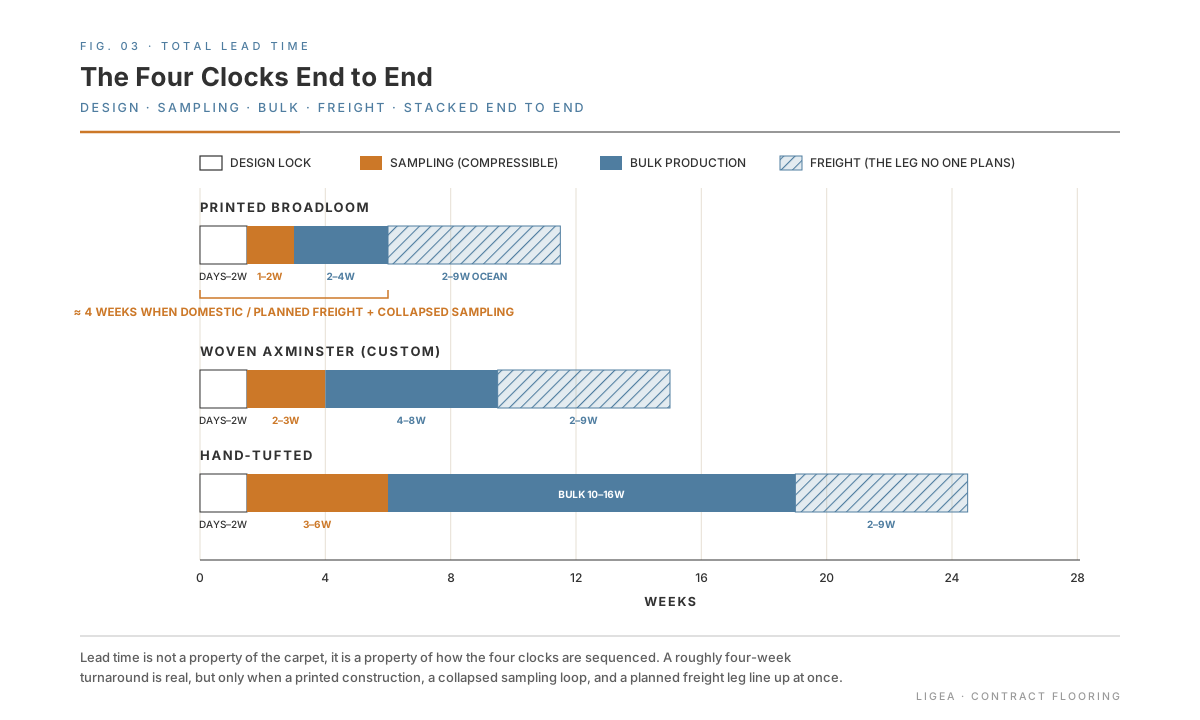
Lay the bands end to end and the picture clarifies fast. The same brief can be a four-week project or a five-month one, and construction is only one of the four reasons why:
| Stretch | Print broadloom | Woven Axminster (custom) | Hand-tufted |
|---|---|---|---|
| Design lock | Days–2 weeks | Days–2 weeks | Days–2 weeks |
| Sampling & approval | 1–2 weeks (compressible) | 2–3 weeks | 3–6 weeks |
| Bulk production | 2–4 weeks | 4–8 weeks | 10–16 weeks |
| Freight (overseas, ocean)* | 2–9 weeks | 2–9 weeks | 2–9 weeks |
*Ocean freight is highly route-dependent and volatile: some lanes have run as little as 2 weeks transit, while EU- and US-East-Coast-bound routings via the Cape were running considerably longer as of autumn 2026. Treat this band as a snapshot to reconfirm at the time of quoting, not a fixed number.
Read the table and the headline of this piece stops being a slogan. A roughly four-week turnaround is real, but only when three things line up at once: a printed construction (no loom to dress), a sampling loop already collapsed in software (so the strike-off confirms rather than explores), and either a domestic route or a freight leg that has been planned, not assumed. Knock out any one of those and you are back to the longer bands. Lead time, in other words, is not a property of the carpet. It is a property of how the four clocks are sequenced. And that is a planning problem, which means it is a solvable one.
07Where ligea Comes In
We plan the four clocks backwards from the opening date, so the construction choice, the sampling rounds and the freight booking all serve that date rather than compete with it.
Because we work with several producers and are not tied to one loom or print line, we can normally start production directly instead of queueing behind another order. Where the design allows it, print anchors the fast end at 2–4 weeks; where a brand standard or heavy traffic calls for woven density, we plan Axminster at 4–8 weeks or hand-tuft at 10–16 weeks openly from the start. Every custom shade is matched to Pantone TCX, NCS, RAL or a physical sample and confirmed on a strike-off before bulk. Freight is quoted on a clear Incoterm and planned with a buffer for the route, not booked to the median transit.
Explore our surfaces and constructions, or talk to us about a project on a tight schedule.