
Hand-Tufted vs Machine-Woven Carpet: When Bespoke Is Worth It
How hand-tufted and machine-woven carpet are actually built: construction, density, luxury surface, colour limits and lead time. Plus how mixing the two across a hotel buys a richer floor at the same budget.
There is a moment in almost every hospitality scheme where the floor stops being a finish and becomes a decision. The lobby wants a single sweeping artwork. A signature suite wants a sculpted, organic rug that exists on no sample rack. The corridors just need to survive a decade of luggage wheels. The same word, "carpet", covers all three, but the construction underneath does not. The clearest fault line runs between hand-tufted and machine-woven carpet, and the most common mistake is to treat that line as a simple durability-versus-cost trade. It is mostly a question of surface and luxury. The real skill is matching each technique to the design and the zone, then mixing them across a property so the same budget reads as a richer, more expensive floor.
01How each is actually made
The difference is mechanical, and it dictates everything downstream, including which failure modes you inherit.
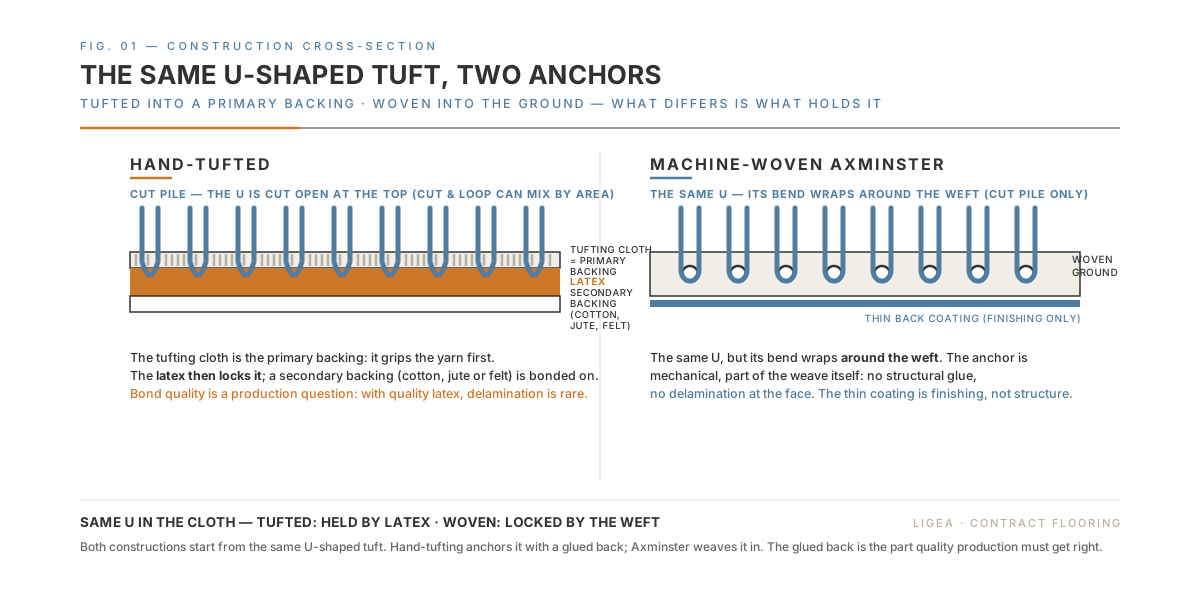
Both constructions start from the same element: a U-shaped tuft set into a backing. In hand-tufted carpet, a craftsperson uses a hand-held tufting gun to punch that U through a stretched tufting cloth, the layer inspectors call the primary backing, following a pattern traced onto it. At this stage the tuft is held purely by the grip of the backing's weave around the yarn. Cut pile is formed directly during tufting, and the gun can switch between cut and loop within the same piece, so different areas of one rug can carry cut pile next to loop pile. Axminster cannot offer that mix. The permanent hold comes from the back: a coat of latex adhesive locks every tuft; higher-grade construction embeds a reinforcing mesh in that latex, and a secondary backing, typically cotton, jute or felt, is bonded on as the finished underside (Carpet & Rug Institute). That latex bond is where production quality shows. When it fails, the failure is called delamination, and today that is essentially a cheap-production story: filler-stretched latex, or rugs shipped before the back has cured. With quality latex and proper curing it has become rare, and buyers can specify it outright (delamination strength to ASTM D3936). Quality manufacturers work with latex compounds engineered for exactly this, which all but eliminates the problem.
In machine-woven Axminster the tuft is the same U. The difference is the anchor: each coloured tuft is locked into place by the weft as the pile and the ground weave are formed in a single pass. Because the pile is bound in integrally, anchored by the weave itself, it does not shed or delaminate at the surface the way a glued tuft can. That is the genuine construction advantage. A line you will read in woven marketing, that woven carpet "does not rely on adhesive", is only half true though: it does not rely on adhesive to hold the pile, yet a finished Axminster still receives a thin applied latex back coating in finishing, mainly to stop cut edges fraying and to add dimensional stability and handle. It is markedly lighter than the structural latex-and-secondary-backing sandwich hand-tufted carpet depends on. The precise picture: integral pile that will not delaminate at the face, plus a thin applied coating. Not adhesive-free, and not the same weight of backing hand-tufting carries.
One confusion worth clearing up, because it is often used as a sales prop: hand-tufted is not hand-knotted. Hand-knotted rugs are tied knot by knot, with no glue, in a fixed size. They are loose-laid signature pieces. Producing fitted, wall-to-wall hospitality carpet by knotting is technically possible, but as commercial practice it is vanishingly rare: cost, time and capacity rule it out for broadloom runs. Hand-tufting is the technique used for bespoke hospitality rugs and broadloom-scale work.
02Density, durability and where each belongs
Here the contract world parts ways with showroom marketing, though not in the way it is usually told.
For hand-tufted carpet, durability is set by two dials: density and fibre. The denser and heavier the tufting, the more durable the carpet, and the material matters at least as much, because the fibre has a direct influence on how the pile survives traffic. Together those two settings set the zone. A very dense, heavy quality belongs in lobbies and public areas. A lighter, more open quality costs less, sometimes in a different fibre such as polyester or wool, and is a legitimate choice for lower-traffic guestrooms. There is no fixed "hand-tufted lasts X years" verdict; it depends on how heavily it is built.
For machine-woven Axminster, the integral pile that will not shed or delaminate at the face makes it the robust default for the busiest floors, and the reason it is the durability gold standard for five-star work. The back-side latex bond deserves respect, but in perspective: latex ages slowly over years and decades, and the acute delamination cases the trade still sees come almost entirely from the cheap import segment. Specified quality production plus sensible care (aggressive wet-cleaning stresses any adhesive bond) keeps it a non-issue in practice. It is a reason to buy tested production and to place lighter tufted work in gentler zones, not a reason to avoid the technique.
Fibre choice is a separate dial again. 80/20 wool-nylon has long been the market convention for the toughest contract floors, on the reasoning that a portion of nylon reinforces wear. Worth knowing: independent testing on identical Axminster constructions (BTTG, reported by IWTO) found 100% wool performing on par with 80/20 in heavy commercial use, holding pile thickness and pattern clarity well (IWTO). So 80/20 remains the sensible default, and 100% wool is a fully legitimate choice rather than a compromise. Construction, density and fibre are separate dials, and "machine-made means inferior" is simply wrong in a contract context.
03The luxury question: why hand-tufting earns its keep
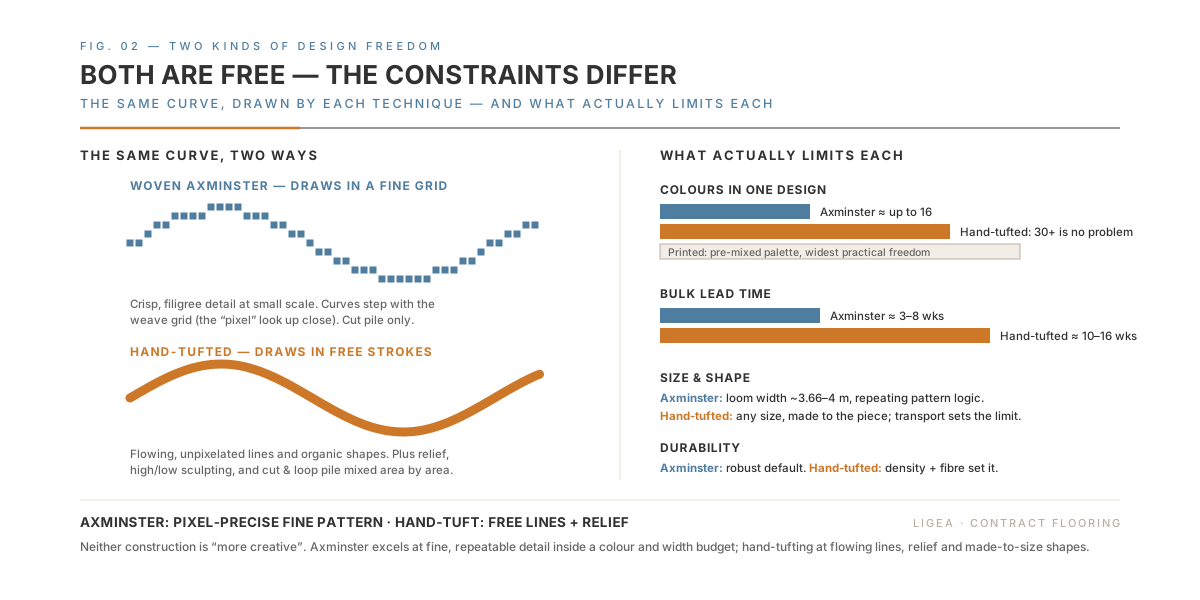
This is the part the durability framing misses, and it is the real reason to reach for hand-tufting: it simply looks more luxurious than Axminster. It is a different surface: deeper, softer, with relief and hand. Not a finer version of the same woven grid, and crucially not the slightly pixelated look that even very good woven artwork carries up close. When a space is meant to be experienced rather than walked across, that surface is the point.
Both techniques give a designer real freedom; the constraints are just different. Axminster draws in a fine grid. That makes it superb at small, filigree, repeating detail that stays crisp under traffic, and it is also the reason curves step ever so slightly when you look closely. Hand-tufting draws in free strokes: flowing, unpixelated lines, organic non-repeating shapes, and three-dimensional relief carving with high/low sculpting, the pile sheared to different heights after tufting. Some designs genuinely render better woven, others hand-tufted. A good specifier judges each design on its own terms rather than applying a rule.
Colour follows the same logic. Axminster carries a limited number of colours in a single design, realistically up to around 16. Hand-tufting handles 30-plus colours without difficulty; its constraint was never the palette. Printed carpet works from a palette of pre-mixed colours with no pattern-repeat limit and the widest practical design freedom, which is why gradient and photographic-style artwork is printed rather than woven. Woven carpet is also bounded by loom width and its repeating pattern logic: Axminster looms typically run 3.66–4 m and tufting machines 4–5 m; anything wider is special-case territory, usually hand-woven. Seamless woven artwork beyond the loom therefore needs planning. Hand-tufting has no such ceiling: the frames are built to the piece and the tufting cloth can be repositioned on the frame during production, so size is effectively open-ended and transport sets the practical limit.
So the split is not "woven good, tufted pretty". Woven holds branded, repeatable, fine-detailed pattern and keeps its definition under traffic. Print carries the widest colour and gradient freedom. Hand-tufting delivers the richest, most sculpted surface for the spaces where luxury is the brief.
04Lead time: hand-tufted is the longer route
Here a stubborn myth needs correcting, because it gets specified wrong constantly: hand-tufted is not the fast option. It is the slow one. Each piece is built by hand to size, and that takes longer than running a woven or printed programme through a machine.
| Stage | Printed | Woven Axminster | Hand-tufted |
|---|---|---|---|
| Design lock | days–2 wk | days–2 wk | days–2 wk |
| Sampling & approval | 1–2 wk | 2–3 wk | 3–6 wk |
| Bulk production | 2–4 wk | 3–8 wk | 10–16 wk |
| Freight (ocean) | 2–9 wk | 2–9 wk | 2–9 wk |
Ocean freight is route-dependent and currently volatile. The 2–9 wk range reflects routes as of mid-2026 (some lanes run as short as 2 weeks; EU/US East Coast routings via the Cape are presently longer); confirm current transit at quote stage.
The implication is the opposite of the showroom story: when the calendar is tight, a woven or printed programme clears faster, while a hand-tufted feature piece needs its time booked early. One detail runs the other way: roll goods cut into rugs need about a week extra to cut and bind, whereas hand-tufted is already made to size. It does not close the gap.
On cost, the discipline is to judge on life-cycle value, not sticker price, and to drop the assumption that the woven option is always the expensive one. In guestrooms, a richer hand-tufted quality costs more than Axminster, not less, so nobody chooses it to save money. But the premium is small, and that is precisely the lever: for a marginal upcharge you buy a visibly more luxurious surface.
05The zone-by-zone picture, and the move that matters
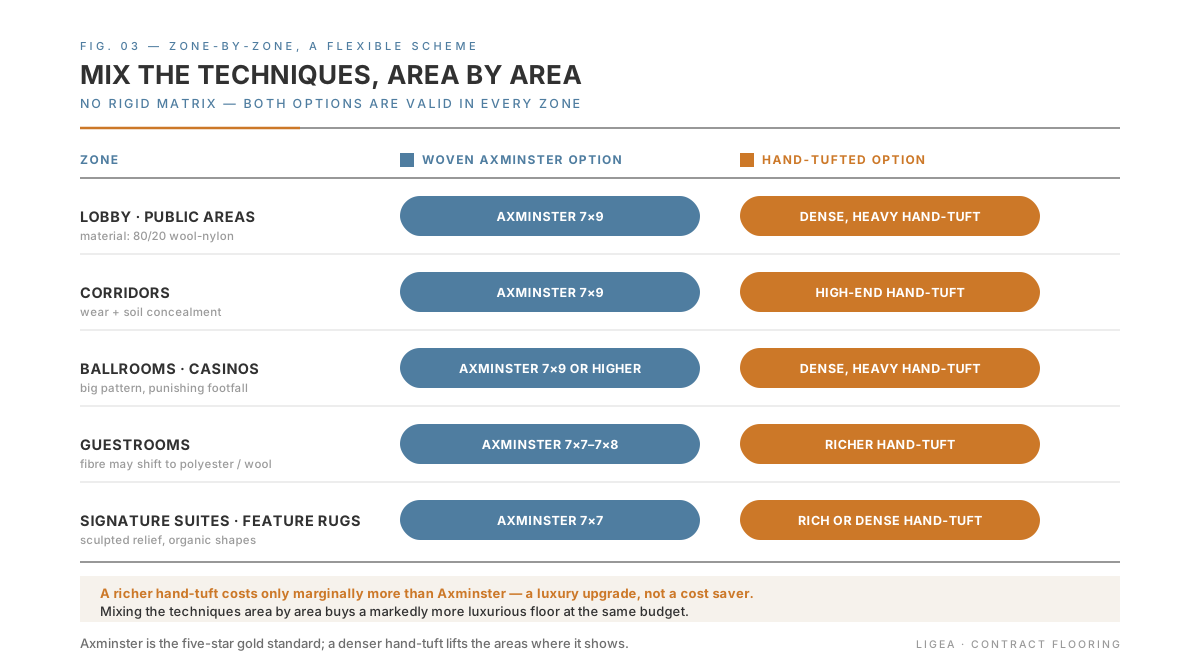
There is no rigid matrix here; the right answer depends heavily on the hotel's luxury level. Axminster is the gold standard a five-star scheme can be built on entirely. The move that lifts a property is mixing a richer hand-tufted quality into the areas where it shows. A workable starting frame:
- Lobby: Axminster in 7×9, or a dense, heavy hand-tuft where the entrance is meant to feel exceptional.
- Corridors: Axminster in a heavier construction, typically 7×9 (the usual band runs 7×8–7×10), for wear and soil concealment, or a high-end hand-tuft where the budget reaches.
- Ballrooms and casinos: 7×9 woven or higher; in our practice a casino's extreme frequency argues for the top of that band. Alternatively a dense, heavy hand-tuft, for big intricate pattern under punishing footfall.
- Guestrooms: Axminster 7×7 or 7×8, or a richer hand-tufted quality, marginally more expensive than Axminster: a luxury choice, not a cost saver, but not a big premium either. Guestroom fibre may shift to polyester or wool.
- Signature suites and feature rugs: practically everything is on the table here, from Axminster to the densest hand-tuft, even hand-woven or hand-knotted pieces. This is the place to do something genuinely special, including the sculpted relief and organic shapes only hand-tufting delivers.
- Material: Axminster stays 80/20 wool-nylon in public areas and guestrooms alike; it is row density that differentiates a lobby-grade construction from a guestroom-grade one, not the fibre. A hand-tufted guestroom is the exception: wool or polyester as standard, other fibres on request.
The one-line version, and the actual selling argument: specify by zone, not by habit. Splitting the property between techniques puts the luxury where guests see it, and the spend stays where it was.
06Where ligea comes in
Almost every "which construction?" question is really a brief in disguise: a designer's vision, a developer's budget, and a floor that has to survive a particular kind of traffic and light. Our job is to read all three and, more often than not, to mix techniques across the property so the budget lands where it shows. Where a scheme needs durability and branded, repeatable pattern, we specify woven Axminster in 80/20 wool-nylon or 100% wool, built to a defined pitch and rows (a heavier 7×9 for corridors and public areas, a 7×7 for guestrooms) in up to around 16 colours, with refined edge binding, an IMO-marine version for cruise, and constructions reaching EN 13501-1 Bfl-s1 (Centexbel · EN classification). Where a space is meant to feel exceptional, we move to hand-tufted Royal or the dense Grand Royal ("550") for the richer, sculpted surface Axminster cannot match. And where the design lives on gradient, photographic detail or sheer colour freedom, we specify printed 100% nylon, working from pre-mixed colours with no pattern-repeat limit. All come as broadloom rolls, cut-and-bound rugs or made-to-size pieces, with colour matched to Pantone TCX, NCS, RAL or a physical sample and proven on a strike-off before anything goes into bulk.
Because we work across multiple producers rather than a single loom or print line, the brief picks the method and the maker, not the other way round. Plan the calendar accordingly: printed and woven bulk typically run two to eight weeks after sign-off, while hand-tufted runs longer; book it early. We are also rolling out AI-assisted rendering to compress the approval rounds that usually slow a project down.
---
ligea engineers contract surfaces for hospitality projects worldwide, matched to your design, your construction and your budget. Whether the brief calls for woven endurance or hand-tufted luxury, see our surfaces or book a 15-minute spec call.