
Shedding or Delamination? Reading Early Wear Signals Right
New carpet losing fibres and a rippling backing years later look like the same alarm to housekeeping. They aren't. How to tell shedding from delamination, and what to document before you call the supplier.
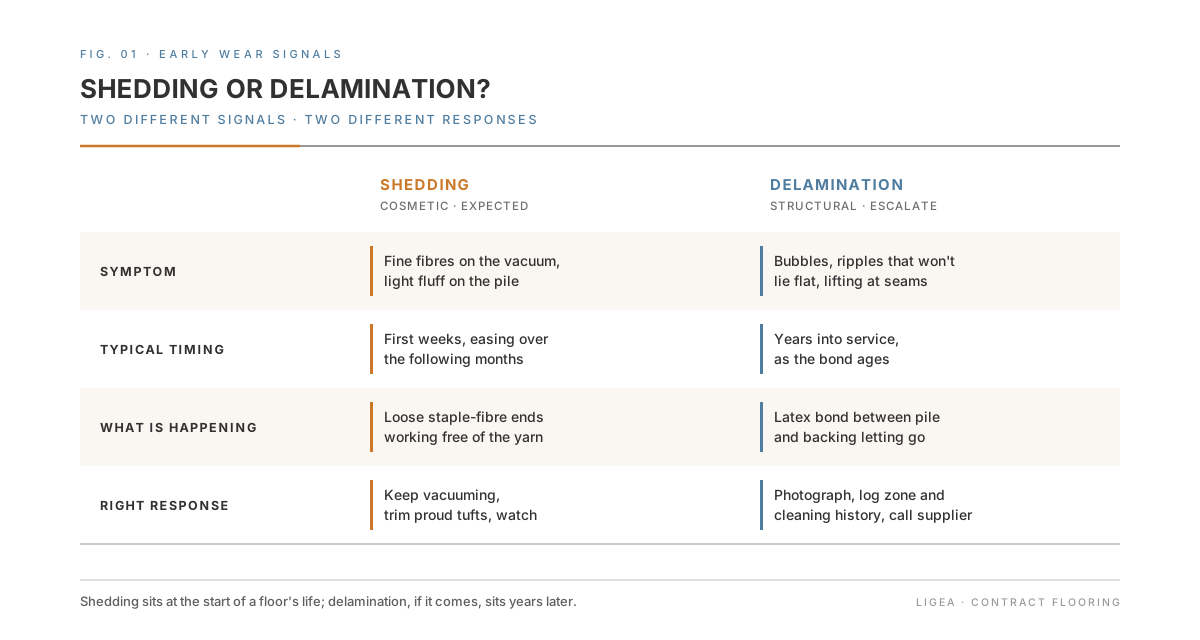
The call often comes within the first two weeks after installation. Housekeeping has noticed fine fibres on the vacuum brush, a faint fluff collecting along the pile of the new lobby rug, and the report that reaches the GM's desk reads like a fault: the new carpet is falling apart. Usually it is nothing of the kind. It is shedding, a cosmetic and expected part of a new tufted pile settling in.
The call that should actually worry you sounds completely different, and it tends to come much later. Some years in, someone on the floor team notices a soft wave running across a section of corridor runner, or a bubble that won't flatten back down no matter how many times it gets rolled and weighted. That one is delamination, a structural question in the backing rather than the face, and it is the one worth escalating properly.
The two get confused in both directions. Properties panic over normal shedding and treat a healthy new floor as defective. Others wave away early delamination signs as "probably just settling," because that was the right explanation the first time housekeeping raised an alarm about fibres. Both mistakes cost money. Here is how to read the signal correctly.
01Shedding: Loose Fibres, Not a Defect
Shedding is fibre loss from the pile surface, and on a new hand-tufted rug, especially in wool, it is very common. It shows up as fine strands on the vacuum and a light fluff on and around the pile, sometimes enough in the first few passes to look alarming on a dark floor.
The reason lies in the yarn. Wool pile yarn is spun from staple fibres, shorter lengths twisted together rather than one continuous filament, and the loosest fibre ends work free under the first foot traffic and vacuuming (Woolmark). That is why shedding is front-loaded: it is heaviest in the first weeks of use and usually eases over the following months, faster in zones with more traffic and more frequent vacuuming. It is not a sign that the carpet is losing density or that the tufting was faulty; it is loose material that was always going to work its way out.
What helps is unremarkable, and that is the point: vacuum regularly and don't fight it. Suction removes the loose fibre without damaging anything underneath, so regular vacuuming in the first months shortens the shedding period rather than prolonging it. If a single tuft stands visibly proud of the surrounding pile, trim it level with scissors rather than pulling it, because pulling can draw adjacent yarn loose. No cleaning chemistry or backing intervention is needed, and there is no reason to call the supplier unless loose fibre is still heavy well past the first months or the pile itself looks visibly thinner. At that point it stops being ordinary shedding and is worth a second look.
02Delamination: When the Backing Lets Go
Delamination lives in a part of the carpet housekeeping never sees at handover: the back. Hand-tufted and other tufted constructions are built by punching yarn through a primary backing, the tufting cloth, and then locking it from behind with a coat of latex adhesive, with a secondary backing (typically cotton, jute or felt) bonded on for stability. That back-side bond is where production quality shows. With a latex compound engineered for the job and proper curing it holds for many years; when it eventually ages or fails, that is delamination.
It reads very differently from shedding. Instead of loose fibre, you get bubbling or blistering across the field, a rippling that doesn't press flat and stay flat, backing lifting or peeling at a seam or an edge, or a patch that feels soft or detached underfoot. None of that is cosmetic, and none of it resolves with a vacuum.
Two things push a bond toward failure, and on quality production both are slow rather than sudden. The first is age: a latex and secondary-backing bond has a working life measured in years, and on a hand-tufted piece it is usually the backing rather than the pile that sets the ceiling on physical life. The second is care. Aggressive wet extraction can put real stress on the bond, particularly as it ages, so cleaning method matters here in a way it doesn't for shedding, and care guidance belongs in the maintenance programme.
03Delamination Is a Production-Quality Question
Tufted pile is held in with adhesive, so there is a back-side bond that a woven floor's pile does not depend on. Whether that bond ever becomes a problem is mostly a question of production quality, not of the technique. Acute delamination cases concentrate in low-cost production, where filler-stretched latex or a roll shipped before the back has properly cured leaves a bond that was never going to hold. Quality latex compounds and proper curing largely remove the problem, and the bond itself is a specifiable, testable value: delamination strength to ASTM D3936. Put a minimum value in the specification and ask for the test report, and the risk becomes a documented number rather than a guess.
Woven Axminster carries a different profile at the face, because its pile is not glued in: it is locked by the weft as pile and ground weave are formed together, so the pile cannot come unglued. It is worth being precise, though. Woven carpet is not backing-free; modern commercial Axminster also receives a thin latex coating in finishing, which mainly stops cut edges from fraying and adds dimensional stability. That coating is a finish rather than the structural bond holding the pile in place.
None of this is an argument for one construction over the other. That call belongs to the design brief, the zone and the look, and hand-tuft gives relief, cut and loop in one piece and the sharpest contours of any construction. It simply explains why a rippling backing is, mechanically, a tufted-carpet conversation, and why tested production and sensible care decide whether that conversation ever happens on a given floor.
04What to Watch, What to Call In, What to Document
The practical test is simple once the two are separated. Loose fibre on a new hand-tufted piece, especially in wool, within the first months of use: watch it and keep vacuuming. It is not a fault and does not need a supplier call.
Bubbling, a wave that won't flatten, backing lifting at a seam or edge, or a soft, detached-feeling patch: that is a call to the supplier, not a housekeeping fix, and not a case for on-site re-gluing without guidance, since the cause (bond age, moisture or a cleaning event) needs a proper look before anyone treats it.
What makes that call useful is what you bring to it. Photograph the affected area from a few angles, including one wide enough to show its position in the room and the traffic pattern around it. Note the exact zone, the installation date and the cleaning history for that area: method, frequency and the date of the most recent deep clean or extraction. If the issue appeared after a spill, a flood or a specific cleaning event, say so. That record lets a supplier tell bond age, moisture and cleaning method apart instead of guessing from a phone description.
05Where ligea Comes In
We build the difference between shedding and delamination into handover, so housekeeping knows what to expect from a new hand-tufted piece and which signs to report. Hand-tuft from our Royal family is specified with a tested bond and comes with care guidance for the cleaning team, including how to handle wet extraction. Where a zone will see years of aggressive wet cleaning, woven Axminster is often the calmer choice, and because we work with several producers, each zone can get the construction that suits it. When a report does come in, we start with the same three questions: what does it look like, where exactly is it, and what has the cleaning history been.
Questions about a wear signal on an existing floor, or specifying a new one with the right construction for the zone? Explore ligea Surfaces or book a 15-minute spec call.