
Who Pays for the Carpet? FF&E Reserves, Owners and Operators
For hotel owners, operators and FF&E procurement: how the FF&E reserve at 3–5% of gross revenue actually funds carpet, who signs off at what threshold, and how to budget the soft-goods and PIP cycle before it forces your hand.
If you own or operate a hotel, "we need new carpet" is never really the decision. The real decision was made years earlier, when the management agreement was signed and a reserve account started collecting a slice of every month's revenue for exactly this moment. Who pays, out of which account, approved by whom, against which budget, in which fiscal year? Those questions have answers long before a corridor starts looking tired, and knowing them changes how you plan the renovation, not just how you pay for it.
This is how the money actually moves, and what it means for your budget and your timing.
01The FF&E Reserve: A Sinking Fund for Things That Wear Out
Carpet is FF&E: furniture, fixtures and equipment, the movable, non-structural assets a hotel needs to operate. And FF&E wears out on a predictable schedule, which is exactly why the industry funds its replacement through a dedicated sinking fund called the FF&E reserve (or "reserve for replacement").
The mechanics are old and remarkably stable, and if you are the owner, this is the line item you are already funding whether or not you have ever thought about carpet specifically. Each period, usually monthly, a percentage of the hotel's gross revenue is set aside into the reserve so the cash is there when assets need replacing. HVS notes that management agreements "generally include a reserve for replacement of FF&E of between 3% and 5% of gross revenue per month, with the lower percentage more likely to relate to budget hotels and the higher percentage to upper upscale and luxury hotels." The rule of thumb itself is nearly a century old: academic and industry accounting work traces it to the 1930s, when the convention settled at around three per cent of annual gross revenues.
In practice the contribution usually ramps, which matters for how you should read your own reserve balance. A new hotel needs little in years one and two, when everything is new, so agreements often start the reserve low and step it up: a common pattern runs roughly 1–2% in the early years, rising through 3% and 4% to a steady-state 5% from the fourth or fifth year onward, by which point the first soft-goods refresh is due. If you are three years into a new build and the reserve looks thin, that is normal, not a red flag; if you are seven years in and it still looks thin, that is worth a conversation with your asset manager before the carpet forces it.
Where lenders are involved, this stops being a convention and becomes a covenant. Hotel loan agreements routinely require borrowers to deposit a fixed share of gross operating revenues into a segregated reserve. One representative loan-agreement clause requires monthly deposits equal to "the greater of (i) four percent (4%) of Gross Operating Revenues for the Property for the previous month, and (ii) the amount required to be deposited into any FF&E reserve... pursuant to the terms of any applicable Franchise Agreement and/or Management Agreement", frequently in an account "under the sole dominion and control of the lender." So in many deals there are two masters of the same money: the brand's contract minimum and the bank's loan minimum, whichever is higher. As an owner, check both before you assume you know your own reserve rate.
02Owner Pays, Operator Spends (Usually)
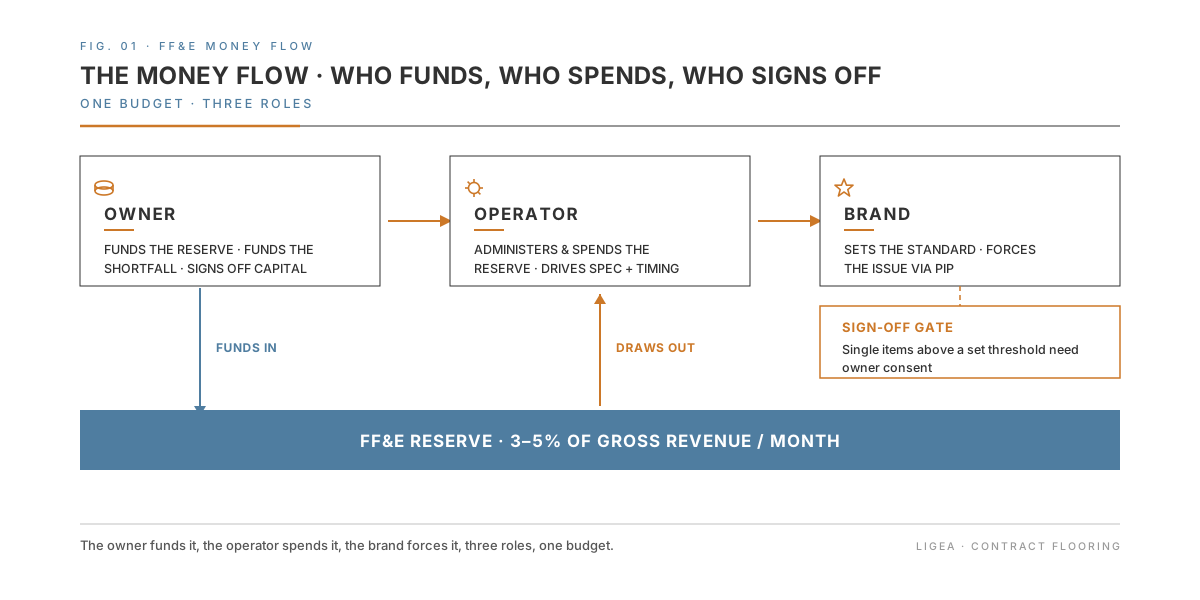
The single most useful thing to internalise, whichever side of the table you sit on, is that the owner funds the reserve, but the operator typically controls how it is spent, and the exact balance is the most negotiated clause in the whole agreement.
Under a management agreement, the owner carries the FF&E obligation outright: a percentage of revenue flows into the reserve each month, and "if the amount required exceeds that available in the reserve, then the owner will typically be required to fund the shortfall." The operator runs the hotel and administers the reserve, but the cheque-writer of last resort is the owner.
That is not the only structure, and the model changes who pays:
- Lease. Under a lease the lessee (the operator) in most cases provides the FF&E and OS&E and is responsible for the renovations, which is why a lease lowers the property owner's capital exposure. The replacement burden sits with whoever holds the lease.
- Franchise. The investment profile is close to a management agreement: the owner generally bears FF&E and renovation costs while the brand exerts its influence through standards rather than day-to-day operation.
- Owner-operated independent. No third party at all; the owner is sponsor, operator and capital source in one.
For an owner, the practical consequence is simple: the name on the door is rarely the name on the cheque. The brand sets the standard, the operator usually drives the specification and timing, and you, as owner, release the capital and cover the shortfall if the reserve runs light. If you are not in the room when the operator and the designer agree on a spec, you are still the one who has to fund it.
03Who Actually Signs Off, and the Discretionary Threshold
"The operator controls the reserve" is a simplification. Real agreements distribute control along a spectrum and put guardrails on it. If you are the owner, these guardrails are your main lever over a spend you are not managing day to day. Real management agreements commonly provide that the manager may apply reserve funds without owner consent only inside an approved capital plan, "provided that not more than a specified amount may be expended... for any single item without prior written consent of Owner, which consent shall not be unreasonably withheld."
Two things follow from that. First, a full-floor corridor or ballroom carpet order will almost always sit above the discretionary threshold, which means it needs your explicit sign-off as owner. Ask to see it before it is presented as a done deal. Second, you commonly retain the right to demand competitive bids and a cost-benefit case above a negotiated threshold. That is a standard owner protection, and it is worth using: a designer's favourite spec still has to survive a bid comparison against every other claim on the reserve.
The annual rhythm matters too. The operator typically submits a forward FF&E and capital plan for the coming fiscal year, and you, as owner, review and approve it. That approval is conventionally "not to be unreasonably withheld," which is exactly why the review has to be substantive rather than a rubber stamp. Carpet that is in next year's approved plan is fundable on schedule. Carpet that surfaces as a mid-year surprise fights for scraps against everything else on the reserve. If you want the renovation to land on your timeline rather than the operator's, the budgeting cycle is where your involvement matters, well before a corridor finally looks tired.
04Carpet Is Soft Goods, and Soft Goods Have a Clock
Within FF&E, the trade draws a hard line between soft goods and case goods, and carpet falls firmly on the soft side. Soft goods are the textile and decorative layer a guest sees and touches: carpets, rugs, drapery, sheers, bedspreads, upholstery, cushions, lampshades, wall and floor coverings. Case goods are the hard furniture skeleton: headboards, dressers, wardrobes, desks, nightstands.
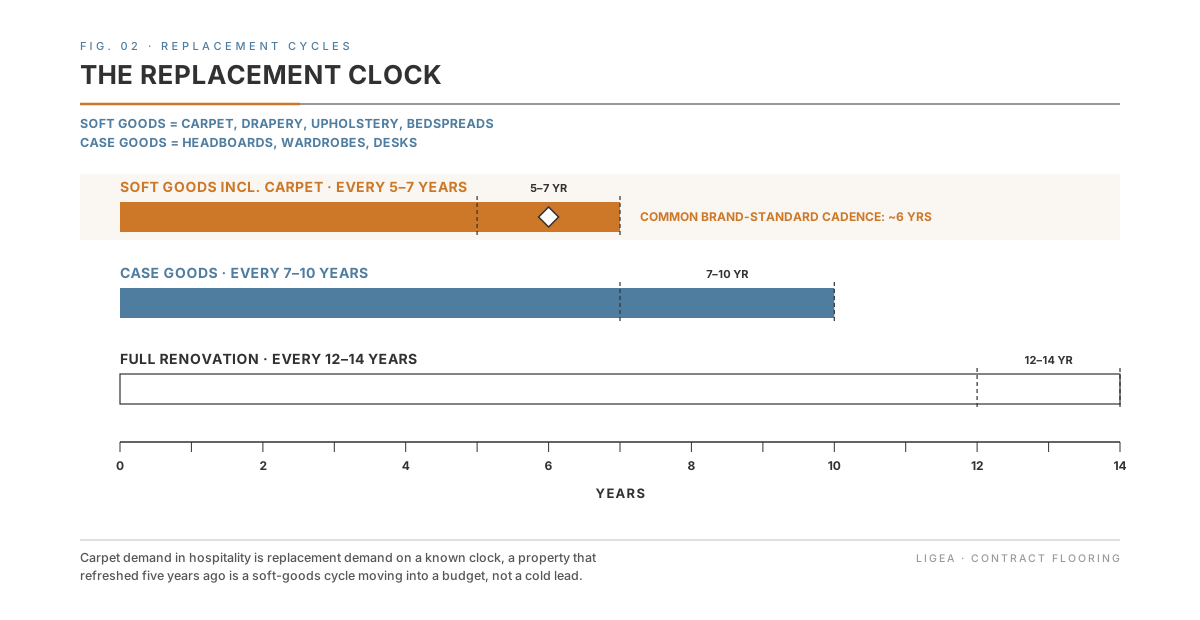
The distinction is not pedantry; it sets the replacement clock, and the clock is what drives demand for carpet. Soft goods wear and date fastest, so they cycle first. The widely-cited industry pattern runs roughly:
- Soft goods (incl. carpet): every 5–7 years
- Case goods: every 7–10 years, on longer cycles
- Full renovation (case goods, bathrooms, hard finishes, layout): every 12–14 years
Most branded hotels run on a roughly six-to-seven-year soft-goods cycle, with targeted refreshes of high-wear items every three to five years. Brand standards then sharpen this into a contractual cadence: one widely-reported figure has a major operator's standards calling for carpet replacement on a six-year cycle, with hard flooring on a twelve-year cycle. Read these as brand-specific conventions rather than universal law, but the order of magnitude is consistent across the sector.
Here is the nuance worth budgeting around: the replacement cycle and the physical life of the carpet are two different numbers, and brands change carpet on the shorter one regardless of condition. A well-specified woven Axminster can physically last fifteen to twenty-five years; a good hand-tufted wool piece can run eight to fifteen; even a solid tufted nylon broadloom is good for ten to fifteen. None of that buys you an extra cycle: the brand replaces "soft goods" every five to seven years whether the carpet still looks fine or not. What it does buy you is peace of mind within the cycle you are already paying for: a carpet that would have physically lasted twice as long is the one that will not need an emergency mid-cycle spend when a section wears through early. If you are the one signing off on the capital plan, the question for your designer is whether the carpet will get to year six or seven without an unplanned line item.
For a hotel that opened or last refreshed five to six years ago, this is not an abstract topic. It is a renovation moving into your next budget cycle whether you have started planning it or not.
05The PIP: When the Brand Forces the Issue
The other engine of carpet demand is the Property Improvement Plan (PIP), the brand's mechanism for forcing a property back up to current standards, usually triggered at franchise renewal, on a change of ownership, or on a brand conversion. PIPs are a regular feature of franchised life, often involving soft renovations at around six years, a harder or more extensive renovation at twelve, and a complete redo around eighteen, increasingly bundled into the franchise agreement on a five-to-seven-year cadence.
Two facts about PIPs matter if you are the one paying for one. First, you fund it as owner, and it is not cheap: guest room renovations are a substantial per-room expense, with public space costing far more again; the long-standing rule of thumb has owners spending around 7.5–8% of revenue on a PIP issued roughly every decade. Second, PIPs are negotiable, both scope and timeline, and this is the point most owners underuse. Trade-press reporting on PIP negotiations consistently puts subjective, finish-level items (flooring, wall finish, ceiling) among the first things a brand will trade on, ahead of structural or life-safety items that are genuinely fixed. The PIP as a whole is not optional, but the carpet spec inside it usually is. That cuts in your favour if you get a floor consultant involved early, while the spec is still being negotiated, rather than after it has been locked. A PIP can also mandate a flooring change outright; one reported case was a 50-room-hotel PIP that forced a switch from carpet to hard flooring at a heavy per-room cost. The earlier you understand which way your brand's current standard is leaning, the more room you have to negotiate the outcome instead of just paying for it.
06The Uncomfortable Truth: The Reserve Is Usually Too Small
If you are an owner, there is a structural tension worth understanding before your next renovation conversation: the reserve you have been funding is very likely underfunded relative to what brand-standard upkeep actually costs.
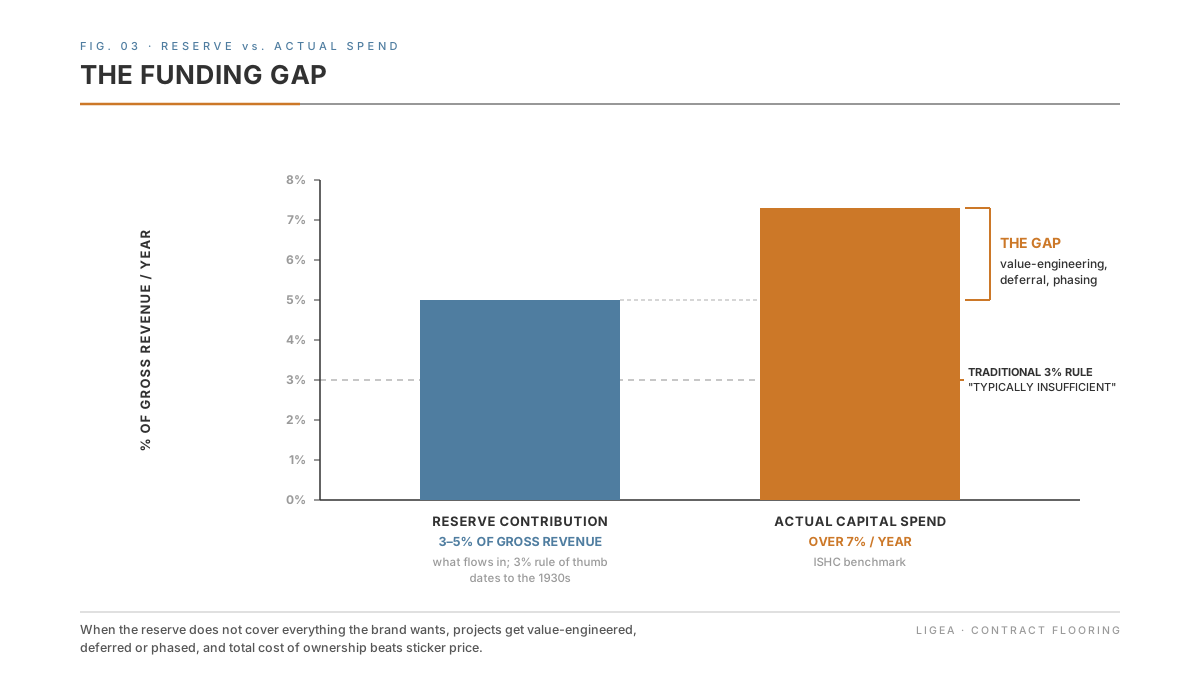
The 3% rule of thumb is a known understatement. The accounting literature is blunt: the traditional contribution "is typically insufficient to cover the true cost of FF&E expenditure because it ignores plant life cycles, routine maintenance costs and hotel building ageing," with the reserve account in many cases running materially short of the true capital cost of maintaining standards. More recent benchmarking points to actual capital spend averaging well over seven per cent of a hotel's gross revenue per year according to ISHC, far above the 3–5% that flows into most reserves.
The practical takeaway is to plan for the gap rather than panic. When the reserve does not cover everything the brand wants, projects get value-engineered, deferred, or split into phases, and this is exactly where a well-chosen construction earns its keep instead of costing you more. In guest rooms, for instance, a Royal-grade hand-tufted wool carpet typically prices only marginally above a comparable woven Axminster, far less than you might expect for a visibly more luxurious, higher-relief look. Spent inside an already tight reserve, that is a small premium for a materially better result, and it is a cheaper way to hit a brand-standard upgrade than most alternatives on the table. Total cost of ownership, not sticker price, is the number that should decide the spec.
07Getting Carpet Onto Your Capital Plan Without a Fight
Put the financial picture together and the path from "we need new carpet" to an approved purchase order becomes clear, and it runs through the same four gates every time. The reserve funds it; the operator and brand drive timing through replacement cycles and PIPs; a designer specifies; a procurement agent or purchasing firm executes the specification, prepares purchase orders, runs the competitive bid and tracks budget; and you, as owner, sign off above the discretionary threshold. Every stakeholder typically signs off before purchase: designer for intent, procurement for price and schedule, you for capital.
For the spend to clear all four gates without friction, the carpet itself has to hold up on three fronts at once: specified correctly by the designer (right look, right certification), defensible to procurement (right price against a competitive bid, right lead time against the renovation deadline), and fundable within your capital plan (inside the approved budget, the right side of the discretionary threshold, a sound total-cost case). If you get a knowledgeable floor partner involved while the spec is still being written, rather than after it is locked, all three become far easier to satisfy at once, which is the whole argument for bringing that expertise in early rather than treating carpet as a line item to approve at the end.
08Where ligea Comes In
The carpet decision gets easier when the floor partner knows the reserve balance and the discretionary threshold before the spec is final. With that in hand we can show where a construction choice moves the number, for example Axminster at 7×7 to 7×8 in the guestrooms, or Royal hand-tuft for a visibly richer room at only a small step up from Axminster. Phasing a refresh is realistic because production after approval is short, 2–4 weeks for print and 4–8 for Axminster, and because we work with several producers we can usually start straight away. Every shade is matched to your reference and confirmed on a physical strike-off before production, which keeps colour questions out of the owner's approval round.
Working a refresh, a PIP or a new-build capital plan? See our surfaces or book a 15-minute call and we'll talk through the spec and the budget at the same time.