
Hotel Noise Complaints: The Owner's Case for Quiet Floors
Only 43% of noise-bothered hotel guests ever complain; the rest just don't come back. The owner's view of hotel noise complaints: what they cost, where they start, and which floor decisions move them, zone by zone.
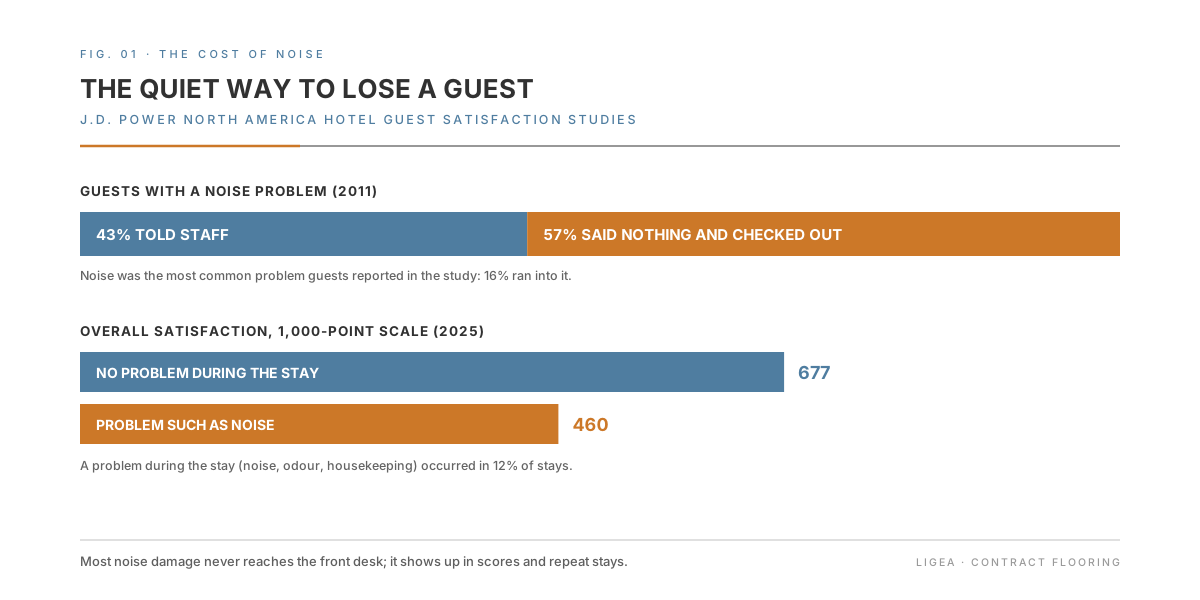
Hotel noise is the guest problem owners hear least about, and that is exactly what makes it expensive. Most guests it bothers never say a word: they check out, write it into a review, and book somewhere else next time. This article looks at noise complaints as an owner's question (what they cost, where they start, and which floor decisions actually move them), and leaves the detailed physics to our guide to carpet acoustics in hospitality.
01The Business Case Nobody Puts in the Deck
J.D. Power's 2011 North America Hotel Guest Satisfaction study found noise to be the single most common problem guests experienced: 16% ran into it. The number that should worry an owner more is the second one. Only 43% of guests who had a noise problem ever reported it to staff. The other 57% simply checked out, and the property never had the chance to put it right.
Sleep is where the same pattern turns into revenue. J.D. Power's 2019 study found that guests who experienced better-than-expected sleep quality scored their overall stay 114 points higher on J.D. Power's 1,000-point satisfaction scale, and only 29% of guests had that experience. Quietness of room sits among the drivers of sleep quality the study measured, alongside bed comfort and room temperature, and unlike a pillow it can't be upgraded at turndown.
By 2025 the pattern had a harder number attached. J.D. Power's 2025 study (n=39,219) found that when a guest experiences a problem during their stay, with excessive noise among them alongside odour and housekeeping issues, satisfaction falls from 677 to 460 on the same scale. That happens in 12% of stays. Noise is one of the few things that can cut a satisfaction score by nearly a third, and in most cases it does that damage without a complaint ever reaching the front desk.
02Where Hotel Noise Complaints Start
For an owner, two kinds of noise matter, and the floor plays a different role in each. Room noise (voices, dishes, a clattering trolley) stays in the room where it is made and is controlled by absorption. Impact noise (footsteps, luggage wheels, a dropped bag) travels as vibration through the floor structure into the rooms below and beside. The two are physically independent, which is why one acoustic figure on a data sheet never answers the whole question; our acoustics guide explains the measurements in detail.
What matters commercially is the asymmetry. A guest room's own echo stays inside that room. A corridor's impact noise does not: every footstep, cart and closing door in the hallway reaches every room along it at once, so one noisy trolley run at 2 a.m. is a whole-floor complaint, not a one-room one. That is why corridors carry the heaviest textile specification in most hotels, and why a concrete floor finished in carpet performs far better on impact sound than one finished in LVT.
03The Guest-Room Hard-Floor Trend and Its Acoustic Bill
Since the pandemic, a real share of guest-room renovations have moved toward hard, easy-to-sanitise flooring in place of wall-to-wall carpet, for hygiene and housekeeping reasons. Trade press coverage of the move toward hard-surface guest rooms is clear about the trade-off: without an equally engineered underlayment, removing carpet reopens the impact-noise problem carpet had been solving, and noise between rooms goes up.
The countermeasure that has become common practice is an overlay rug: a substantial rug over the hard floor exactly where a foot lands, beside the bed and on the path to the bathroom. It restores much of the impact benefit without giving up the easy-clean base, because impact noise is generated where a heel strikes, and that is the one spot the rug still covers.
Corridors have mostly not followed guest rooms down the hard-floor path, for a second reason beyond acoustics: slip resistance. A wet trolley run or a spilled drink on a hard corridor floor is a liability question a soft floor simply doesn't raise.
04The Restaurant: A Room That Turns Its Own Volume Up
If a guest room's noise problem is quiet and invisible, a restaurant's is loud and immediate, and diners rank it accordingly. Zagat's 2018 Dining Trends survey of nearly 13,000 US diners found noise to be the most common complaint about eating out, at 24%, narrowly ahead of poor service at 23%. Crowdsourced sound-level data from SoundPrint puts the average measured restaurant at roughly 78.1 dBA, with 66% of venues logged as too loud for comfortable conversation.
Restaurants get louder as they fill because of the Lombard effect, the reflex that makes people raise their voice against background noise. Research on it found a tipping point at around 58.3 dB(A): below it, voices climb a modest 0.27 dB for every added dB of background noise; above it, that rate nearly doubles, to 0.51 dB per dB. Above the tipping point, every voice raised to be heard becomes background noise for the next table. For an owner, that makes the restaurant the zone where acoustic design pays back fastest, with the floor as one contributor alongside ceiling and wall absorption.
05Zone Decisions for Owners
Each zone is solving a different acoustic problem, and a sensible brief treats them separately:
| Zone | Primary acoustic job | Working target | Why it matters commercially |
|---|---|---|---|
| Corridor | Impact noise + slip resistance | IIC 55+ at the guest-room-facing floor (50 as a hard floor) | One footstep reaches every room along the corridor |
| Guest room | Impact noise between adjacent and stacked rooms | Concrete + carpet ≈ IIC 65–75, vs. roughly 25–35 for concrete + unpadded LVT | The floor is the practical lever short of a structural retrofit |
| Ballroom / multipurpose | Absorption, reverberation control | RT ≈ 1.2–1.5 s (trade consensus for flexible-use rooms) | Has to work for a plated dinner and a mic'd keynote |
| Restaurant | Absorption + diner behaviour (Lombard effect) | Background ideally under ~50 dB(A); stay clear of ~58 dB(A) | Below the tipping point a busy room is lively; above it, it self-amplifies |
The ballroom figure is trade consensus, not code. Two frameworks are useful reference points even though neither was written for hotels: DIN 18041 sets target reverberation times by room use and volume, and the WELL Building Standard's Sound concept sets ceilings of ≤0.5 seconds for open workspaces and ≤0.6 seconds for meeting rooms. Use both as a reference frame, not as a certificate a ballroom is required to hold.
06What Carpet Will and Won't Fix
An honest business case includes the limits. Carpet does little in the low frequencies where most speech sits, so a carpeted meeting room still needs ceiling and wall absorption to become quiet for conversation. Its strength is impact noise: it removes the excitation where a heel meets the floor, before it becomes a structure-borne problem in the room below.
The headline lab figures also need context. Laboratory impact-sound reductions for carpet, such as Fraunhofer IBP's ΔLw of 16.6 to 32.7 dB, are measured on a bare reference concrete slab. On the floating screed a real hotel floor is built on, the added benefit compresses to roughly 2–15 dB, because the screed is already doing much of the work; thick, dense constructions keep the larger share of that margin. Knowing which number applies to which floor is most of what a sound acoustic brief is.
07Where ligea Comes In
We plan acoustics zone by zone, not as one figure for the whole hotel. In corridors that usually means a dense woven Axminster at 7×9 or higher on a suitable underlay, so impact noise stays out of the rooms along the hallway; in guest rooms, carpet or a generous hand-tufted overlay rug from our Royal family where the scheme keeps a hard floor. We are open about what the floor can and cannot fix in a room that also needs its ceiling and walls to go quiet, and because we work with several producers, each zone gets the construction that suits it.
Explore our surfaces and constructions, or talk to us about acoustic zoning for your next project.