
Carpet Acoustics in Hospitality: Impact Noise and Guest Comfort
How hospitality carpet really performs acoustically — impact-sound reduction (IIC/ΔLw) versus sound absorption (NRC/αw), the role of pile, weight and underlay, and the targets that matter for guest comfort.
Noise sits at the top of every guest-satisfaction debrief, year after year — footsteps from the room above, a cart down the corridor at 6am, the slam of a neighbour's door. Flooring is one of the few levers a designer controls that measurably moves that complaint, and carpet is the quiet workhorse of the discipline. But the way carpet is sold acoustically — "it soundproofs the room" — is mostly wrong, and that single misconception leads to spec sheets that promise comfort the floor cannot deliver. The useful starting point is to understand exactly which acoustic job carpet does well, which it does only modestly, and which it cannot do at all.
01Two Different Jobs, Two Different Metrics
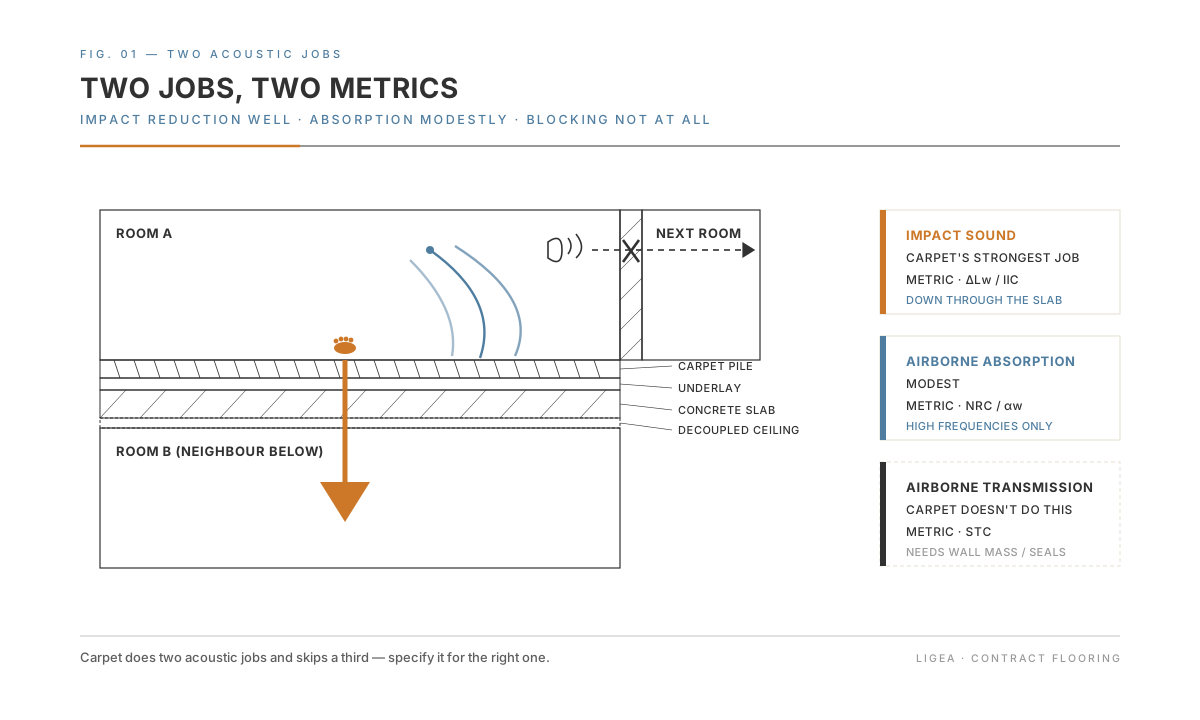
The most common error in acoustic specification is treating "noise" as one problem. Carpet does two distinct acoustic jobs, measured by two unrelated metrics — and it does a third job barely at all.
The first is impact sound reduction: the footfall, dropped object or rolling cart that transmits through the floor to the room below. This is carpet's strongest and most reliable benefit. In Europe it is captured by the weighted impact sound improvement index ΔLw — the frequency-dependent reduction is measured in the laboratory under ISO 10140-3, then weighted into the single-number ΔLw under ISO 717-2; in North America by Impact Insulation Class (IIC), lab-tested to ASTM E492 and field-verified as AIIC/FIIC under ASTM E1007.
The second is airborne sound absorption: how much reverberation and echo the surface soaks up within a room. This is measured by Noise Reduction Coefficient (NRC) — the average absorption at 250, 500, 1000 and 2000 Hz — or the European αw (measured per ISO 354 and rated under EN ISO 11654). Carpet helps here, but only modestly, and mostly at high frequencies.
The third job carpet simply does not do: block airborne sound travelling between rooms — voices and music through a wall or floor-ceiling assembly. A carpet reduces impact sound but offers no significant insulation against airborne sound. Blocking transmission needs mass, decoupling and sealed gaps — wall construction (rated by STC) and door perimeter seals — not floor finish. Specify carpet to fix a "voices through the wall" complaint and you will solve the wrong problem.
02Where Carpet Is Genuinely Powerful: Impact Sound
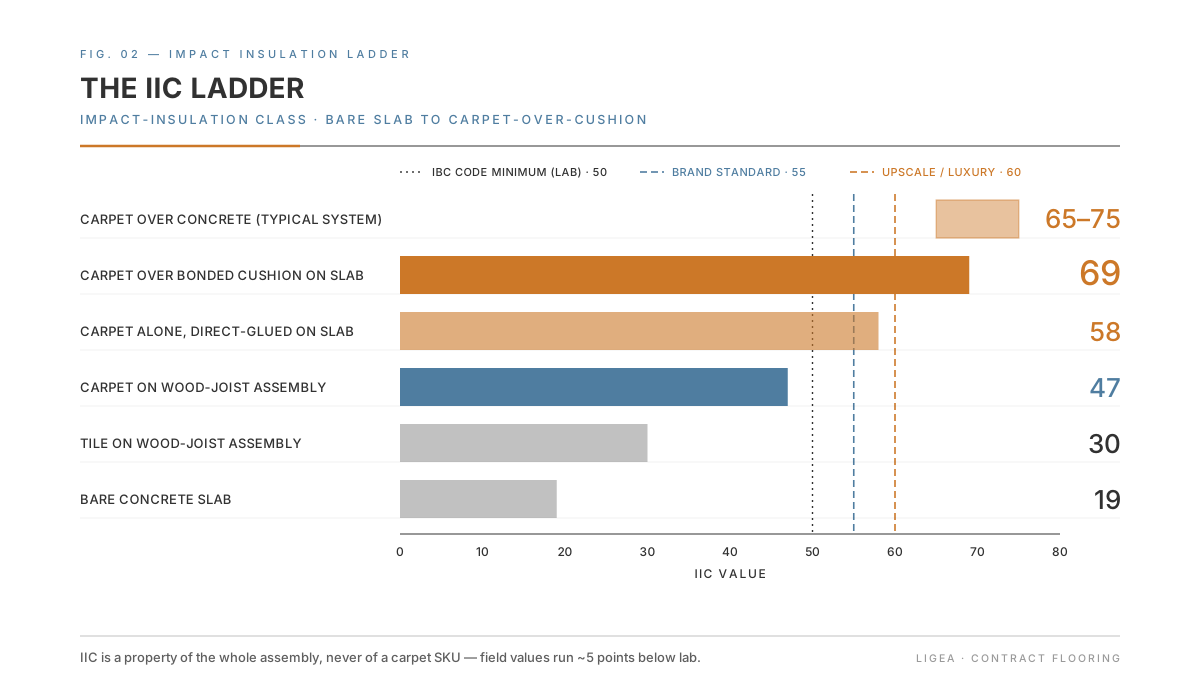
On impact sound, the numbers are decisive. On an identical structural assembly, carpet typically adds 20 or more IIC points over a hard finish like tile or LVT — though modern LVT with an attached acoustic backing narrows that gap. In one cited comparison, a wood-joist assembly scored IIC 47 with carpet versus IIC 30 with tile, a 17-point spread.
The starkest illustration comes from a Carpet Cushion Council–sponsored slab test conducted by Intertek: a bare slab measured IIC 19, carpet alone (direct-glued) jumped to IIC 58, and carpet over a bonded cushion reached IIC 69 — with companion absorption testing showing a cushion roughly doubling sound absorption, from NRC 0.25 to 0.50. Independent Carpet & Rug Institute laboratory data confirms the same pattern: a bare slab rates poorly, carpet alone lifts impact insulation by tens of IIC points, and a cushion adds more still (Carpet & Rug Institute). In broad terms a soft floor cuts footfall noise by more than 20 dB where a hard floor manages only a few, and for intuition a 10 dB change is heard as a doubling or halving of loudness.
Manufacturer spec sheets put hard ΔLw figures on this. Engineered carpet-tile backings commonly publish impact reductions in the 24–28 dB range, with high-performance acoustic backings reaching up to 29–33 dB. The same vendors' hard-surface products tell the other half of the story: an LVT with an engineered acoustic backing reaches only around 16 dB — confirming that hard floors need substantial help to approach what carpet does inherently.
03The Targets That Matter for a Hotel
So what should a specifier actually aim for? The IBC code minimum is IIC 50 (lab-tested) for floor-ceiling assemblies between guestrooms and between a unit and a public corridor — with a field-tested equivalent of 45 (International Building Code, Section 1206). But code is the floor, not the goal. The widely cited industry and brand-standard target for hotel guestroom floors is IIC 55+, with upscale and luxury properties specifying IIC 60+; guestroom and corridor walls typically run STC 50–55.
Two cautions separate the brochure from the building. First, IIC is a property of the whole assembly, never of a carpet SKU. Slab thickness, ceiling decoupling and underlay are all tested together; swap any one and the published number is meaningless. A carpeted floor over concrete commonly reaches IIC 65–75, but that figure belongs to the system, not the roll. Second, the IIC 50 code minimum is a lab value; real-world field performance typically runs about five points lower, and hard-surface flooring is repeatedly named the leading cause of IIC failures in the field. Specify to lab numbers and you may miss them on site.
There is a corollary every renovation team should price in: switching a carpeted floor to wood-look LVT or tile for cleanability drops floor-ceiling impact performance by roughly 15–25 IIC points overnight — the single biggest real-world source of new footfall complaints in hotel and multifamily conversions. If a brand goes hard-surface, budget for an acoustic mat or expect the calls.
04Absorption: Useful, but Don't Oversell It
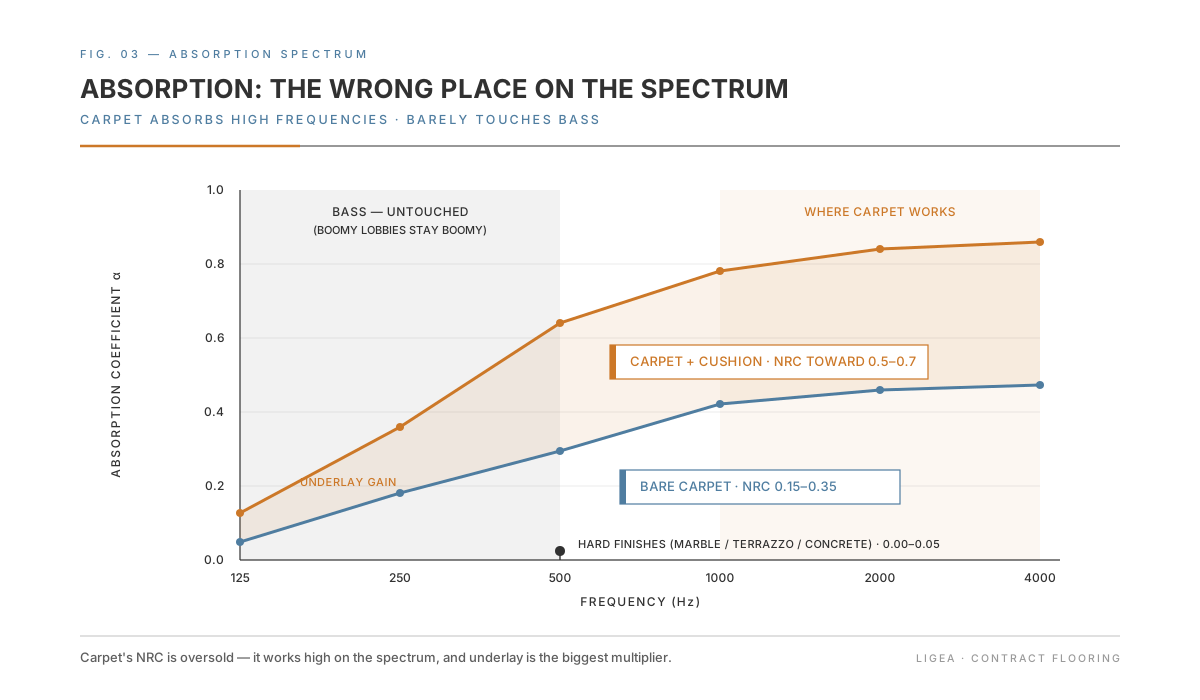
Where carpet is often over-sold is room absorption. Plain commercial carpet has a low NRC — typically 0.15–0.35, meaning it absorbs only about 15–35% of airborne sound, and almost nothing at low and mid frequencies. It absorbs high frequencies — footsteps, the hiss of chatter — well, but the absorption sits in the wrong place on the spectrum: a carpeted lobby or ballroom can still be boomy because the bass is untouched. For comparison, that 0.15–0.35 still dwarfs hard finishes — smooth concrete, marble and terrazzo sit near 0.00–0.05 — but it is no substitute for proper broadband treatment where speech intelligibility or reverberation control is the goal.
That said, the modest number understates how useful carpet can be as a first move. In practice, specifiers often find that when a meeting room or restaurant simply sounds harsh, operators reach first for wall and ceiling panels — yet putting a soft floor in the main walking path, or a bound rug under the conference table, can deliver a surprisingly large drop in perceived harshness for far less disruption, because it turns one of the room's biggest hard surfaces into an absorber. The mechanism is the same porous-absorber physics: a thin soft layer over a hard slab works mainly in the mid-to-high band, taming the footfall, clatter and edge of speech that make a space feel sharp. The honest limit still holds — conventional porous absorbers perform poorly at low frequencies unless the layer is very thick — so the carpet alone will not settle a boomy, bass-heavy room or block voices through the wall. As an opening, low-effort intervention it often closes much of the gap; as the only intervention in a genuinely reverberant volume, it leaves the panels still to do.
Construction does move the absorption number, in ways worth knowing:
- Cut pile generally absorbs more than loop, because the open surface lets sound waves penetrate.
- Backing permeability is the lever most specifiers miss: sound must pass through the backing to reach the cushion, so a heavy, sealed secondary backing suppresses NRC while a permeable one raises it.
- Underlay is the single biggest absorption multiplier. Putting carpet over a quality permeable cushion can lift combined NRC from the 0.15–0.35 bare range toward 0.5–0.7, with permeable hair, hair-jute and foam-rubber pads outperforming dense closed ones (Carpet & Rug Institute).
A separate acoustic underlay is itself rated by ΔLw, with roughly 40 dB and above treated as the threshold for meaningful impact reduction. One marketing trap to watch: some pads quote a headline "soundproofing dB" that actually refers only to airborne reduction on concrete — not the impact-improvement figure that matters underfoot.
05What Wears Out, and Where It Matters Most
A final reality the spec sheet rarely shows: acoustic performance decays with the pile. As corridor carpet crushes under 24/7 traffic and cart wheels, the absorption you specified is not what you measure in year three — an argument for denser, higher-twist, heavier wear-rated constructions specifically in corridors, the number-one complaint zone in any hotel. And carpet only ever addresses the footfall half of the corridor problem; the door-slam and "corridor chatter" that travel by air are tamed by door perimeter seals, not the floor. Treat carpet as one layer in an acoustic system — paired with the right ceiling, underlay and seals — and it earns its keep. Treat it as a cure-all and it disappoints.
06Where ligea Comes In
Most acoustic briefs are really three things at once: a designer's vision for how a space should look and feel, an operator's budget, and a floor that has to perform under a specific kind of traffic and structure. Our job is to read all three and translate them into the right construction — not to oversell what a carpet can do. For schemes where look and durability lead, we specify woven Axminster in 80/20 wool-nylon or 100% wool, built to a defined pitch and rows — from guestroom weights of around 1,050 g/m² up to airport-grade densities near 1,880 g/m², in up to sixteen colours, with matt-and-gloss zoning, refined edge binding, an IMO-marine version for cruise, and constructions reaching EN 13501-1 Bfl-s1. Where a design lives on gradient, photographic detail or a very wide colour range, we move to printed 100% nylon, working from pre-mixed colours with no pattern-repeat limit, accepting the sharpness-versus-pile trade-off knowingly.
Because we work across multiple producers rather than a single loom or print line, we can match the brief to the construction and the maker — heavier, higher-twist weights where corridor traffic and acoustic durability demand it, lighter builds where they do not. Both come as broadloom rolls, cut-and-bound rugs or modular tiles, with custom colour matched to Pantone TCX, NCS, RAL or a physical sample and proven on a physical strike-off. Bulk lead times vary by construction — typically two to four weeks for printed nylon and three to eight weeks for woven Axminster — after design, colour, strike-off and mockup are signed off, with AI-assisted rendering compressing the approval rounds that usually slow a project down.
---
ligea engineers contract surfaces for hospitality projects worldwide — matched to your design, your construction and your budget. To get the acoustic spec right from the start, see our surfaces or book a 15-minute spec call.