
Marine and Cruise Carpet: The IMO FTP Code, Decoded
What IMO-certified marine carpet actually requires: the 2010 FTP Code Parts 2 and 5, MED Wheelmark and Module B+D, and why a hotel fire cert never crosses the gangway onto a SOLAS ship.
A cruise ship is a floating hotel until the moment something catches fire, and then it is a steel box full of people a long way from a fire brigade. That single fact is why the carpet under a guest's feet on a SOLAS vessel is governed by a different rulebook than the identical-looking carpet in the resort that owns the brand. Specifiers who come to marine work from hospitality routinely make the same mistake: they bring a beautiful land carpet, a stack of fire certificates, and a confident assumption that "fire-rated" is fire-rated. It is not. A hotel cert pack does not cross the gangway. This guide decodes what actually does.
01Why Marine Is Its Own World
Fire at sea has no easy exits. There is no stepping outside, no perimeter the brigade can attack from, no quick evacuation onto a pavement. Egress runs down internal corridors and stairwells that fill with smoke, and rescue may be hours away. So the maritime fire regime is built around a harder premise than any building code: limit how fast a surface spreads flame, and limit how much smoke and toxic gas it puts into the very corridors people must escape through.
That regime is set by the International Convention for the Safety of Life at Sea (SOLAS),-1974.aspx), the master safety treaty administered by the International Maritime Organization. SOLAS Chapter II-2 governs fire protection, and it hands the actual test methods to two companion documents: the FSS Code (the International Code for Fire Safety Systems) and the FTP Code, the 2010 International Code for Application of Fire Test Procedures. When a marine specification calls for a "low flame spread" floor covering, that phrase has a precise meaning defined by the FTP Code, not by the designer's intuition.
The first thing to settle on any project is whether SOLAS even applies. As a working rule, SOLAS applies to passenger ships on international voyages of effectively any size, and to cargo ships of 500 gross tonnage and over,-1974.aspx) on international voyages. Cruise ships, ferries, RoPax and offshore accommodation vessels sit squarely inside it. Private pleasure yachts not engaged in trade generally sit outside SOLAS, and yachts above 24 m typically fall under flag-state large-yacht codes (the UK's Large Yacht Code is the best-known) that use SOLAS as a basis with certain equivalencies. The practical upshot: even where SOLAS is not strictly mandatory, serious superyacht builders specify marine-certified materials anyway, because the classification society and the flag administration usually demand it regardless. So in practice the FTP Code reaches well past the legally-mandated fleet.
02The FTP Code, Part by Part, and the Two That Catch Carpet
The 2010 FTP Code is organised into parts, each a self-contained test for a different fire behaviour. Intertek's overview lays them out: Part 1 non-combustibility, Part 2 smoke and toxicity, Part 3 fire resistance of divisions, Part 4 fire-door control systems, Part 5 surface flammability, Part 6 (left blank), Part 7 vertically supported textiles and films, Parts 8–9 upholstered furniture and bedding, and Parts 10–11 covering high-speed-craft materials. A textile floor covering is touched mainly by two of these, and missing the second is the classic marine error.
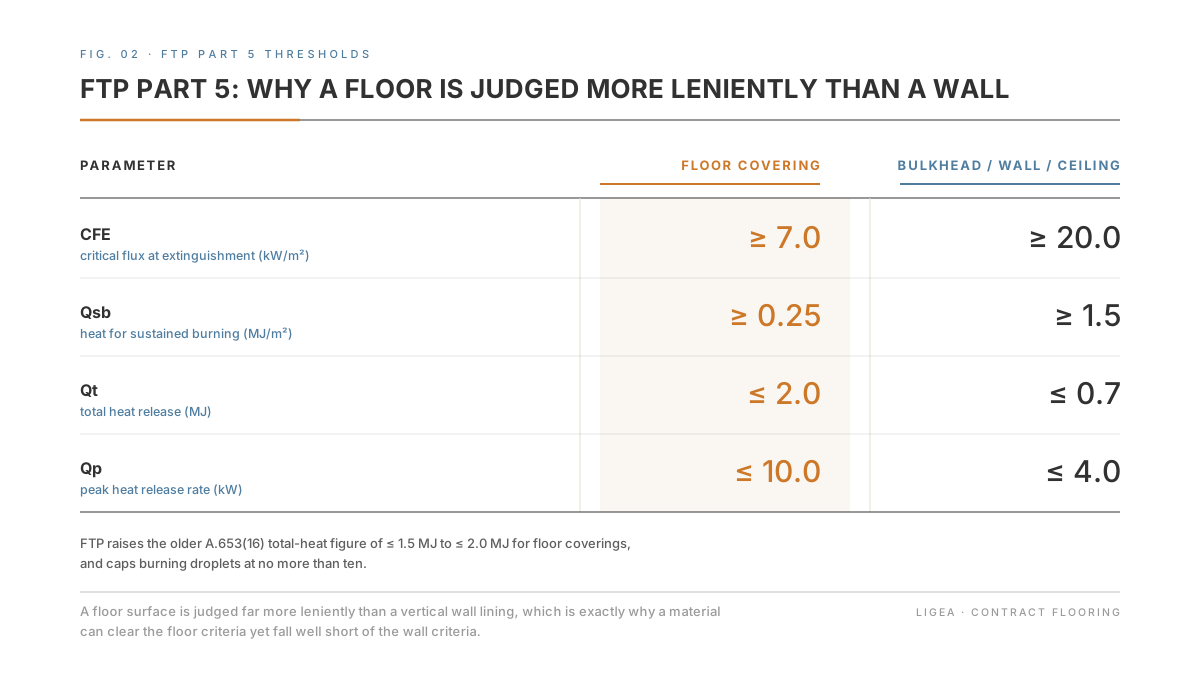
Part 5: surface flammability. This is the headline test, and the reason a land carpet usually fails to qualify. Following the apparatus and method historically rooted in IMO resolution A.653(16) (the same lineage as ISO 5658-2), a sample is mounted and exposed to a radiant heat panel that drives a controlled flame front along its surface. At least three specimens are run, and the lab measures how the flame travels, how much heat the material releases, and whether it drips burning material. Per the published FTP Part 5 criteria for floor coverings, the parameters reported are the critical flux at extinguishment (CFE) in kW/m², the heat for sustained burning (Qsb) in MJ/m², the total heat release (Qt) in MJ, and the peak heat release rate (Qp) in kW. For floor coverings (primary deck coverings) specifically, the published qualifying thresholds are CFE ≥ 7.0 kW/m², Qsb ≥ 0.25 MJ/m², Qt ≤ 2.0 MJ, and Qp ≤ 10.0 kW, markedly less demanding than the bulkhead, wall and ceiling case (CFE ≥ 20.0 kW/m², Qsb ≥ 1.5 MJ/m², Qt ≤ 0.7 MJ, Qp ≤ 4.0 kW). The FTP Code reaches this floor-covering set by explicitly replacing the A.653(16) total-heat-release figure of ≤ 1.5 MJ with ≤ 2.0 MJ for floor coverings, and it caps burning droplets at no more than ten. Any live project should still confirm the figures against the current FTP Code text and the testing laboratory, but the floor-vs-wall distinction is the durable point: a floor surface is judged far more leniently than a vertical wall lining, which is why the criteria differ by application, and why a material can clear the floor criteria yet fall well short of the wall criteria.
Part 2: smoke and toxicity. This is the part people forget, and on a passenger ship it is arguably the more important of the two. Using a method aligned with ISO 5659-2, the material is heated under several radiant conditions and the optical density of the smoke is measured, alongside the concentration of toxic gases. The FTP Code sets maximum permitted concentrations for a panel of gases: carbon monoxide, hydrogen chloride, hydrogen fluoride, hydrogen cyanide, hydrogen bromide, nitrogen oxides and sulphur dioxide among them. The logic is brutally simple: smoke disables egress before flame does. A floor covering can be hard to ignite and still produce a smoke or gas profile that fails Part 2, so on accommodation, service and control spaces, a marine floor covering needs both parts cleared.
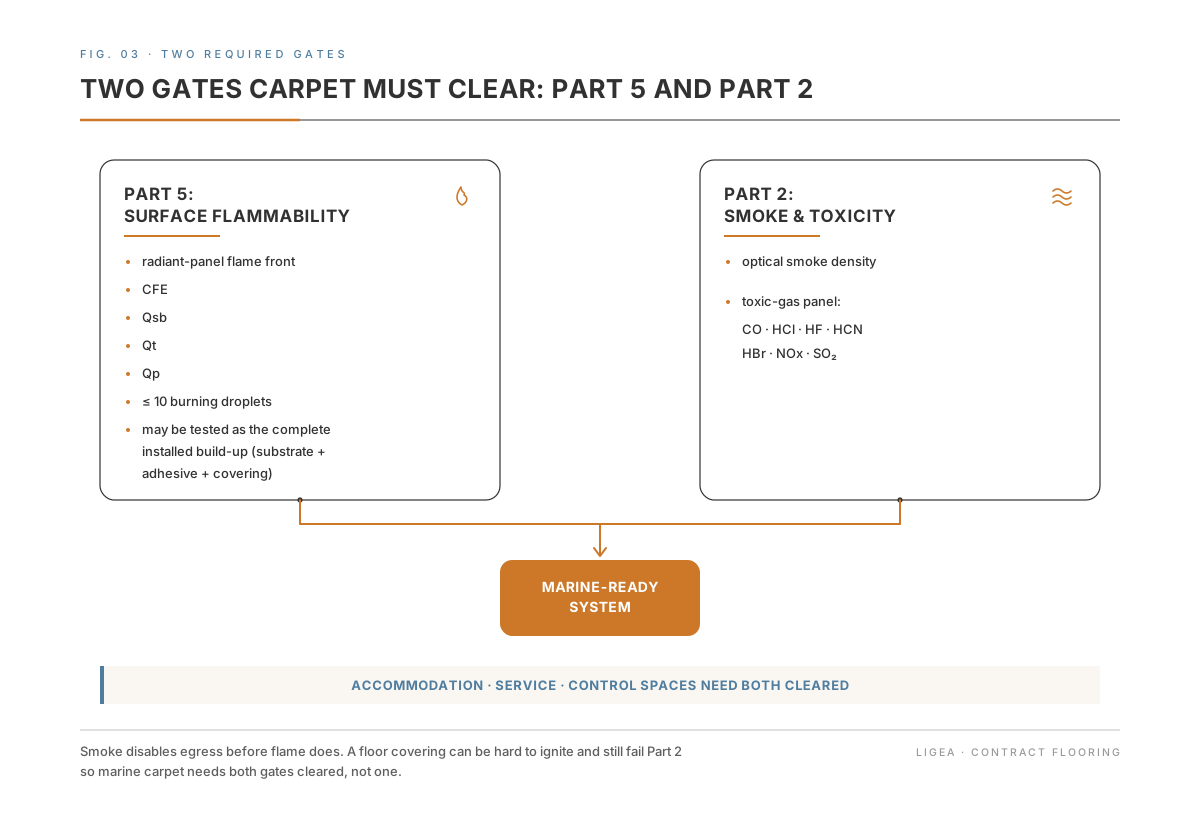
A third subtlety trips up vinyl and resilient systems more than textiles, but is worth knowing: Part 5 can be applied to the complete installed build-up (substrate, adhesive and covering tested together as a system), not just the wear layer in isolation. As marine-flooring certification practice makes clear, you cannot take a Part-2-approved finish, bond it to an arbitrary subfloor with an arbitrary adhesive, and assume the assembly is compliant. For carpet the adhesive and underlay choice is therefore part of the certified scope, not a site decision left to the fitter.
03From Test Report to Wheelmark: Certification Is Not the Same as Testing
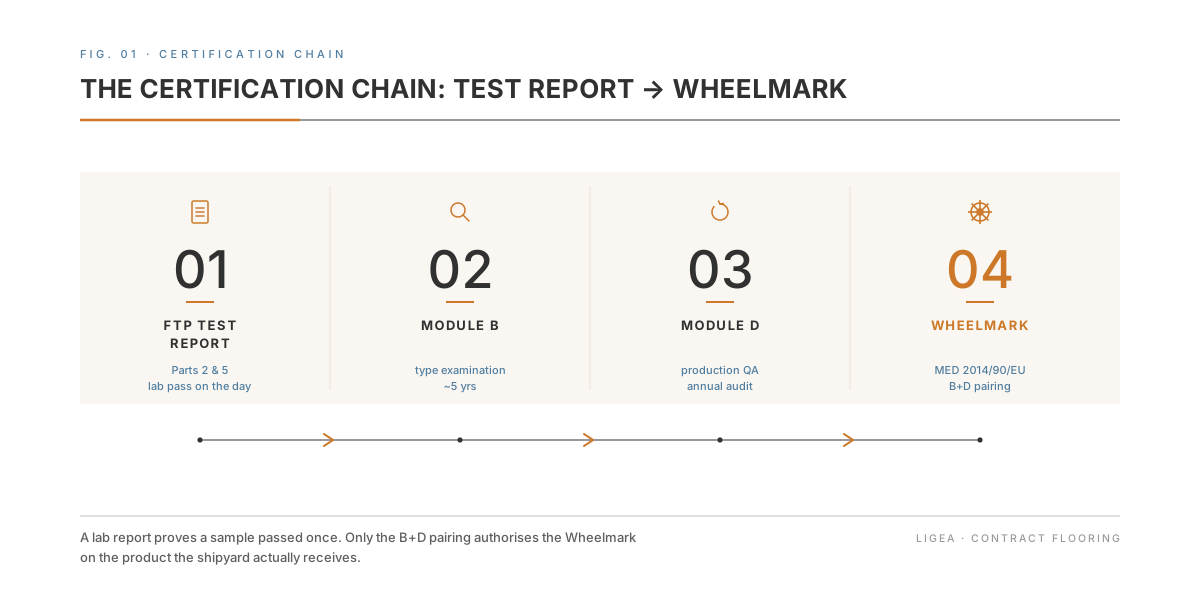
Here is the distinction that separates a compliant marine spec from a near-miss, and it is the single most common pitfall on the buyer side: a passing FTP test report is not the same as marine certification. A lab report proves a sample passed on the day it was tested. It says nothing about whether the product the shipyard actually receives matches that sample, and that gap is exactly what the European conformity regime exists to close.
For EU-flagged vessels, and in practice for most serious marine work regardless of flag, the relevant instrument is the Marine Equipment Directive (MED) 2014/90/EU and its conformity mark, the Wheelmark: a small ship's-wheel logo followed by the four-digit number of the Notified Body that issued the certificate. The Wheelmark is built on two modules working together:
- Module B: type examination. A Notified Body reviews the FTP test evidence and certifies that the product type conforms. Module B certificates are typically valid for around five years and renewed via repeat testing.
- Module D: production quality assurance. The same body audits the factory annually to confirm that every production run still matches the approved type. Lapse the Module D audit and the manufacturer can no longer legally apply the Wheelmark to new production, even if old stock still carries the printed logo.
It is the B+D pairing that authorises the Wheelmark on real product. The four-digit number identifies the issuing body; the EU's NANDO database holds the authoritative list, and several major classification societies act as Notified Bodies for marine flooring. A Wheelmark reference reads in a format such as `MED/3.18a/EC0062-...`, where the module/item reference and body number let you trace the certificate in that body's public register.
The common verification failures are worth committing to memory because every one of them produces paperwork that looks fine:
- A test report with no Wheelmark certificate behind it: the product passed a lab but never completed Notified-Body review.
- An expired Module B still showing a logo on old stock.
- A valid Module B with a lapsed Module D factory audit: the type is fine, but current production is uncontrolled.
- A scope mismatch: a finish certified under Part 2 only, where the project actually needs the full system certified under Part 5.
The defensible move is to request, per shipment: the current Module B certificate with its validity dates, the annual Module D audit certificate, an EU Declaration of Conformity, and the underlying FTP test reports for Part 2 and (where applicable) Part 5, then verify the certificate number in the issuing body's online register rather than trusting the printed logo.
On the US side, the Coast Guard runs its own approval lineage and historically referenced the A.653 surface-flammability method through NVIC guidance, so a vessel under US flag may call for USCG-approved materials specifically; the underlying physics is shared with the IMO method, but the approval paperwork is a separate track and should be confirmed for the flag in question rather than assumed equivalent.
04Why a Hotel Cert Never Crosses the Gangway
This is the heart of it, and it is worth stating plainly because it derails projects. A land carpet's fire certificates are real and rigorous, and irrelevant on a SOLAS ship.
A European hotel carpet is classified to EN 13501-1, typically Cfl-s1 or Bfl-s1, via a radiant-panel test (EN ISO 9239-1) and an ignitability test, with CE marking under EN 14041. A US hotel corridor carpet is qualified to ASTM E648 / NFPA 253 Class I, plus the methenamine pill test as a baseline. Both regimes are sound. Neither is the FTP Code. They use related radiant-panel physics, but different apparatus, different sample conditioning, different acceptance thresholds and, critically, neither building-code regime systematically tests the toxic-gas panel that FTP Part 2 demands. A Bfl-s1 rating is sometimes described as roughly comparable in spirit to a marine pass, but "roughly comparable" is not a certificate a flag-state surveyor accepts. The cross-walk does not exist on paper.
The fibre choice is where land and sea quietly converge, though. The hospitality default, 80% wool / 20% nylon or 100% wool, happens to be a strong starting point for marine work too, because wool is naturally flame-resistant: its high moisture and nitrogen content give it a high ignition temperature (around 560–600 °C) and a tendency to self-extinguish rather than melt and drip. That helps a construction reach FTP thresholds with less aggressive chemical treatment, which in turn helps the Part 2 toxicity numbers. Natural flame resistance is a head start, not a certificate (the assembly still has to be tested and Wheelmarked), but it explains why so much high-end marine carpet is wool-rich.
A practical reality from the field is worth carrying into procurement: certification governs the material, but installed performance on a ship still depends on the same fundamentals that decide a corridor on land: backing and adhesive system, seam placement along the direction of travel, pattern rapport across a long ribbon of deck, and a maintenance regime for a floor that never gets a quiet weekend. Marine simply adds a hard gate in front of all of it. Clear the gate first; the carpet only earns a place on the deck once the certificate is real, current and scoped to the actual installed system.
05Where ligea Comes In
For marine work we start from the regime, not the swatch: the IMO 2010 FTP Code (Parts 2 and 5) is part of the brief from day one, and the adhesive and backing are treated as part of the certified system rather than a site decision.
We supply IMO-certified carpet in two constructions: woven Axminster, in 80/20 wool-nylon or 100% wool, and hand-tuft from our Royal family for suites, lounges and signature pieces. We check the certificate chain (test report, Module B, Module D, Wheelmark) against the project scope before the strike-off, and custom colour is matched to Pantone TCX, NCS, RAL or a physical sample and confirmed on a strike-off before bulk.
Working a cruise, ferry or superyacht spec? Explore our surfaces or book a 15-minute spec call.