
Rug Shapes for Hotels: Rounded Corners, Oval, Round and Free-Form
How to choose a hotel rug shape: three corner radii, stadium, oval, round and free-form pebbles, how the radius scales with the rug, which construction draws which contour, and how to hand planners DXF and SVG outlines.
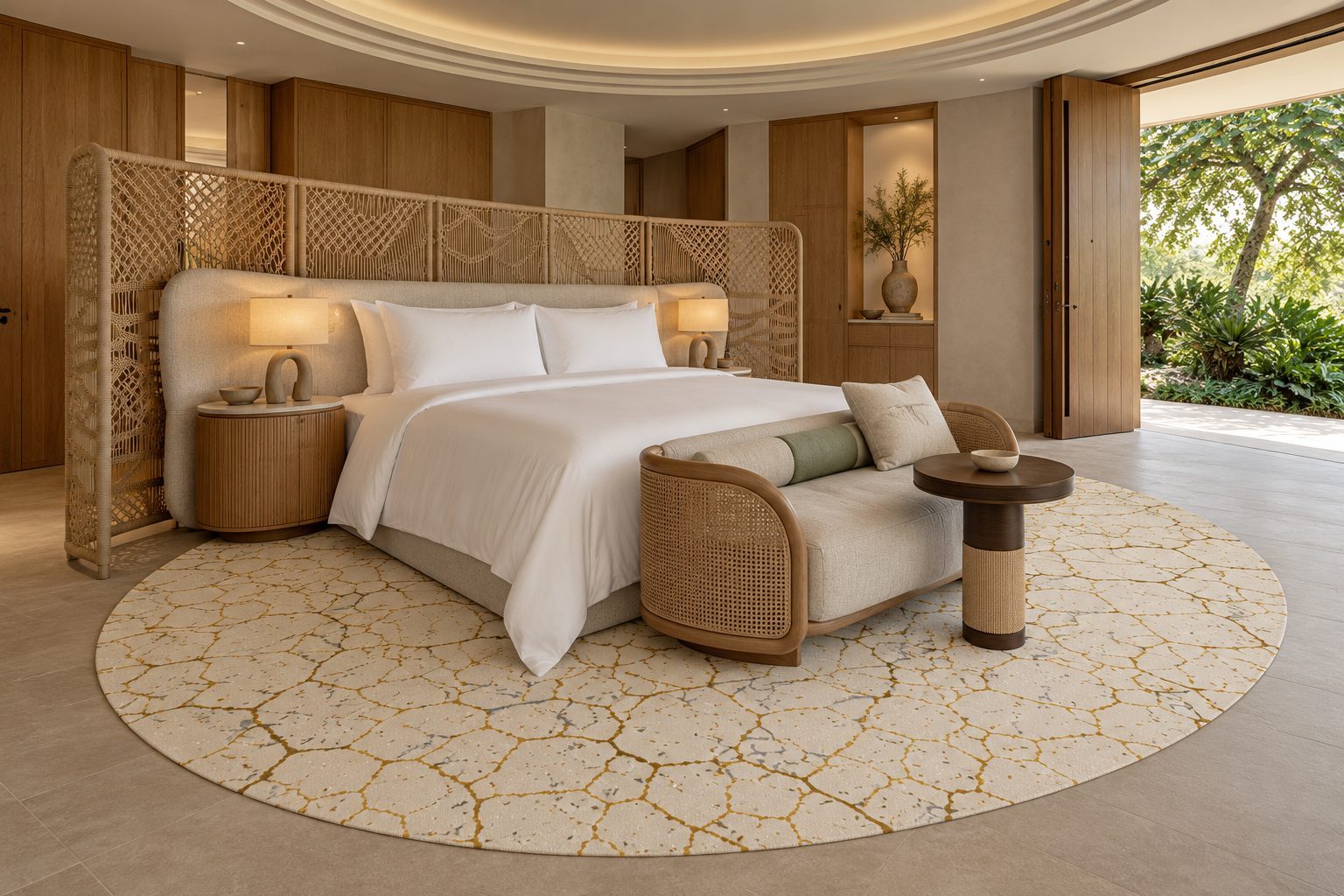
Walk through a recent hotel lobby and the furniture has already softened. Sofas curve, lounge chairs are round, coffee tables are ovals, arches replace door frames. Then you look down, and a rectangle with four sharp corners sits under all of it. The rug argues with the room it is meant to anchor.
The ligea trend report 2027 puts a number on the gap. Curved sofas, round tables and arches shape about one interior in three, while only about one rug in seven is round or free-form. The room curves, the rug mostly does not. This piece is about closing that gap with a specification that stays practical: which shapes exist, how big a corner should be, what each construction can draw, and what a planner needs on the drawing board.
01Why the furniture got rounder and the rug stayed square
A large part of the answer is habit. A rectangle is the default in every drawing and every size chart, and a shape that is not a rectangle sounds like a custom job. In a made-to-measure rug it does not have to be one: the outline is a drawing decision, and in a library with set templates it is no manufacturing exception.
The visual case is simple. A curved sofa, a round table and a pair of barrel chairs form a group with no straight edges, and a rectangular rug beneath them leaves corners nobody uses. A rounded outline follows the group.
02Three radii, the stadium, the oval and the free forms
The ligea shape library works from ten outlines. Three of them are rectangles with rounded corners, which is where most hotel projects start:
- Soft corners have a radius of 1/16 of the shorter side. The rug still reads as a rectangle, with the hard edge taken off.
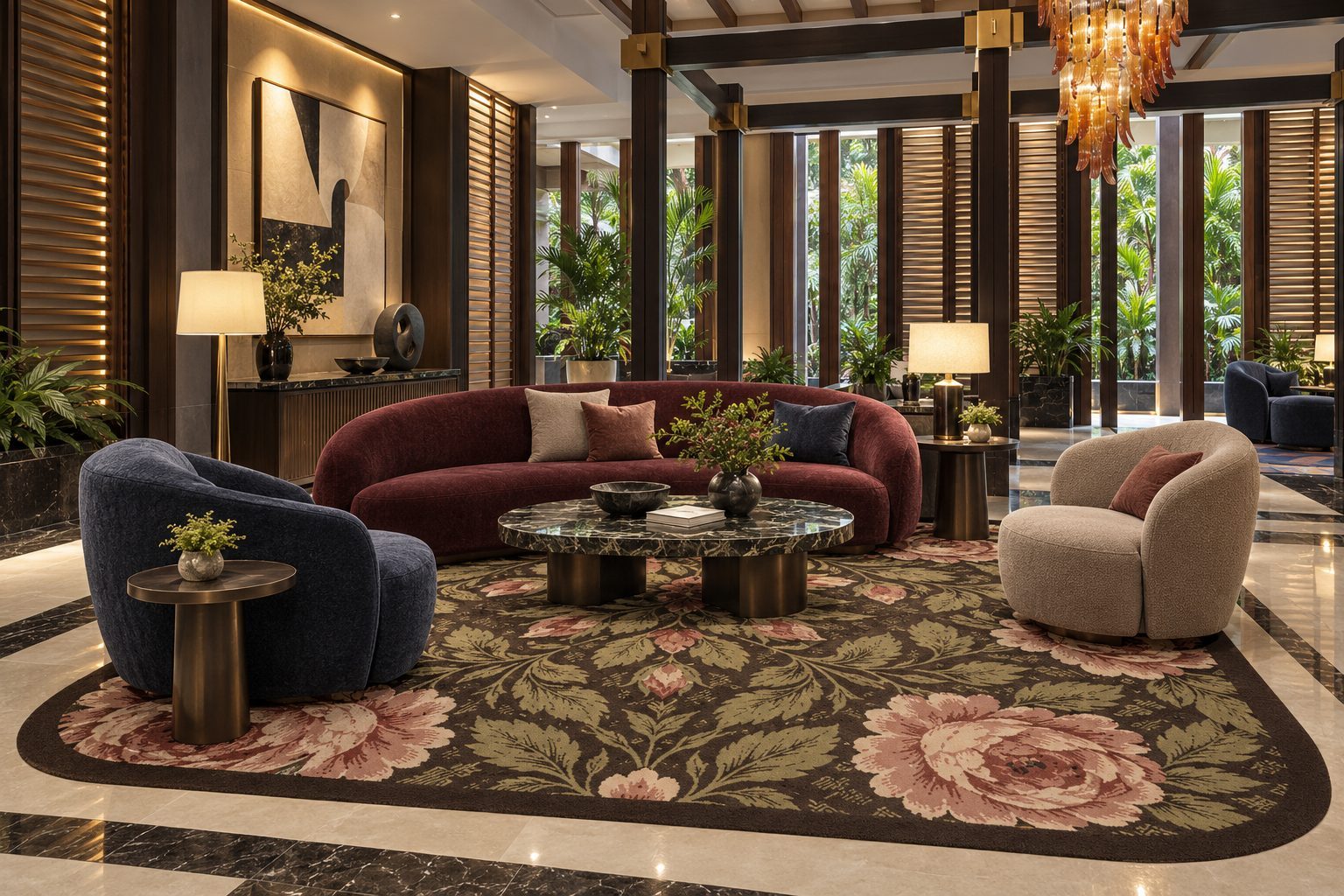
- Standard corners have a radius of 1/8 of the shorter side. This is the main shape and the safe first choice.
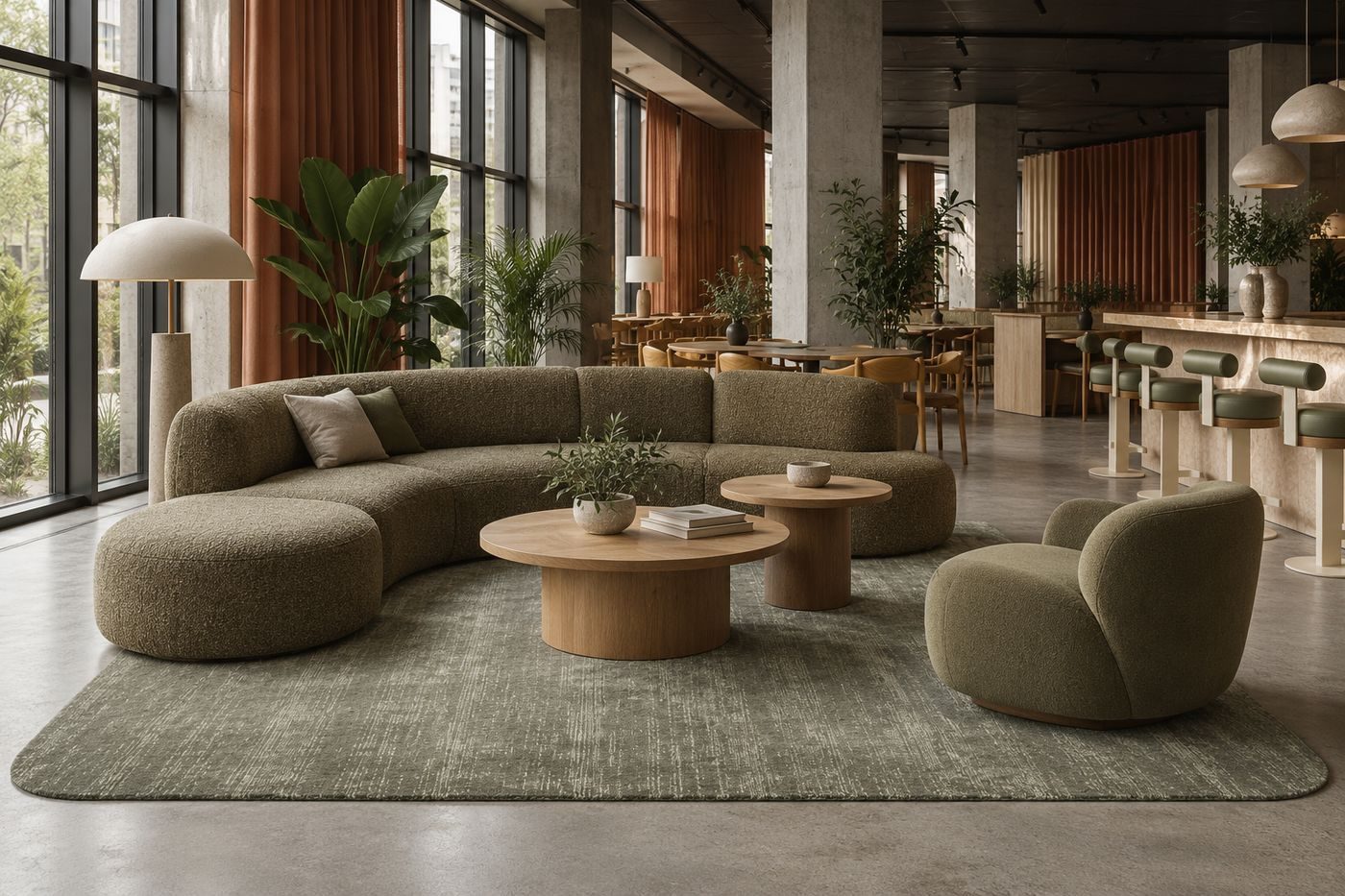
- Organic corners have a radius of 1/5 of the shorter side. The corner is generous enough that the rug starts to look like a soft cushion of floor.
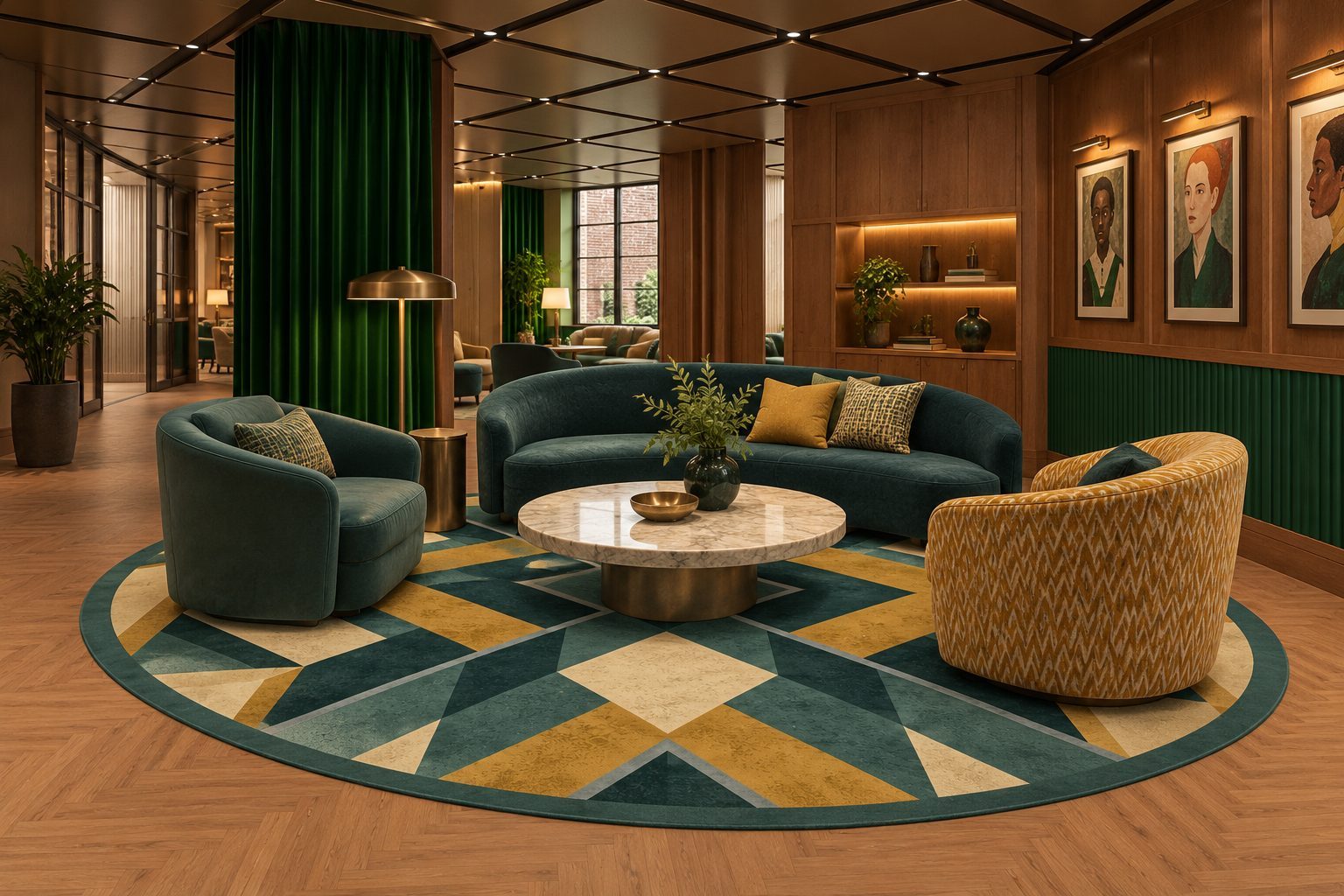
Beyond the corners sit the classic geometries. The stadium has straight long sides and short ends that are a full half circle. The oval is a true ellipse, the round rug a circle, and the rectangle with square corners stays in the library for the places where it is right. Three free-form pebbles complete the set: River, a flat stone with one almost straight side, Lagoon, asymmetric with one wide round end, and Leaf, tapering softly to both ends.
Choosing between them is mostly a question of what the furniture does. A round table with four chairs wants a circle. A long curved sofa with a facing pair of chairs wants a stadium or an oval, or a rectangle with organic corners if the room is formal. A seating group with no clear axis, the kind a lounge often has, is where a pebble earns its place. The full library is on the rug shapes page, and every outline is available in every production method.
03How the radius grows with the rug
A corner radius that looks right on a small rug is wrong on a large one, and the other way round. A fixed radius makes a small rug look oval and a large one look heavy. For that reason the radius is not a single number. It is a proportion of the shorter side, rounded to 5 cm and held within limits for each level: 10 to 25 cm for soft corners, 15 to 50 cm for standard corners and 25 to 80 cm for organic corners.
In practice the numbers look like this:
| Format | Soft | Standard | Organic |
|---|---|---|---|
| 170 × 240 cm | 10 cm | 20 cm | 35 cm |
| 250 × 350 cm | 15 cm | 30 cm | 50 cm |
| 400 × 600 cm | 25 cm | 50 cm | 80 cm |
The standard corner of a 170 × 240 cm rug is 20 cm, and that of a 400 × 600 cm rug is 50 cm. Both follow the same eighth of the short side, so they read as the same shape at two scales. The same rule sets the radius for a rug in your own dimensions, so a rug made for a particular alcove or seating group does not need a hand-drawn corner.
Round rugs come in diameters from 150 to 400 cm, and the stadium, oval, rectangle and the three pebbles follow the same standard formats as the rounded rectangles.
Check the corner against the furniture that will meet it, not on the plan view alone. A sofa leg or a table base that lands on a corner shows quickly whether the radius is large enough.
04Which construction can draw which contour
All three constructions can make all ten shapes. What changes is how the contour and the drawing inside it behave, and the trend report is direct about it.
Round, oval and free shapes can be tufted to size or cut and bound from Axminster or printed carpet. A hand-tufted rug is made to size in almost any dimension, limited in practice by transport, and hand-tufting gives the sharpest contour. It can also add relief along the curve, with cut and loop in different areas of one rug, which Axminster cannot do. Cut and bound pieces stay within the standard roll width of 4 m, and cutting and binding adds about a week to the schedule.
The difference lies in the drawing, not in the outline. Curves inside an Axminster drawing step slightly along the tuft grid, so a flowing motif is rendered a little more coarsely than in hand-tuft. In Axminster, ask for the gauge: the finer it is, the smoother the curve. Print works with soft contours and smooth gradients, and it is the more economical option when budget and calendar are tight.
A plain rug is a good base for a bold outline. ligea's plain rugs come in velvet and tip-sheared, hand-tufted or hand-woven, in any colour from your scheme. With a single colour and a pile that catches the light, the shape does the work and no motif competes with it. The comparison of hand-tufted and machine-woven carpet sets out the strengths of each construction, and the qualities page lists the hand-tufted range.
05Handing the outline to a planner
A shaped rug has to appear on the floor plan before it appears on the floor. The furniture is placed around it, and the shape needs to be a real outline, not a sketch.
For that reason every library shape is available as a DXF and an SVG in every standard size. The DXF is in centimetres, with the outline as one closed polyline. The SVG is drawn at a scale of 1:10, so 1 mm in the file is 1 cm on the floor. Each outline comes from one exact template per shape and size, so the drawing and the rug start from the same geometry.
A good brief for a shaped rug names the shape, the size and, for rounded corners, the radius level. In the ligea configurator all three travel with the project request, so the size, the corner and the design arrive together. Where a project needs a form outside the library, any other shape is available on request, and the custom carpet process explains how a drawing becomes a strike-off and a mock-up.
06Where ligea Comes In
We offer ten shapes in a library: three corner radii, stadium, oval, round, rectangle and three free-form pebbles, at no extra cost, in printed, Axminster and hand-tufted construction. Every outline is available as DXF and SVG in every standard size, and the radius follows the shorter side of the rug, also in your own dimensions. For a project in planning, we prepare one to three visualisations within 24 hours on working days, reviewed by our team, so a shape can be judged in the room before it is specified. Any other shape is available on request.
Explore the collections and the 2027 trend report, or book a 15-minute spec call to choose a shape for your lobby.