
From Moodboard to Floor: How a Custom Hotel Carpet Is Made
A buyer's walkthrough of the custom hotel carpet design process (brief, layout, strike-off, mock-up and production) and where AI-assisted rendering can shorten the approval loop.
A custom hotel carpet starts as a feeling. A moodboard, a palette pulled from the lobby's stone, a reference image the designer keeps coming back to. Somewhere between that mood and the day the floor is laid sits a process most specifiers only half-see: a sequence of drafts, conversions, physical samples and sign-offs that each carry their own clock and their own way of going wrong. Understanding that journey is the difference between a floor that lands the vision on programme and one that arrives a shade off, a seam too many, or six weeks late. Here is how a bespoke carpet actually gets made, and where new tools genuinely speed it up.
01The Stages, and the Clock on Each
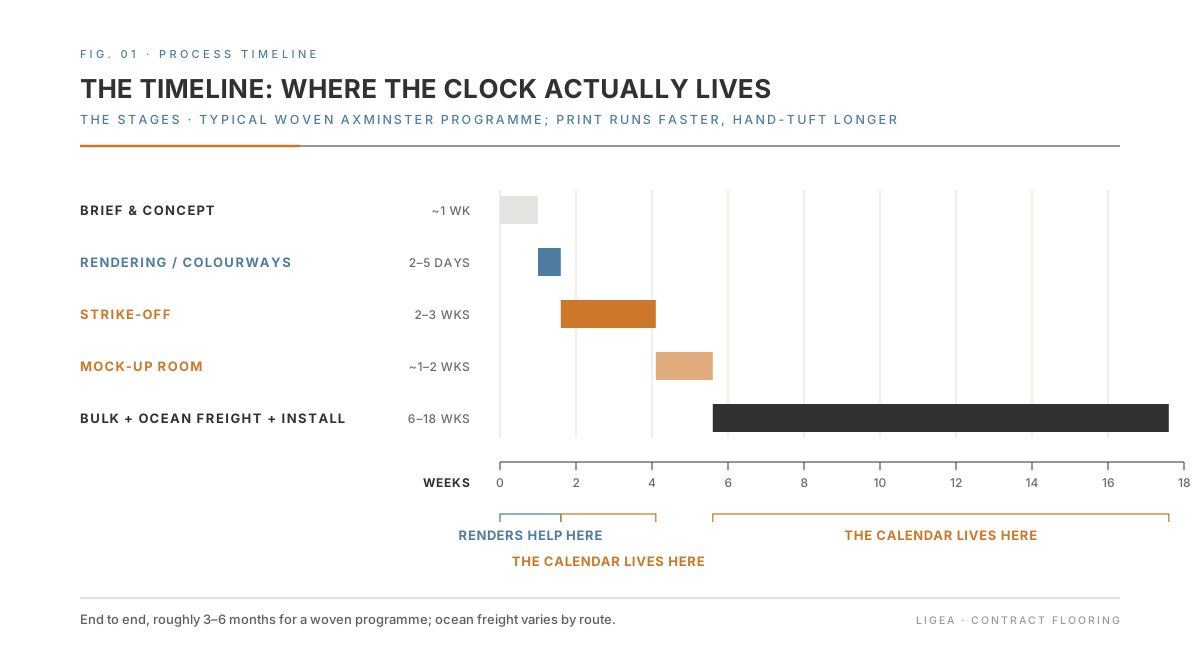
Across manufacturers the custom carpet journey moves through a broadly similar sequence, though the exact number and order of stages varies by vendor and by construction, with published process maps ranging from as few as three steps to five or six. In broad strokes it runs from brief and concept, through CAD conversion and a digital mock-up, to a physical strike-off, a mock-up-room sample, and finally full production with quality control and install. Yarn dyeing usually happens as part of yarn preparation inside production rather than as a discrete sequential step.
What surprises first-time specifiers is how the time is distributed. The creative front of the process (concept, colourways, rendering) is fast and cheap to iterate. Turnaround varies by vendor and by how complete the brief is, but a rendering can often come back within a week, with some studios quoting two to five business days. The physical back of the process is where the calendar lives: a physical strike-off typically takes on the order of one to six weeks after rendering approval, and bulk production commonly runs anywhere from two to four weeks for a printed run up to ten to sixteen weeks for hand-tufted goods, with woven Axminster in between at roughly four to eight weeks. Both figures depend on size, colour count, construction and the individual producer.
End to end, a useful rule of thumb puts a full custom programme at roughly three to six months, with the caveat that hand-knotted construction, rarely practical at full hospitality wall-to-wall scale, and large multi-item FF&E packages can run longer. The method you choose moves that number sharply, which is the next thing to understand.
02Method Decides Almost Everything Downstream
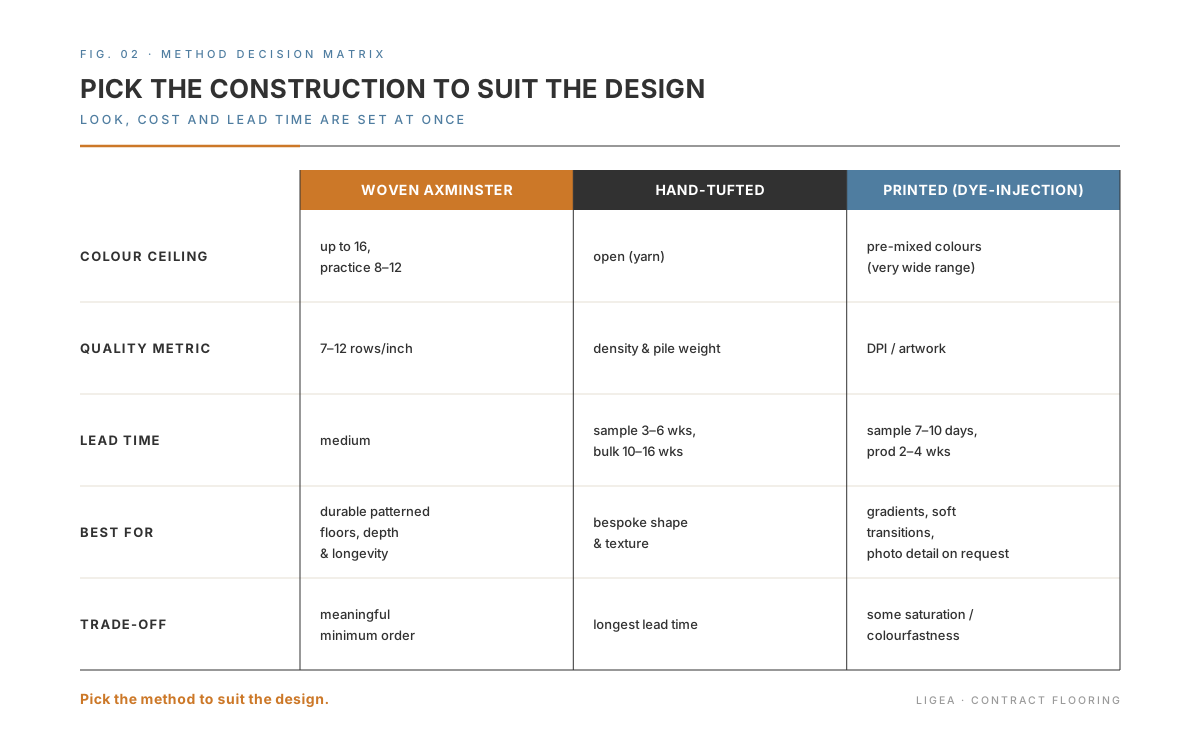
The single most consequential choice is construction method, because it sets the look, the colour ceiling, the minimum order, the cost and the lead time all at once. Pick the method to suit the design, and avoid bending the design to suit a method.
Woven Axminster is the classic patterned hospitality floor. Strictly, "Axminster" names a weave construction rather than a fixed fibre recipe, so it can be made in 100% wool or other blends; the most common contract convention, pioneered in the mid-20th century, is an 80% wool / 20% nylon blend, usually spun as a two-ply yarn. Quality is read in rows per inch: roughly seven rows for bedrooms and light traffic, nine or ten for public spaces and corridors, and up to about twelve at the densest end for the most demanding zones and finest design definition. Colour counts are bounded by the loom: spec sheets commonly cite up to 16 colours as the ceiling, though most contract programmes work within roughly 8 to 12 in practice. It is beautiful and durable, but it carries a meaningful minimum order.
Hand-tufted construction gives free, unpixelated lines, relief and texture, and it takes longer to make. It is the hand-made construction that is actually practical for hospitality wall-to-wall work. Wool quality, pile density and pile height matter most for contract durability, more than any single spec number. Pile is generally kept low and dense in high-traffic zones, where shorter, denser pile resists crushing better than tall pile; note that accessible routes are independently capped at about 12 mm (1/2 inch) under ADA guidance from the US Access Board, and most commercial high-traffic pile sits well below that. Lead times are the longest in the category and vary by producer, broadly 3 to 6 weeks for sampling and approval, then roughly 10 to 16 weeks for bulk production. Hand-knotted construction sits in the same family but is rarely economical or practical at hospitality wall-to-wall scale: cost, production time and mill capacity keep it to small feature rugs rather than full-floor runs.
Printed (digital dye injection) is the speed play. It works with a limited number of pre-mixed colours across a wide colour space, which gives it soft gradients and smooth transitions where woven constructions step from colour to colour; photographic detail is possible on request. It also skips yarn dyeing entirely. Sample turnaround can be seven to ten business days from approved artwork, with production two to four weeks from release. The trade-off is fibre saturation: printed carpet tends to sacrifice some colour depth and long-term colourfastness that solution-dyed and pre-dyed yarns deliver. Treat the old "printed equals cheap" line as a myth. It is a different tool, strongest where pattern complexity and lead time outrank maximum saturation.
03Where AI Compresses the Loop, and Where It Cannot
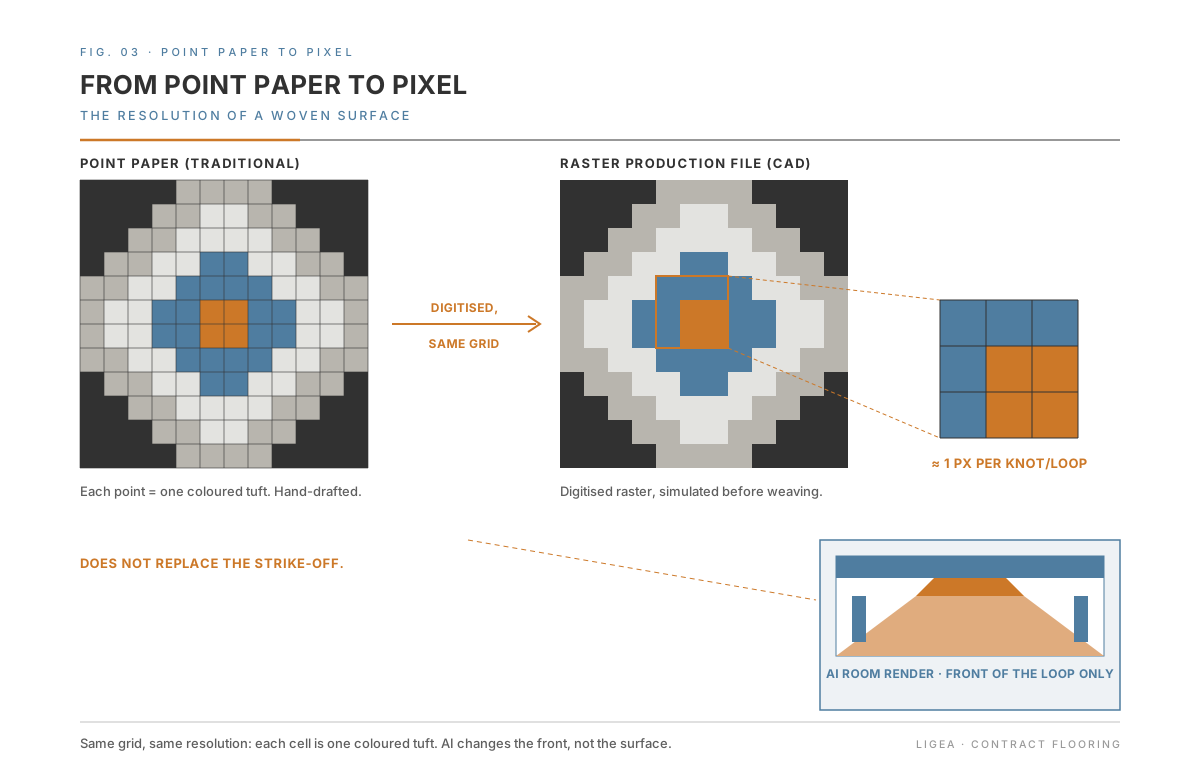
The most genuine change to this process in recent years sits at the front. Traditionally, designers hand-drafted patterns onto point paper, where each point represents a single coloured tuft. Modern CAD digitises that grid (production files are raster, not vector, with roughly one pixel per knot or loop) and simulates the finished surface before anything is woven.
On top of that, AI-assisted room rendering now generates photorealistic interiors in seconds rather than weeks, letting a designer test many colourways and pattern scales before committing to a single physical sample. That collapses the moodboard-to-approval gate, which is exactly where indecision used to eat weeks.
The honest caveat, and every serious source agrees on it, is that the render does not replace the physical strike-off. Screens and photography misrepresent colour, sheen and texture; a physical sample reviewed under the actual site lighting remains the only reliable basis for sign-off. AI shortens the iterative front of the loop. It does not shorten the multi-week strike-off at the back. Vendors advertising "renderings in 48 hours" are describing the cheap part of the process, not the load-bearing part.
04Two Details That Quietly Wreck Bespoke Floors
First, pattern repeat governs ordering, not floor area. Traditional weaving once capped a design repeat at around 1.8 m, a ceiling tied to the mechanical jacquard of gripper Axminster looms. Larger motifs were sewn together, and every seam is a weak point. Electronic jacquard largely removed that ceiling, enabling very large repeats in a single breadth. But the procurement trap remains: drops must be cut roughly one pattern repeat plus 3 to 4 inches longer than the measured run, and a large repeat with a half-drop match generates significantly more waste than estimators routinely budget. Order to the repeat and the joint plan, or you end up with two seams where one would have done.
Second, mock up before you commit, and zone the design to traffic. A sensible sequence is rendering, then small samples, then a full mock-up-room carpet, and only then the production run. Corridors take concentrated rolling load from luggage and housekeeping carts down their centre lanes, so busy, higher-contrast patterns are often favoured there precisely because they mask wear lanes and soiling. One install detail worth writing into the spec: pile direction should run against the main flow of traffic.
05Don't Forget the Compliance That Sits Under the Pattern
A custom design still has to pass the same fire performance as any commercial floor. In the United States, flooring radiant-flux testing under ASTM E648 / NFPA 253 classifies floors as Class I (critical radiant flux of at least 0.45 W/cm²) or Class II (at least 0.22 W/cm²), with Class I required in corridors and exits of many public and healthcare occupancies, as the Carpet & Rug Institute summarises. European projects work to EN 13501-1 fire classifications. Whatever the motif, the construction and backing have to reach the class the location demands, so settle that before the artwork is finalised.
06Where ligea Comes In
A moodboard tells us how a room should feel, and our part is turning it into a carpet that can be produced and signed off. The design itself usually points to the construction: soft gradients sit naturally in print, sharp contours or relief call for hand-tuft, and most patterned work in between goes to Axminster. AI-assisted rendering is something we use more and more to try colourways and pattern scales on screen before anything is sampled; how much time it saves depends on the brief, and it never replaces the physical strike-off. Colour is matched to Pantone TCX, NCS, RAL or a physical sample and confirmed on that strike-off. Because we work with several producers and are not tied to one loom or print line, production can usually start as soon as it is approved.
Explore our custom surfaces or start a conversation about your moodboard.