
Mixing Carpet Constructions by Zone: Planning, Calendar and Colour
How to plan a hotel carpet scheme that mixes hand-tufted, Axminster and print: which zones to release first, sampling and production windows per construction, freight, briefing and colour matching across techniques.
Most hotel carpet schedules are written the same way: pick a construction, pick a quality, run it property-wide. One line item, one production route, one set of specs to manage. It is the easiest schedule to write, and it rarely puts the budget where guests actually see it.
The case for mixing constructions zone by zone, with a richer hand-tufted quality where the surface matters and Axminster where it is already the right answer, is made in our comparison of hand-tufted and machine-woven carpet. This piece picks up where that one stops. Once a scheme mixes techniques, it runs on two or three production clocks at once, and the work shifts to planning: which zones are released first, how the sampling windows overlap, and how one palette holds together across surfaces made in entirely different ways.
01The zone logic in brief
There is no rigid matrix; the split depends heavily on the hotel's luxury level, and Axminster is a gold standard a five-star scheme can be built on entirely. The workable starting frame:
- Lobby: Axminster in 7×9, or a dense hand-tufted Grand Royal where the entrance is meant to feel exceptional.
- Corridors: Axminster in a heavier construction, usually 7×9 (the band runs 7×8–7×10), or a high-end hand-tuft.
- Ballrooms and casinos: in our practice 7×9 or higher, with casinos toward the top because of their near-continuous footfall. This is how we specify, not an industry norm. Grand Royal is the alternative.
- Guestrooms: Axminster 7×7–7×8, or a hand-tufted Royal quality.
- Signature suites and feature rugs: practically every quality is possible, from Axminster to Grand Royal, even hand-woven or hand-knotted pieces.
Design freedom is not the reason to pick one over the other. Both constructions leave a designer a lot of room; the constraints are simply different. Axminster renders small, filigree patterns precisely, with contours stepped by the pitch and rows of the weave. Hand-tuft draws free, unpixelated lines and adds what a woven surface cannot: relief, cut and loop pile in one piece, several pile heights.
On price, the honest framing is that a hand-tufted Royal costs a little more than Axminster, not less. It is a small step up for a markedly different surface, and it should never be sold as a saving. Most schemes therefore use it selectively, in the room categories or the lobby where the difference shows.
02Planning the calendar for a mixed build
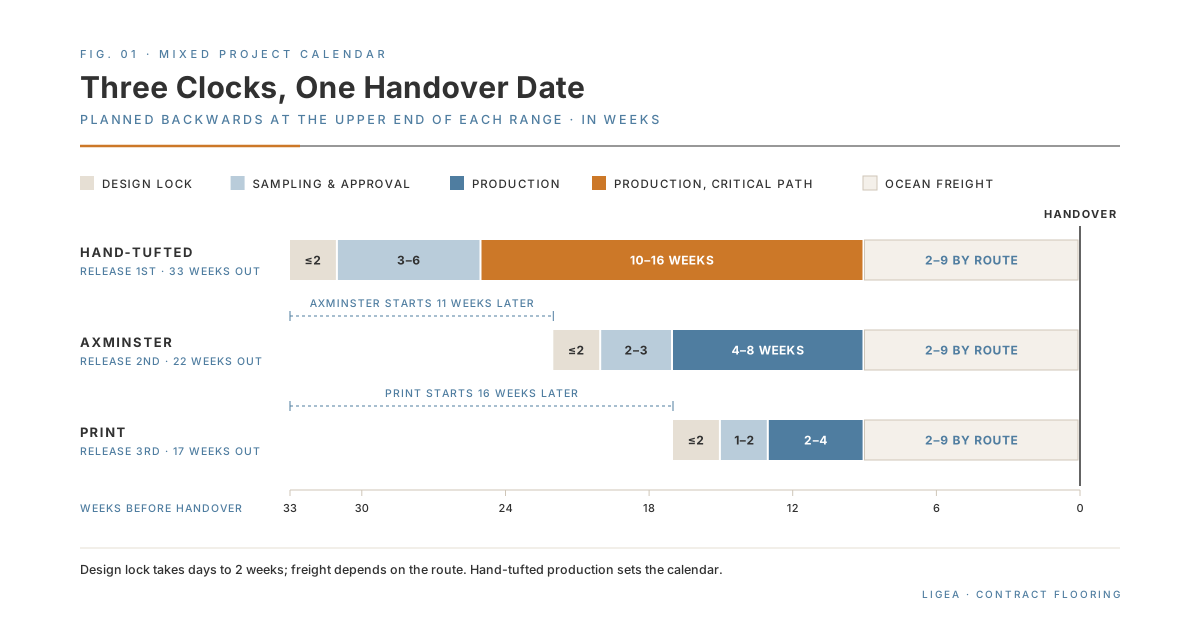
A mixed schedule is a scheduling decision as much as a design one, because each construction runs on its own clock. These are the windows we plan with, per construction, from a locked design to goods on site:
| Stage | Woven Axminster | Hand-tufted | |
|---|---|---|---|
| Design lock | days to 2 weeks | days to 2 weeks | days to 2 weeks |
| Sampling and approval | 1–2 weeks | 2–3 weeks | 3–6 weeks |
| Bulk production | 2–4 weeks | 4–8 weeks | 10–16 weeks |
| Ocean freight | 2–9 weeks, by route | 2–9 weeks, by route | 2–9 weeks, by route |
Hand-tuft is the slower route in production, not the faster one design teams sometimes assume it to be, and its sampling window is the longest as well. Freight is the most volatile line: depending on the route, ocean transport has taken anything from two weeks to nine, and as of autumn 2026 some routes to Europe and the US East Coast run at the longer end. It is worth confirming per route at the point of order, not at the start of the project. Rugs cut and bound from Axminster or printed roll goods add roughly a week for cutting and binding; a hand-tufted rug made to size does not.
The practical consequence is a release order. Plan backwards from one handover date, at the upper end of each range, and the hand-tufted zones need to start roughly eleven weeks before the Axminster zones and sixteen before any printed areas. If a scheme pairs a Grand Royal lobby with Axminster corridors and guestrooms, the lobby is locked and ordered first. Left to the order most projects follow, with public areas finalised after the guestroom typicals because the guestrooms are the larger line item, the hand-tufted lobby becomes the one piece holding up the opening.
Three habits keep the calendar honest:
- Approve by zone, not by package. A lobby design that is ready should go to sampling without waiting for the corridor repeat to be settled. Each zone that waits for the slowest decision inherits its delay.
- Plan at the upper end of each range. The lower ends happen, but a handover date built on them has no slack for a second sampling round, and in hand-tuft a second round means another sampling window.
- Keep sampling rounds inside their window. A hand-tufted sample that goes back for a third revision moves the whole hand-tufted line, and with it the opening date.
03Briefing a mixed scheme
Briefing two or three constructions into one coherent scheme starts from a single design language: one motif, one colour story, one geometric idea. Each construction then translates it on its own terms. Forcing an identical pattern to run unchanged across a woven grid and a hand-tufted surface usually produces the weaker version of both.
The translation follows what each technique does well. A fine, small-scale repeat belongs on the Axminster zones, where the weave renders it crisply; hand-tuft is the wrong place for very small mini-patterns. A large, flowing contour or a motif meant to be felt underfoot, carved into relief or picked out in loop against cut pile, belongs on the hand-tufted zones. Print sits apart again: a limited set of pre-mixed colours on a broad colour range, with soft contours and smooth gradients, and photographic detail on request. Large single-colour printed areas risk visible banding, so we always build a slight texture into them, which can read like a melange.
A useful brief for a mixed scheme therefore contains more than the design files. It names the construction and quality per zone, the areas involved, the one colour reference every zone is matched to, and the handover date. It also marks which zones sit on the critical path, so the people approving them know their sign-off sets the calendar.
04Matching colour across constructions
Colour is what actually holds a mixed scheme together. Nothing reads as more disjointed to a guest walking from a hand-tufted lobby into a woven corridor than a palette that shifts with the construction.
The constructions reach colour differently. Axminster yarns are dyed before weaving, and a design runs in up to 16 colours. Hand-tuft yarns are dyed too, and 30 or more colours are no problem, although a single colour or a melange is far simpler than a gradient, which needs many yarns dyed to sit in sequence. Print applies its pre-mixed colours to a finished surface. A shared palette has to work within the tightest of these limits: if a motif runs in both the Axminster corridor and the hand-tufted lobby, its colour count is set by the Axminster side.
The discipline that makes it work is one physical reference for the whole property: Pantone TCX, NCS, RAL, or the client's own sample. Every construction is matched to that reference and confirmed on a physical strike-off before bulk production, and the strike-offs from the different routes are approved side by side, against the same reference. That way the lobby's Grand Royal and the corridor's Axminster are unmistakably part of the same floor.
05Where ligea Comes In
We work with several producers and are not tied to one loom or one print line, so a mixed scheme can usually go into production as soon as each zone is approved. We build the calendar from the slowest piece: hand-tufted zones are released first, while Axminster and printed areas follow on their shorter clocks toward the same handover date. After approval, production takes 2–4 weeks for print, 4–8 for Axminster and 10–16 for hand-tuft, with freight quoted per route. Every zone is matched to one reference, Pantone TCX, NCS, RAL or a physical sample, and confirmed on a physical strike-off before production.
Explore our surfaces and constructions, or book a 15-minute spec call to plan your property zone by zone.