
Sustainable Hospitality Carpet: Recycled Content, EPDs and Take-Back
A buyer's guide to the green credentials that matter in contract carpet: recycled content vs recyclability, EPDs, Cradle to Cradle, take-back, wool's carbon debate and LEED/BREEAM points.
Sustainability has quietly become a gating question in hospitality FF&E. Owners want a green story for the press release, operators want to defend a brand commitment, and certification consultants want documents that score points. So the carpet line on the spec sheet now carries a second column of questions: recycled content, an EPD, a Cradle to Cradle level, a take-back programme. Read properly, each of these credentials gives a buyer real leverage. The trick is to keep apart a few ideas that often travel together: recycled content and recyclability, a take-back route and a closed loop, a natural fibre and a low-carbon one. This is a guide to reading the green credentials well, so the floor you specify delivers what its documents promise.
01Recycled Content and Recyclability: Two Questions That Pay Off
The headline number everyone asks for is recycled content, and the headline material behind it is regenerated nylon. The best-known regenerated nylon-6 is made entirely from pre- and post-consumer waste (discarded fishing nets, fabric scrap and old carpet), and its producer reports up to a 90% reduction in global warming potential versus virgin nylon, with closed-loop regeneration that can in principle be repeated indefinitely without loss of quality (EPD International). That is a genuine advance over fibre that can only be mechanically downcycled once.
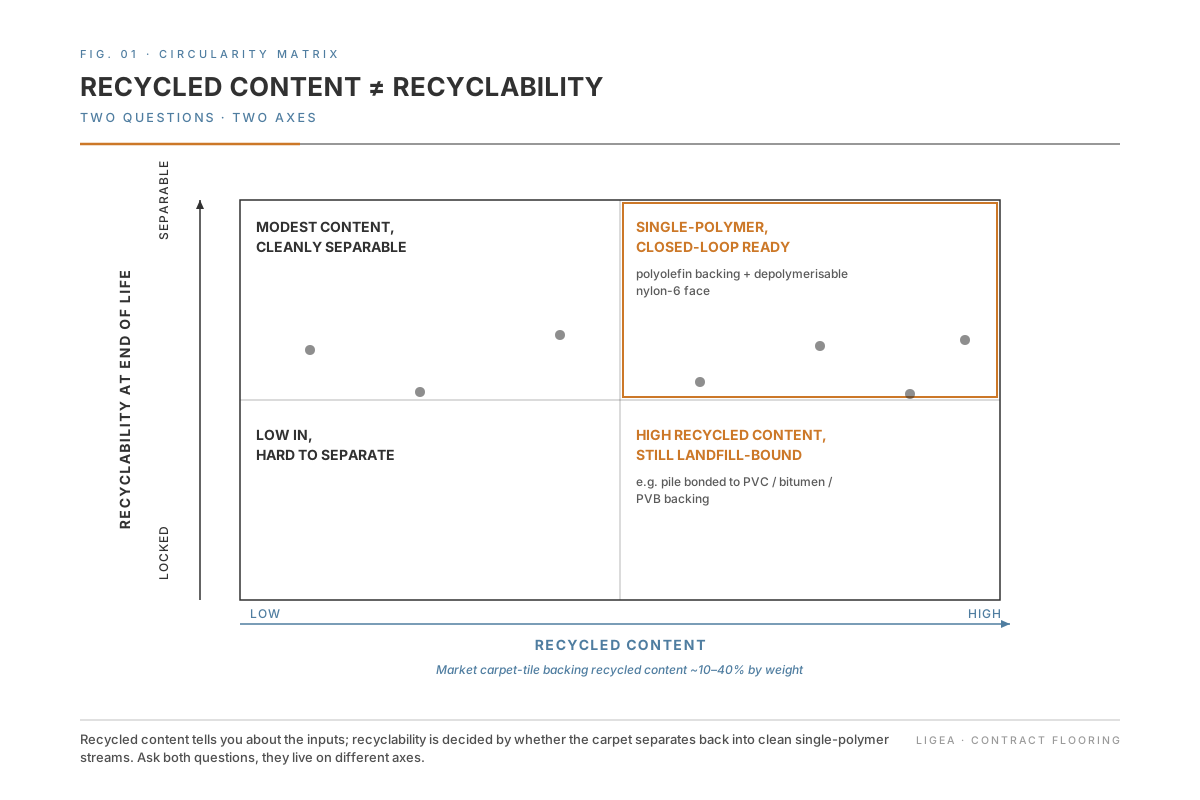
But recycled content tells you about the inputs, not the destiny. Two caveats matter for buyers. First, the percentage often refers to one component, not the whole product: typical carpet-tile backing recycled content across the market sits roughly 10–40% by weight, so a "made with recycled content" line can describe a small fraction of total mass. Some lines genuinely reach much higher: certain tiles are documented at over 90% total recycled content and some backings at up to 91% recycled and bio-based content, but those are the exceptions you verify, not the norm you assume.
Second, and more important: high recycled content does not make a product recyclable at end of life. Recyclability is decided by whether the carpet can be separated back into single, clean polymer streams. Specifiers repeatedly warn that pile attached to PVC, bitumen or PVB backings effectively cannot be reused, and that single-polymer constructions (polyolefin backings, nylon-6 face fibre that can be depolymerised back to near-virgin) are the ones that support real closed-loop separation. PET "bottle" carpet shows the distinction well: its recycled content is a genuine strength, while its face fibre does not yet have a widely developed closed-loop recycling route, with most end-of-life carpet recovery research focused on the easier-to-depolymerise nylon-6 stream rather than PET. The practical rule is to ask both questions, what went in and what can come out, and to treat them as separate. A floor that answers both well is a genuine asset to the project's sustainability case.
02Reading an EPD So It Holds Up
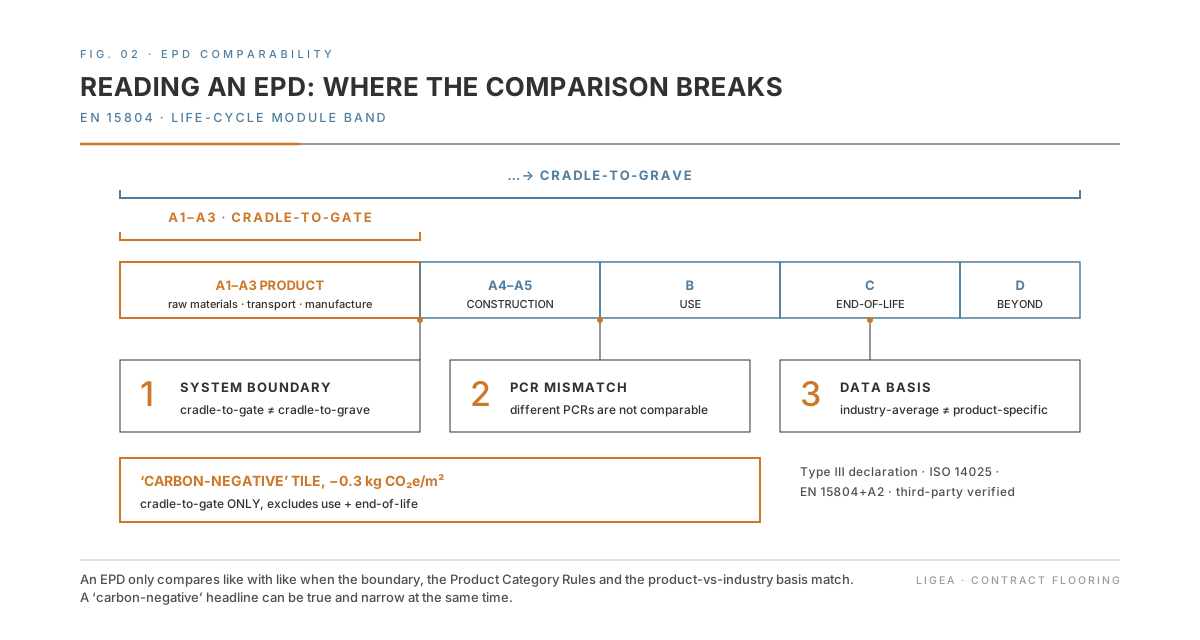
An Environmental Product Declaration is the document that turns a sustainability claim into something auditable. Technically it is a Type III declaration under ISO 14025, built on EN 15804 (current version +A2), requiring a third-party-verified life-cycle assessment and a registered programme operator (per EN 15804's own scope and requirements). Used well, it lets a buyer compare products on evidence rather than on adjectives. Three things decide whether a comparison holds: the same system boundary (modules A1–A3 are cradle-to-gate, cradle-to-grave adds use and end of life), the same Product Category Rules, and product-specific rather than industry-average data. The checklist is short: confirm third-party verification, confirm identical PCRs and boundaries before comparing, check that the end-of-life assumption matches your region's real disposal route, and look beyond greenhouse gases alone. Our guide to reading a carpet EPD walks through the modules and the five comparability checks in detail.
03Cradle to Cradle: What a "Gold" Level Really Tells You
Cradle to Cradle Certified is the multi-attribute mark designers most often treat as a blanket grade. Its current Version 4.0 assesses five categories (Material Health, Product Circularity, Clean Air & Climate Protection, Water & Soil Stewardship, and Social Fairness) across four levels: Bronze, Silver, Gold and Platinum (C2C Certified). The flooring sector has deep roots here; the first Cradle to Cradle Certified flooring product appeared in 1999.
The mechanic buyers most often miss is decisive: the overall level is set by the lowest single category score, not an average and certainly not the best. A product marketed as "Gold" is Gold in its weakest area: it may be Platinum on material health and only Gold on water stewardship. That makes a higher overall level genuinely meaningful, but it also means a "Gold" product is not automatically superior to another product's "Silver" across every dimension that matters to you. If a particular category, say material health for indoor air or circularity for a take-back goal, is the one you care about, read the category scorecard, not just the badge.
04Take-Back: Turning a Refurbishment into a Recovery Stream
Manufacturer take-back programmes are real and, in the right conditions, they work well. The strongest are PVC-free, single-polymer constructions designed for disassembly, with a reclamation number printed on the tile and free pickup; the national recovery body reports diverting more than 4.6 billion pounds of carpet from landfill since 2002 (Carpet America Recovery Effort). Commercial projects make this economic in a way residential never does: large, single-source volumes from one renovation are exactly what reclamation needs, which is why some programmes offer free take-back above a job-size threshold.
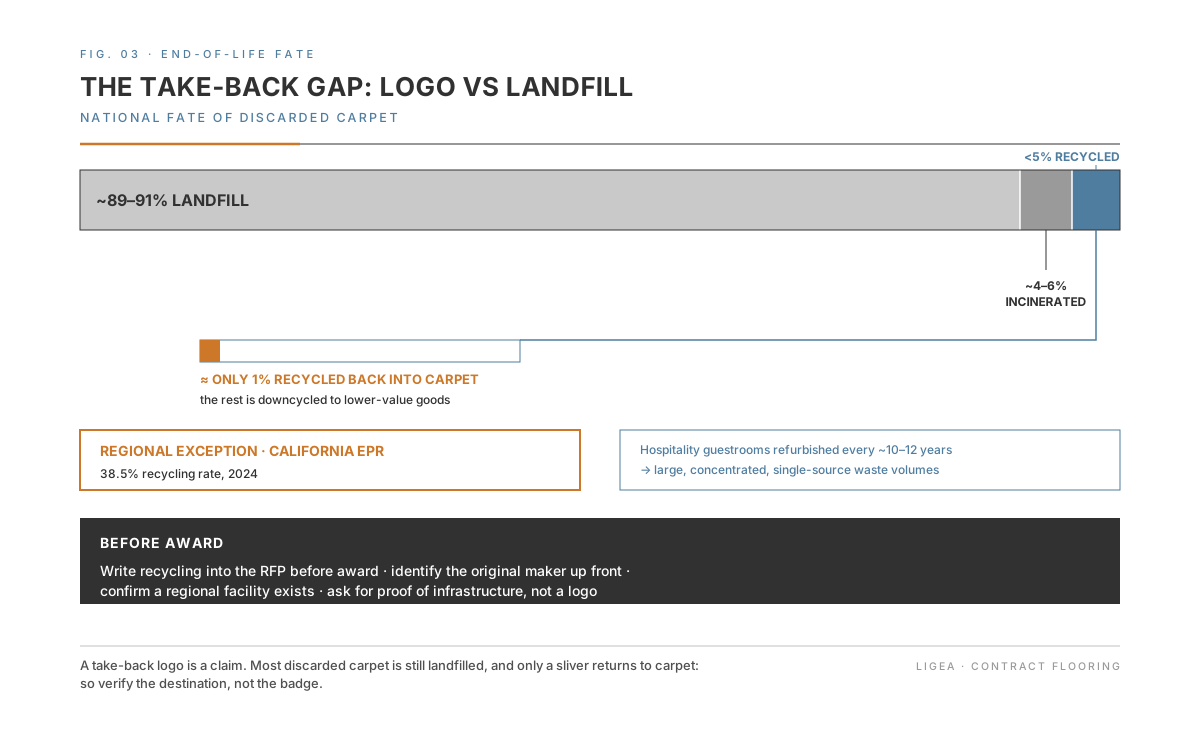
The national baseline shows how much room there is to grow. US EPA figures for 2018 put roughly 73% of discarded carpet and rugs into landfill, about 18% into combustion with energy recovery and about 9% into recycling (US EPA), and only part of that recycled share returns as new carpet; much of it goes into lower-value products. California shows what a structured programme can achieve: it runs the only US state-mandated extended-producer-responsibility programme for carpet, and its 2024 recycling rate reached an all-time high of 38.5%, ahead of its 34% goal (C&D Recycler).
Hospitality is well placed to use this. Guestroom soft goods are typically replaced on a five-to-seven-year cycle, which produces large, concentrated, single-source carpet volumes, exactly what reclamation needs, so design-for-disassembly and a credible take-back route belong in the brief. Projects that achieved real diversion followed a clear sequence: identify the original manufacturer up front, write recycling into the RFP before the contract is awarded, and confirm a regional facility exists. Ask where the material will actually go (back into carpet or into other products) and request evidence of the infrastructure along with the commitment (USGBC California).
05Wool, Carbon and Making the Fibre Choice Count
Wool reads as the intuitive sustainable fibre: renewable, shorn annually and biodegradable. Pure wool can biodegrade within roughly 6–12 months under good composting conditions (faster in some soils), returning nitrogen and sulphur (wool is about 10–11% nitrogen by weight) to the soil like a slow-release fertiliser (Woolmark). On end-of-life and renewability the case is strong. On carbon it is genuinely contested, and buyers should know both sides.
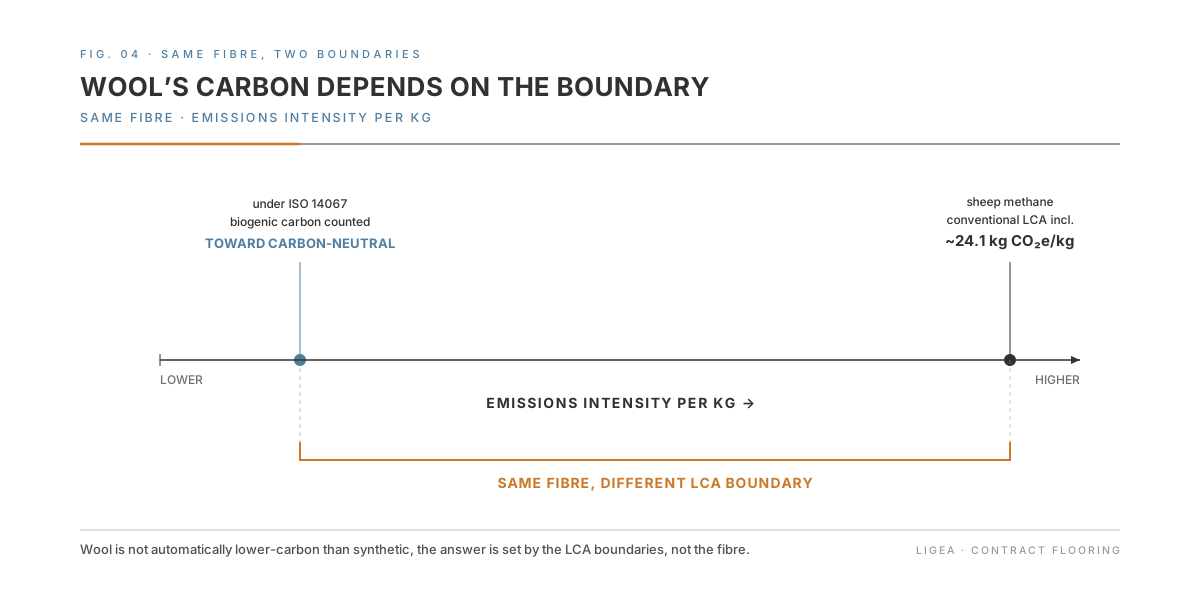
Conventional life-cycle assessments load wool with the methane sheep emit, putting greasy wool around 24.1 kg CO₂e/kg (Agricultural Systems). A peer-reviewed carpet comparison found that producing a fixed area of carpet tile generated more CO₂e for wool than for nylon on an energy/carbon basis, the opposite of the instinctive answer (Journal of Cleaner Production). The counter-argument is that conventional accounting ignores biogenic carbon: when the carbon stored in the keratin fibre and realistic manure modelling are included under ISO 14067, wool's emissions intensity falls dramatically, in some models toward carbon-neutral (IWTO). The honest takeaway is not that wool is bad, but that wool is not automatically lower-carbon than synthetic; the answer depends entirely on the LCA boundaries, which is one more reason to read the methodology behind any carbon figure rather than the headline.
06The Credits Buyers Actually Score
If certification points are the goal, it helps to know what the systems reward. Under LEED v4/v4.1, the Building Product Disclosure and Optimization credits give up to two points for EPDs, needing at least 20 installed products from at least five manufacturers, where a product-specific EPD counts as a whole product and an industry-wide one as half (GBCI). Recycled content, bio-based content and take-back/EPR sit in the optimization credit, and products sourced within 160 km (100 miles) of site count double by cost. Low-emitting-materials points typically require carpet carrying CRI Green Label Plus for indoor air quality. BREEAM folds EPDs into a whole-building life-cycle assessment rather than counting products one by one, and DGNB rewards EPD availability within its material assessment, which is relevant for the German and wider European market. A strong procurement signal worth knowing: NSF/ANSI 140 rates carpet sustainability at Silver/Gold/Platinum, and the US federal government mandates Gold-level for its carpet. The point for a buyer is to specify deliberately for the system in play, because the same product can score very differently depending on which scheme, and which documents, the project is chasing.
07Where ligea Comes In
Regenerated nylon is already part of our production: we have made carpet with ECONYL® regenerated nylon, and recycled PET (rPET) yarn is an active option in our range. That gives a project a recycled-content story it can document rather than merely claim.
Because we work with several producers rather than a single loom or print line, the sustainability requirement (recycled-content target, the right EPD, a credible take-back route) can help choose the construction and the producer. Colour is matched to Pantone TCX, NCS, RAL or a physical sample and confirmed on a strike-off, and bulk production runs roughly 2–4 weeks for print and 4–8 weeks for Axminster once design, colour, strike-off and mockup are signed off, plus freight by route.
---
ligea engineers contract surfaces for hospitality projects worldwide, matched to your design, your budget and the credentials your certification path actually needs. See our surfaces or book a 15-minute spec call.