
How to Read a Carpet EPD: Embodied Carbon for Hospitality Specifiers
A practical guide to reading a carpet EPD: what the document is, A1–A3 vs cradle-to-grave modules, embodied carbon benchmarks, and exactly where carpet EPD comparisons break for hospitality specifiers.
A carpet Environmental Product Declaration is starting to appear in hospitality tenders the way fire certificates did fifteen years ago: as a hard line item, requested before anyone has approved a colour. And like fire certificates, it is routinely misread. A specifier opens two EPDs, finds a kilogram-of-CO₂ figure on each, picks the smaller one, and assumes the work is done. More often than not, the two numbers were never measuring the same thing.
An EPD is a data sheet, not a verdict. Read correctly, it is one of the most useful documents in a sustainability pack. Read carelessly, it produces confident, wrong decisions that survive all the way to a LEED submission. This guide walks through what an EPD actually is, the module system that governs every number in it, what "good" embodied carbon looks like for carpet, and (the part that decides everything) exactly where two carpet EPDs stop being comparable.
01What an EPD Actually Is
An Environmental Product Declaration is a standardised, third-party-verified summary of a product's life-cycle environmental impacts. It is a "Type III" environmental declaration under ISO 14025, which is the formal way of saying the data is independently verified and follows a fixed reporting recipe rather than being a marketing claim the manufacturer wrote itself.
That recipe is the key thing to understand. Every EPD is built on a Product Category Rule (PCR), a document defined under ISO 14025 that fixes "what information should be gathered and how that information should be evaluated" so that products performing the same function are measured the same way. For construction products in Europe, the overarching core rules come from EN 15804; for carpet and other floor coverings specifically, the relevant sub-rule is EN 16810, which sets the product category rules for resilient, textile and laminate floor coverings. That standard exists for one reason worth memorising: by fixing common product category rules, it is what makes floor-covering EPDs comparable in the first place. Declarations built on different rules generally are not. The PCR is what makes comparison legitimate, or impossible.
An EPD reports a basket of impact categories, not just carbon. The common ones are global warming potential (GWP), ozone depletion, acidification, eutrophication, smog formation and primary energy use. Carbon is the headline that specifiers chase, but an EPD reports factual data across all of those categories rather than carbon alone, and water use and acidification can matter as much as greenhouse gases for textile products. For the rest of this guide we concentrate on embodied carbon, because that is what tenders ask for, but a responsible read does not stop there.
02The Module System: A1–A3 vs Cradle-to-Grave
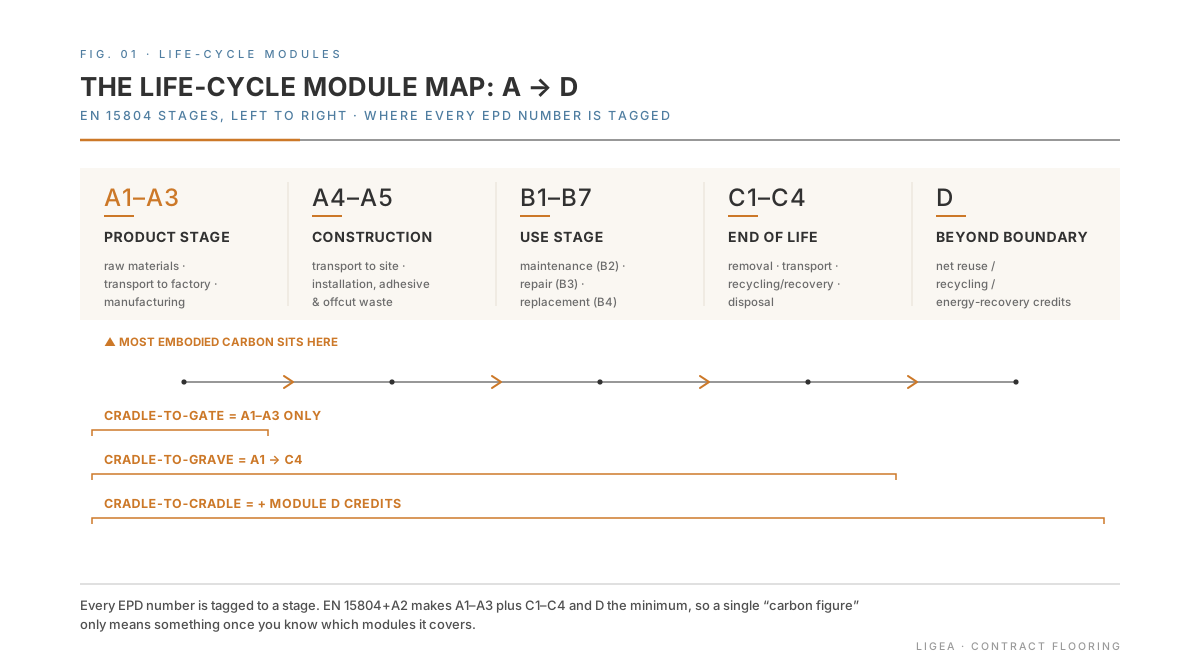
Every number in an EPD is tagged to a life-cycle stage, and these stage codes are the single most important thing to read before you compare anything. Under EN 15804 the life cycle is split into clearly defined modules:
- A1–A3: the product stage (cradle-to-gate). A1 is raw-material supply, A2 is transport to the factory, A3 is manufacturing. For carpet this is where most of the embodied carbon lives, and it is the figure most often quoted.
- A4–A5: construction. A4 is transport to site; A5 is installation, including adhesive and offcut waste.
- B1–B7: the use stage. Maintenance (B2), repair (B3) and especially replacement (B4) sit here. For carpet, this stage is far more consequential than most specifiers expect; more on that below.
- C1–C4: end of life. Removal, transport to waste processing, recycling/recovery and final disposal.
- D: beyond the system boundary. Net benefits and loads from reuse, recycling or energy recovery after the product's life ends.
Three boundaries are worth naming because tenders use the terms loosely. Cradle-to-gate is A1–A3 only. Cradle-to-grave is A1 through C4, the whole life including end of life. Cradle-to-cradle adds Module D's recycling credits on top.
The standard itself has moved. The older EN 15804+A1 required only A1–A3 as the minimum, whereas the current +A2 revision makes the minimum scope A1–A3 plus C1–C4 and D, so newer EPDs declare end-of-life by default and older ones often do not. The +A2 update also split global warming potential into separate fossil, biogenic and land-use figures, which is why a recent EPD shows a GWP-fossil and a GWP-total line where an older one showed a single number. Comparing an A1 number against an A2 number is comparing two different accounting methods, not two different carpets.
03What "Good" Embodied Carbon Looks Like for Carpet
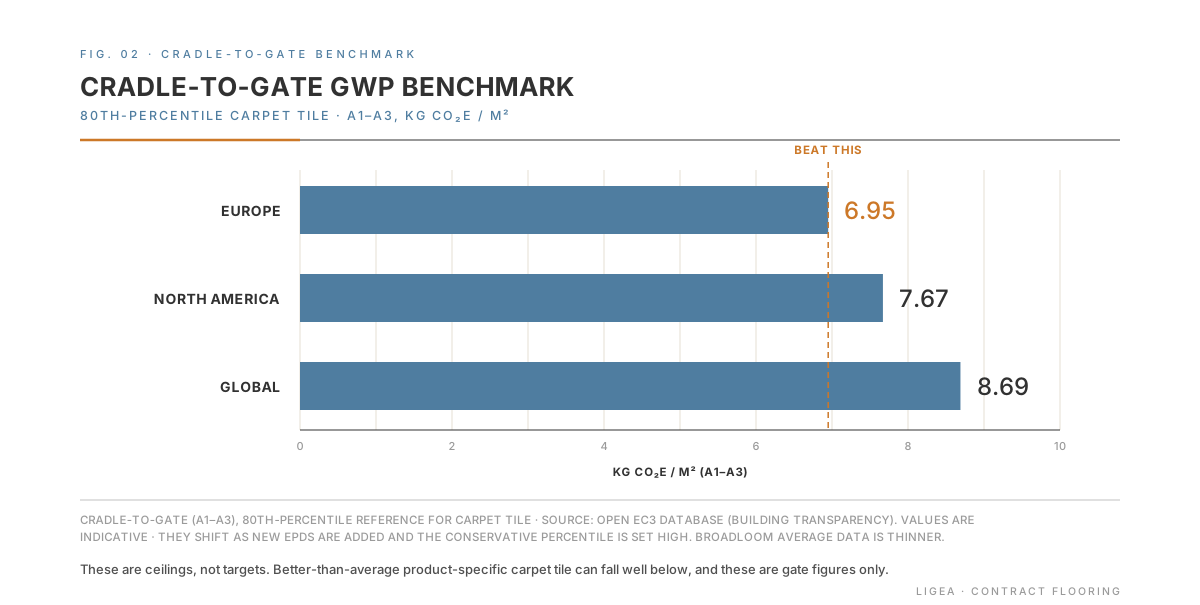
Specifiers want a benchmark, so here is an honest one, with the caveat that these are cradle-to-gate (A1–A3) figures and the spread is wide. Drawn from the open EC3 database of product-specific EPDs maintained by Building Transparency, "conservative" reference values for carpet tile (defined as the 80th percentile of cradle-to-gate GWP across declarations) land at roughly 6.95 kg CO₂e/m² for Europe, 7.67 kg CO₂e/m² for North America and 8.69 kg CO₂e/m² globally. Better-than-average product-specific carpet tile can fall well below those figures, which tells you the category average is a ceiling to beat, not a target. Treat any single benchmark as indicative rather than absolute: EC3 values shift as new EPDs are added, and the conservative percentile is deliberately set high.
The reason for that spread is fibre. Carbon-accounting guidance is blunt that carpet's embodied carbon can vary as much as 8× depending on carpet type and construction, and that for nylon carpet, making the yarn from crude oil is responsible for over 50% of the carbon footprint. The corollary is the single biggest lever a specifier has: high-recycled-content nylon yarn can cut that footprint by over 80%. One caveat that matters in tenders: the most common "recycled content" in carpet is pre-consumer recycled mineral filler in the backing, which "does not significantly decrease the carbon footprint." A recycled-content percentage on a brochure is not the same as recycled yarn. Read the EPD, not the badge.
For broadloom carpet rather than tile, industry-averaged EPD data is thinner, so treat single-product declarations as the more reliable source and be wary of cross-format comparisons.
04Where Carpet EPD Comparisons Break
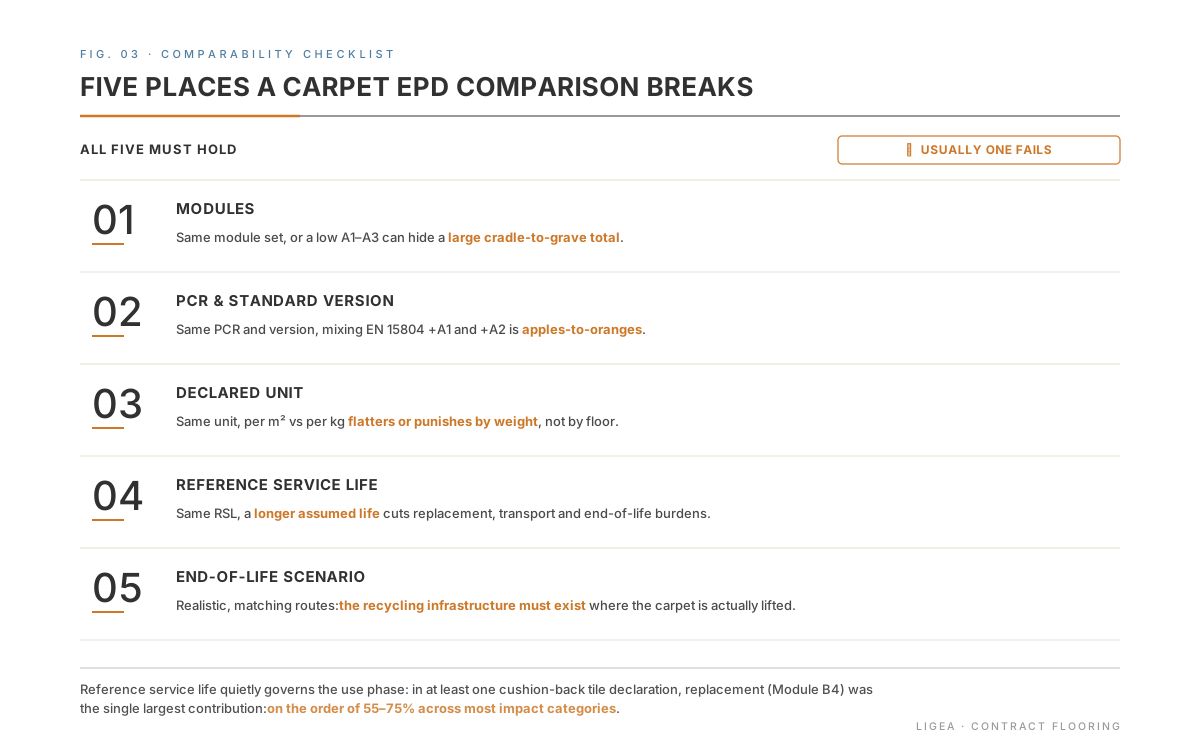
This is the part that decides whether your comparison means anything. Two EPDs are only comparable when a specific set of conditions all hold, and in practice at least one usually fails. Watch for these five.
1. Different modules. The most common error, and the most expensive. It makes no sense to compare an EPD assessed cradle-to-gate against one assessed cradle-to-grave: a product showing a low A1–A3 number can carry a far larger total once the C and B modules are added. Confirm both documents declare the same module set before you compare a single figure.
2. Different PCR or standard version. EPDs "may follow different LCA standards (e.g., EN 15804+A1 vs. +A2), which affects how GWP is calculated," and two EPDs are only comparable when they rest on the same PCR, including the same version. Mixing +A1 and +A2 figures, or two different PCRs, is apples-to-oranges by construction.
3. Different declared unit. Carpet EPDs are usually stated per square metre, but not always: some report per kilogram, which makes a heavyweight wool product look worse and a lightweight one look better for reasons that have nothing to do with the floor you are covering. The unit must match, or be converted, before any number is meaningful.
4. Different reference service life (RSL). This one quietly governs every use-phase and end-of-life figure, because a shift in the assumed RSL multiplies replacements, transport and end-of-life burdens directly. Many commercial carpet-tile EPDs assume a reference service life of around 15 years, often aligned to the manufacturer's wear warranty, but some declare a different figure, and the assumption changes the maths dramatically. Across a building's much longer estimated service life, replacement (Module B4) can be the single largest impact contribution, on the order of 55–75% across most impact categories in at least one cushion-back tile declaration. A carpet that lasts longer needs replacing less often, so a generous RSL can make a higher-carbon product look better over the building's life. If two EPDs assume different service lives, their cradle-to-grave numbers are not on the same axis.
5. Optimistic end-of-life scenarios. Module C and D figures rest on assumptions about what happens to the carpet after removal, and a declaration can model a recycling route that real-world waste streams rarely deliver. Reviews of end-of-life reporting in EPDs find wide variation in the disposal routes assumed, with each scenario producing a different total footprint, so guidance is to check that the applied end-of-life scenario matches the actual situation where the product is disposed of. The recycling infrastructure behind a take-back claim made in one country may simply not exist at your project's location. The honest test is to confirm the declared end-of-life scenario matches the disposal reality where your carpet will be lifted in fifteen years.
One more truth that reframes the whole exercise: for carpet, manufacturing is not always the dominant carbon stage. Life-cycle studies have found that for some carpet-tile systems, maintenance, chiefly the electricity for vacuuming, contributed about 43% of total greenhouse-gas potential, against 38% from the yarn. Other work on nylon carpet still puts raw-material production, dominated by the energy and emissions of producing caprolactam, as the leading hotspot of the total (life-cycle assessment of US wool and nylon carpets). The point is not which number wins; it is that an A1–A3 figure alone can miss most of a carpet's lifetime carbon, and as manufacturing decarbonises through recycled content, the use phase only grows in relative weight.
05EPD as an Ascending Tender Standard
None of this is academic. Public procurement is moving from "EPD welcome" to "EPD required." Under the US federal Buy Clean initiative, GSA now requires product-specific Type III EPDs for materials bought with Inflation Reduction Act funding, with global-warming-potential limits set for the most carbon-intensive categories first. Green-building rating systems pull the same direction: the LEED Building Product Disclosure and Optimization credit rewards specifying products with EPDs, on a sliding scale, alongside the whole-building life-cycle assessment that drives the broader carbon-reduction credits. In Europe the EN 15804+A2 framework feeds BREEAM, DGNB and HQE in the same way. For a hospitality developer chasing a green certification or answering an operator's ESG standard, an EPD on the carpet is no longer optional collateral. It is a gate, exactly like the fire pack.
Which means the read-it-correctly skill is now a procurement skill, not a sustainability-consultant nicety. A specifier who can tell a product-specific EPD from an industry average, spot a cradle-to-gate number masquerading as a full-life figure, and sanity-check an RSL assumption is protecting both the project's carbon claim and its credibility under audit.
06Where ligea Comes In
We treat the EPD as part of the spec from the brief, not as a document chased after award.
Because we work with several producers, we can choose the construction the design needs and then a producer whose declaration covers the right modules under the right PCR. Before any comparison we check that module scope, declared unit and reference service life match, and we flag end-of-life scenarios that will not hold at the project's location. Where carbon is the binding constraint, recycled-content yarn is part of the conversation from the start.
Explore our surfaces and constructions, or talk to us about a carpet spec and its sustainability pack.