
Specifying Hospitality Carpet to Operator Brand Standards: Marriott, Hilton, IHG, Hyatt and Accor
How to specify hospitality carpet to the brand standards of the major hotel operators (the approved-vendor logic, the cert pack, the brand-tier split and the procurement platforms) and what those standards actually publish versus keep behind the vendor wall.
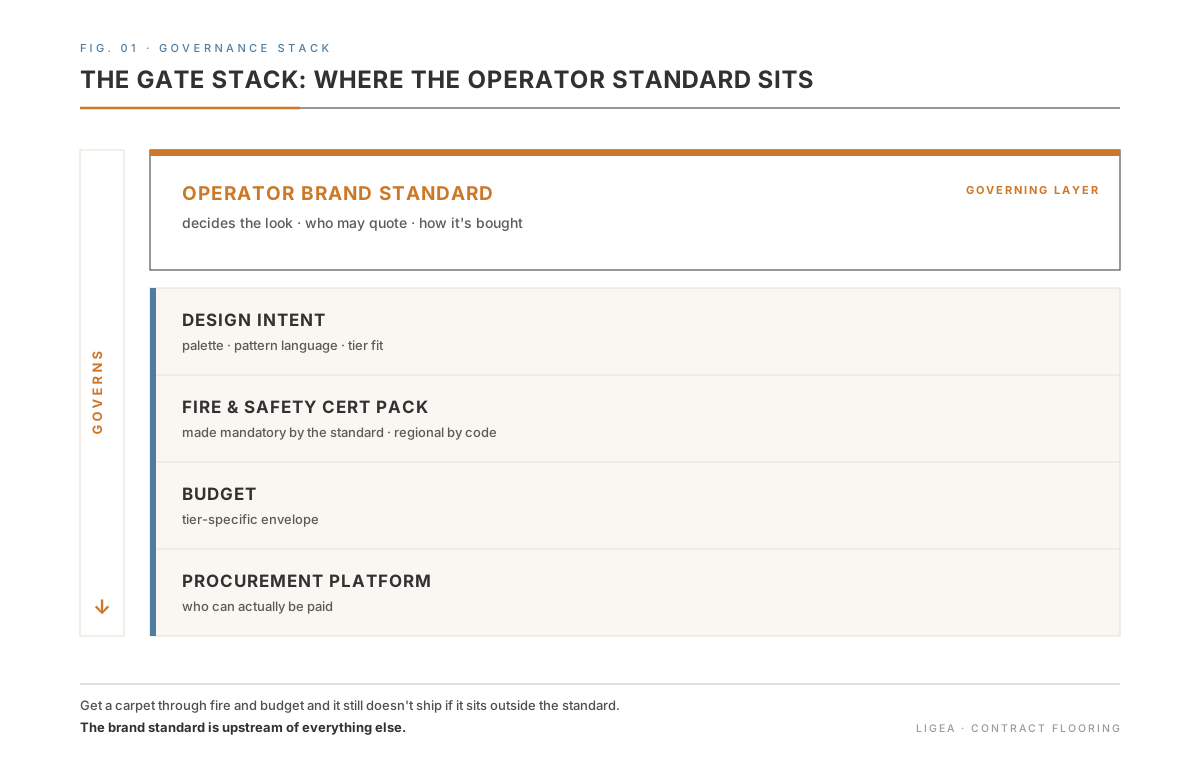
If you are specifying carpet for a Marriott, Hilton, IHG, Hyatt or Accor property, the most important document in the room is one you may never fully see. Above the fire-cert pack, above the budget, above the designer's mood board sits the operator's brand standard. On a branded project it is the standard, not the designer, that decides what may be specified, who is allowed to quote it, and how it gets bought.
This guide explains how those standards actually touch carpet: what the major operators run, how the approved-vendor logic works, why the requirement changes from a select-service flag to a luxury one, and how the procurement platforms turn the spec into a purchase order. It also draws a hard line that a lot of guidance blurs: most of these standards are published only to approved vendors and licensed owners, not to the open market, so anyone quoting exact Marriott or Hyatt face-weight numbers to you is almost certainly guessing. We'll stay on the part that is genuinely verifiable, and flag where the detail is deliberately behind the wall.
01The Standard Is a Gate, Not a Guideline
On an independent hotel, the designer specifies and the owner buys. On a branded hotel, that freedom narrows sharply. Each major operator maintains a design-and-construction standards programme: Marriott's Design Standards, Hilton's Design, Construction and Renovation Standards, the IHG Way of Design, Hyatt's brand standards and Accor's Design & Technical Services. On new builds, conversions and renovations these documents are contractually binding, not advisory.
The clearest place this bites is the Property Improvement Plan (PIP), the brand-issued punch list a hotel must complete to keep or take a flag. Completing the PIP itself is not optional: the work must land inside the brand's timeframe or the flag is at risk. But hospitality guidance on PIP negotiation is equally clear that the subjective items on the list (wall finishes, flooring, ceiling tiles) are typically where owners negotiate hardest, through value engineering and alternative specifications. The brand standard still sits upstream of every other gate. A beautiful carpet that clears fire and budget does not ship if it sits outside the standard, yet within the standard the spec is genuinely negotiable.
02Approved-Vendor Logic: Who Is Even Allowed to Quote
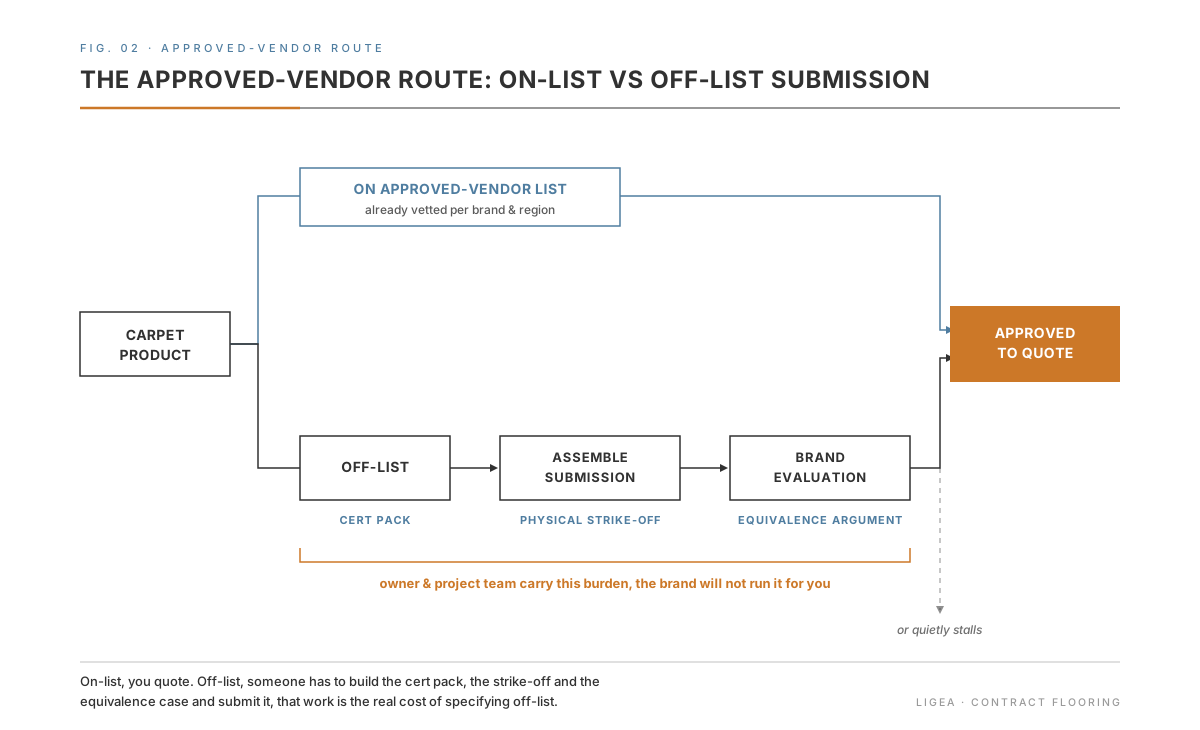
The mechanism every operator shares is the approved-vendor list. FF&E, which explicitly includes carpet, must generally be sourced from suppliers the brand has vetted, and a property's team usually cannot unilaterally choose a vendor outside that network for the controlled categories.
Hilton makes the plumbing of this unusually visible in its design information portal. FF&E selections "must be reviewed and approved by Hilton Global Design Services," and finishes are sourced through the Design Hub and submitted to the Project Hub for sign-off, with an approved supplier list published per brand and region inside the owner portal. Marriott runs the same idea with an explicit door for newcomers: alternate manufacturers "will be considered" against the named standard of quality, but the owner and project team carry the burden of submitting documentation and physical samples for Marriott's evaluation.
That last point is the practical centre of gravity for a carpet specifier. Being outside the approved network is not necessarily fatal, but the route in is a documentation and sampling exercise the brand will not run for you. Someone has to assemble the cert pack, the physical strike-off and the equivalence argument, and submit it for review. That work is the real cost of specifying off-list, and it is where projects either clear or quietly stall.
03How the Standard Actually Touches the Carpet
Strip away the brand language and an operator standard reaches carpet through three levers, each verifiable at the general level even when the exact thresholds are not public.
Design intent and aesthetic fit. The standard defines the look the brand expects (finish palette, pattern language, the line between a Moxy and an EDITION), and a designer is working inside that envelope before a sample box opens. Brand standards exist precisely so a guest "always knows they're in a Marriott," which is a constraint on pattern and palette as much as on hardware.
Technical and safety minimums. Standards reference dimensions, materials, flammability ratings and accessibility, and require code compliance and fire-safety certification as a condition of approval. For carpet this is the cert pack (the radiant-panel fire class for corridors and exits, the emissions route for the green rating), written into the spec as a pass/fail. We've covered the cert pack itself in depth in our procurement guide; here the point is narrower: the operator standard is the document that makes that pack mandatory, and it can layer its own minimum on top of the legal floor.
Sustainability markers. Operators increasingly fold sustainability into the standard, from Hyatt's World of Care framing to Accor's environmental embedding into its technical brief. It reaches carpet as low-emitting-material and certified-content expectations rather than as a single "green carpet" cert.
What the operators broadly do not publish openly is the third layer of detail: the exact face weight, density, pile height or pitch a given brand demands by area. Industry write-ups that quote "minimum 28–32 oz/yd² for corridors, 24–28 oz/yd² for guestrooms" present these as common hospitality conventions, not as a particular operator's official figure. Treat any brand-specific number you're handed as a rule of thumb to verify against the actual standard for that flag and region. The detailed standards live with the brand and its approved vendors, and that is by design.
04The Brand-Tier Split: Select Service to Luxury
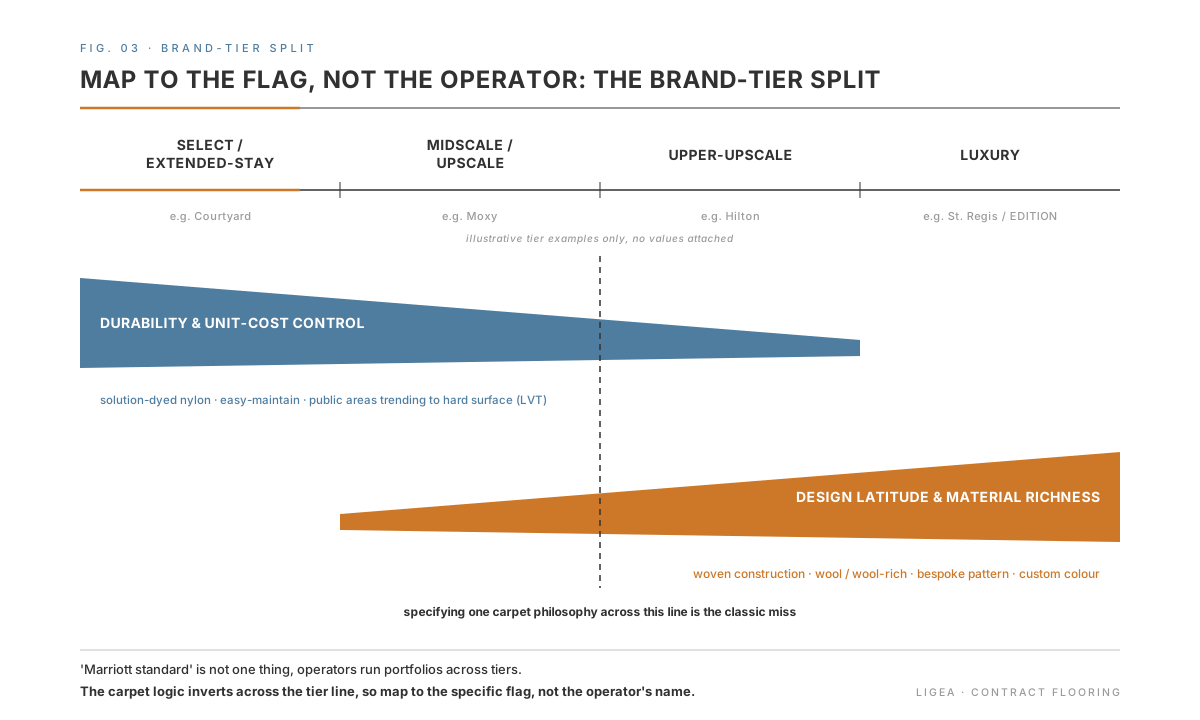
The single most useful thing to understand is that "Marriott standard" is not one thing. Each operator runs a portfolio of brands across tiers. Marriott alone spans roughly 30-plus brands across luxury, premium, select and extended-stay in its brand portfolio, and the standard that applies to a Courtyard is a different document from the one that applies to a St. Regis. Requirements vary by brand tier, with select-service properties facing different specifications than full-service or luxury flags.
For carpet this tier logic runs in two directions at once, and it pays to hold both:
- Durability and economics dominate at the select end. A select-service flag in a high-traffic, cost-disciplined operation leans toward robust, easy-maintain constructions: solution-dyed nylon for colour-fastness and hard cleaning, tighter control on unit cost. Across several brands the standard increasingly nudges public areas toward hard-surface flooring (LVT) over carpet for exactly these maintenance reasons.
- Design latitude and richness open at the luxury end. A luxury or upper-upscale flag specifies for statement and material richness: woven constructions, wool or wool-rich blends, bespoke pattern and custom colour, with the carpet as part of the brand experience rather than a maintenance line. Plusher, higher-crown constructions read as the upscale signal.
The mistake is specifying the same carpet philosophy across the tier line, whether that means forcing a luxury construction onto a select brief it cannot fund, or a value construction onto a luxury brief that expected bespoke. Map to the specific flag, not to the operator's name.
05From Spec to PO: The Procurement Platforms
Even a perfectly compliant spec has to be bought, and on branded projects the buying runs through controlled channels. Two layers matter.
First, the purchasing agent: FF&E and OS&E are typically sourced not by the designer but by a specialist purchasing agent, with carpet explicitly inside the FF&E scope alongside furniture, lighting and wallcovering. These agents manage the spec, the vendor relationship and the logistics, and the carpet maker is one supplier they coordinate, not the project's counterparty.
Second, the e-procurement platforms, with BirchStreet and Avendra as the dominant North-American names and regional equivalents elsewhere. Large hotel groups use them to manage FF&E project purchasing, contracted spend and vendor compliance. The reason this matters to a specifier: these platforms are compliance enforcement. A vendor outside the approved network and outside the platform doesn't just lose the convenience of integration; it can be structurally hard to transact with at all. The standard says who may quote; the platform says who can actually be paid.
06Where Specs Quietly Fail Against an Operator Standard
A handful of failures recur, none of them quality problems:
- Specifying to the operator but not the flag. A standard mapped to "a Hyatt" rather than to the specific tier and region is mapped to the wrong document.
- Off-list with no submission plan. A great product that no one has budgeted the time to document and sample for brand approval will not clear, however good it is.
- Treating a published number as the brand's number. Acting on a "common" face weight as if it were the flag's official minimum, when the real standard sits behind the vendor wall.
- Cert pack to the legal floor, not the brand floor. The brand can demand above the code minimum; meeting code is necessary, not sufficient.
- Ignoring the platform. A spec that can't be transacted through the group's procurement channel stalls at the PO, not the design review.
07Where ligea Comes In
On a branded project the carpet has to survive a brand review before it gets anywhere near a purchase order, and that review runs on samples and documents. We match colour to Pantone TCX, NCS, RAL or a physical sample and confirm it on a physical strike-off before production, so the owner and project team have a real piece of carpet to put in front of the brand. On the fire side, our constructions can reach EN 13501-1 up to Bfl-s1 for European projects. Because we work with several producers and are not tied to one loom or print line, the construction can follow the flag, whether that is a cost-disciplined select-service brief or a bespoke luxury one, and production can usually start as soon as the spec is approved.
08The Short Version
On a branded hotel the operator standard sits above everything. It decides the look, makes the cert pack mandatory, and controls who is even allowed to quote through approved-vendor lists and procurement platforms. The standards are real and verifiable in their structure; their detailed numbers mostly are not public, so the move is to map to the specific flag and tier, not the operator's name, and to treat any brand-specific spec figure as something to verify against the real document. Do that, or hand it to a partner who already holds the cert pack, the budget and the submission together, and the design becomes the conversation you actually get to have.
---
ligea makes contract carpet for hospitality projects worldwide in print, Axminster, hand-tuft and braided constructions, matched per brief to the right technique, certification and budget and to the standard of the operator the project flies under. If you're working a live branded spec, see our surfaces or book a 15-minute spec call.