
Spa and Wellness Flooring: Moisture, Slip and Hygiene
A buyer's guide to spa and wellness flooring: barefoot slip standards, mould and moisture thresholds, what antimicrobial treatment really does, and where carpet belongs versus hard surfaces.
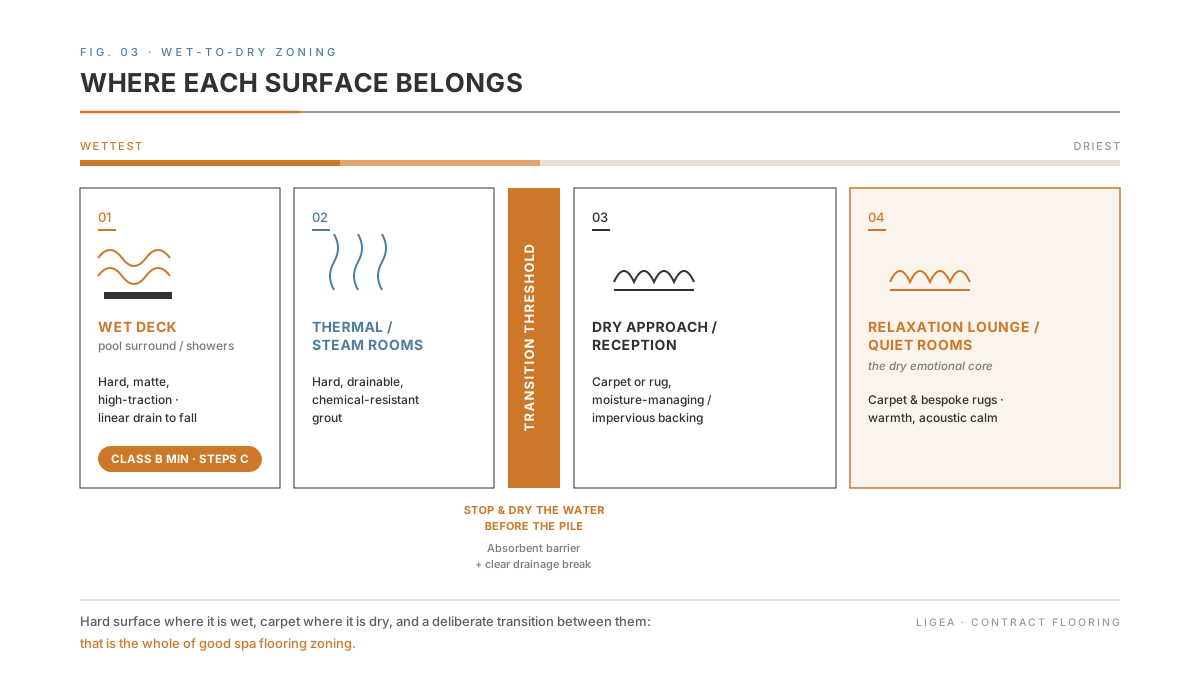
A spa is the one space in a hotel where the floor is asked to do two contradictory things at once. It has to feel soft, warm and quiet under a bare foot in the relaxation lounge, and it has to stay grippy, drainable and disinfectable under that same bare foot two rooms away on a wet pool surround. Treat those as one flooring problem and you get a spa that is either slippery where it should be safe or cold and clinical where it should be calm. The discipline of spa flooring is zoning: matching each surface to what actually happens on it, and knowing the real numbers behind moisture, slip and hygiene rather than the marketing claims. This guide walks through what a buyer needs to verify before signing off a wellness floor, and where carpet genuinely belongs in the mix.
011. Barefoot Wet Zones Use a Different Slip Standard: the One Most Specs Get Wrong
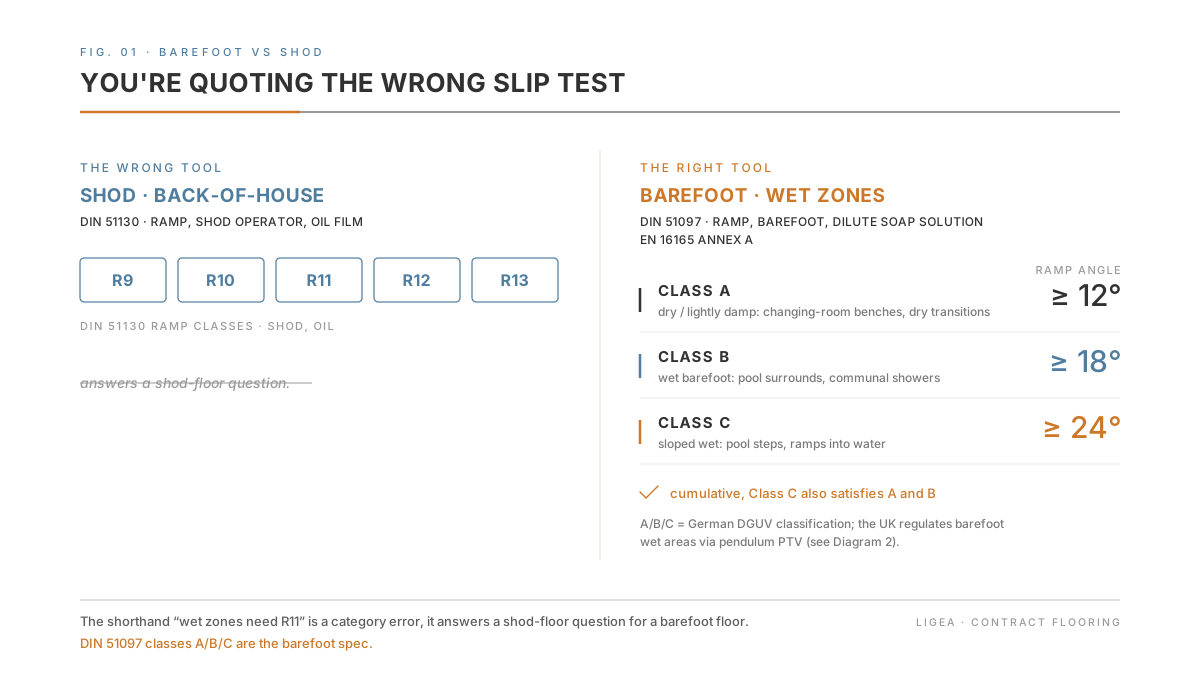
The single most common error in a spa specification is quoting the wrong slip test. The familiar "R-ratings", R9 through R13, come from DIN 51130, a ramp test run with a shod operator on an oil-covered surface. They are the right tool for kitchens and back-of-house, and the wrong tool for a barefoot wet area.
Barefoot wet zones are governed instead by DIN 51097, now folded into EN 16165 Annex A: a ramp test run barefoot with a dilute soap/wetting solution, producing three classes (DGUV):
- Class A (ramp angle ≥ 12°): dry or lightly damp barefoot areas: changing-room benches, dry transitions.
- Class B (≥ 18°): wet barefoot areas: pool surrounds, communal showers.
- Class C (≥ 24°): sloped wet areas: pool steps, ramps into water.
The classes are cumulative: a Class C surface also satisfies A and B. The German DGUV application guidance that travels with DIN 51097 assigns Class B as a minimum on pool surrounds and communal showers, with Class C on steps and slopes into water; dry changing rooms sit at Class A. It is worth being precise that A/B/C is the German classification scheme rather than a single "UK and EU" rule; the UK itself typically regulates barefoot wet areas through the pendulum PTV described below rather than through these classes (DGUV). Either way, the spec shorthand "wet zones need R11" is a category error: it answers a shod-floor question for a barefoot floor.
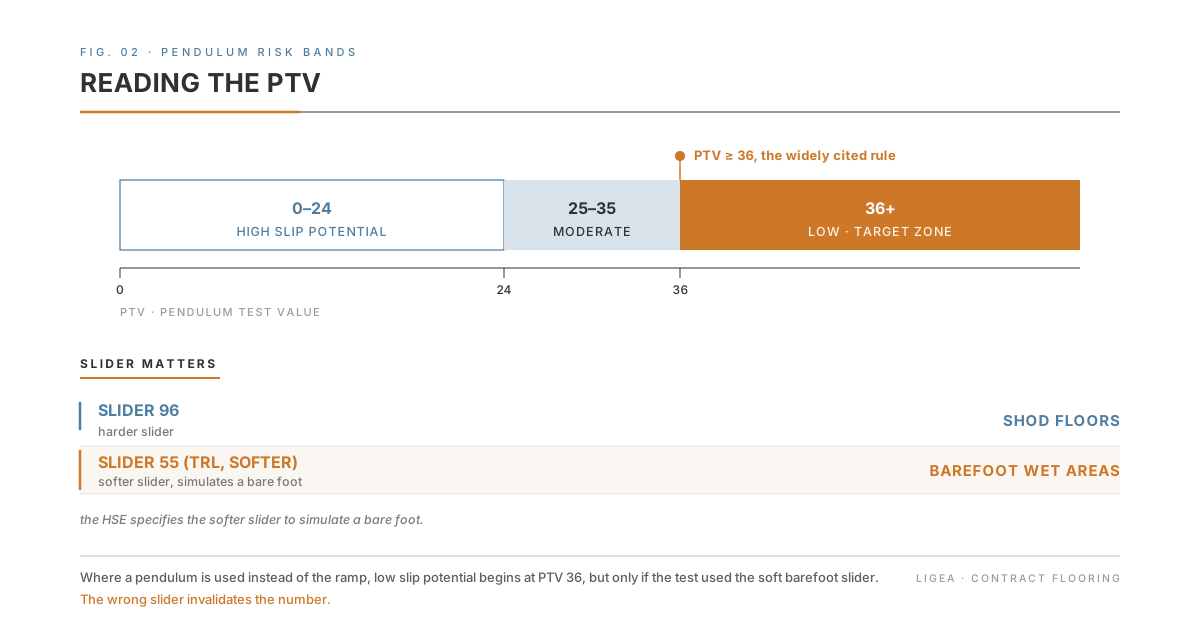
Where a pendulum reading is used instead of the ramp, the UK Slip Resistance Group and HSE risk bands run 0–24 high slip potential, 25–35 moderate, and 36+ low, the widely cited "PTV ≥ 36" rule. For barefoot wet areas the HSE specifies the softer Slider 55 (TRL) rubber to simulate a bare foot, distinct from the Slider 96 used for shod floors (HSE). For pools, spas and hot tubs, NSF/ANSI/CAN 50 asks for a wet slip resistance value of ≥ 40 by pendulum; for these barefoot surfaces accredited testing labs recommend the softer Slider 55, though the standard itself does not mandate a specific slider (NSF).
On hard surfaces, the US measure is dynamic coefficient of friction under ANSI A326.3: wet interior floors need a wet DCOF ≥ 0.42, and the 2022 revision added situation-specific minimums up to 0.55. Worth flagging honestly: critics note 0.42 "sets a very low bar" and does not guarantee safety under real soapy, barefoot conditions, and practitioners commonly insist on ≥ 0.60 for showers and spa wet floors and treat 0.42 as the legal minimum, not the target (TCNA).
Two practitioner tricks are worth carrying into any wet-zone conversation. Small-format mosaic (roughly 2×2 inch or smaller) adds grout joints that act as "thousands of tiny edges" for grip and can follow the fall to a drain; large-format tile can do neither well. And every grippy rating is for clean water: soap, body oil and lotion films defeat a high number, which is the real-world reason wet zones need both texture and drainage, not texture alone.
The stakes are not abstract. Slips, trips and falls on the same level are the single most common cause of non-fatal workplace injury in the UK (around 30% of RIDDOR-reported non-fatal injuries in 2024/25), and accommodation and food service carried the highest rate of non-fatal injury of any UK industry, with slips and trips a leading cause (HSE).
022. Moisture and Mould: The 60% Rule and the 48-Hour Window
Mould is not a property of a material; it is a property of conditions. The building-science and EPA consensus is to hold indoor relative humidity below 60% (ideally 30–50%); above roughly 60% RH most common moulds can sustain growth on a susceptible, soiled surface (EPA). Spa wet zones routinely blow past that, which is why ventilation and dehumidification are part of the floor specification, not separate from it.
Timing is the other half. Spores develop into active mould in roughly 24–48 hours on wet material, and that window is the design target for drying, drainage and air movement (EPA). Positive slope to a drain is the most-skipped fundamental in the whole category: without it, water ponds, biofilm forms, and no surface rating saves you.
Fibre choice changes how a surface behaves in that window. Organic fibres such as wool, jute and sisal absorb and hold water; solution-dyed synthetic constructions do not absorb and dry fast, which is precisely why they dominate pool decks and outdoor terraces. And the carpet-specific truth, stated plainly by the Carpet and Rug Institute, is that "growth of fungi and other microorganisms cannot occur on carpet or any other surface without a nutrient source and water" (CRI). Dry, clean carpet does not breed mould. Soiled, repeatedly wetted carpet does. The engineering answer where carpet meets humidity is a moisture-managing or impervious backing: open-cell or non-PVC attached backings exist specifically so moisture can evaporate rather than be trapped against the slab, and some manufacturers market breathable backings as tolerant of high slab moisture, a claim worth checking against the specific product's warranty rather than taking as a category rule.
033. What Antimicrobial Treatment Actually Does, and Doesn't
This is the most over-claimed corner of the category, so it pays to read the fine print of the people who sell the technology. A leading antimicrobial brand's own disclaimer states that its technologies "are not designed to protect users or others from disease-causing microorganisms or viruses and are not a substitute for normal cleaning practices." The headline "up to 99%" figures describe protection of the product (against odour, staining and material degradation), not protection of the guest (Microban).
The Carpet and Rug Institute is equally measured. Its antimicrobial-treatments bulletin states that "currently, there are no carpets registered as finished treated articles, therefore no healthcare claims can be made or implied for carpets," that EPA's treated-article rules let a treated carpet make claims "only related to protection of the treated article against bacterial- or mold-related odors and staining," and that "regardless of how well the antimicrobial treatments perform, they are not substitutes for proper care, cleaning and maintenance of the carpet" (CRI). Independent research reinforces the limit from the other direction: a 2024 study testing three EPA-registered antimicrobials and steam against norovirus surrogates on nylon carpet found the chemical treatments achieved only limited virus reduction, particularly on waterproof-backed carpet, and that repeated use degraded the backing and fibres, showing how genuinely hard carpet is to disinfect of viruses and why it belongs out of true wet and contamination zones rather than being redeemed by a treatment (ASM Journals).
So the honest buyer position is: antimicrobial additives are worth having as a maintenance aid, particularly built into the backing where odour and microbes accumulate between floor and carpet. They are not a hygiene claim, not a substitute for a cleaning regime, and not a licence to put carpet where it will get repeatedly soaked. In commercial spa practice the real hygiene lever is cleaning frequency (grout-line scrubbing, drain disinfection, descaling and antimicrobial mopping into corners and around fixtures), not the material's marketing.
044. Where Carpet Belongs: The Dry Emotional Core
Carpet's spa role is not a compromise; it is a different job from the wet deck. Hard, matte, well-drained, high-traction surfaces own the genuinely wet zones (pool surrounds, showers, steam and thermal rooms), with linear drains to prevent ponding and chemical-resistant grout where pool chemistry is present. Carpet and bespoke rugs own the dry relaxation lounges, quiet rooms, treatment-room approaches, spa reception and transition corridors, where the brief is warmth, acoustic calm and a sense of luxury.
The reason is physical, not decorative. Carpet absorbs sound where stone, glass and plaster reflect it, which is directly relevant to a relaxation lounge whose entire purpose is hush. And a carpeted room can be held 2–3 °C cooler without feeling colder to the occupant, because the surface itself reads as warm underfoot. That is a comfort and energy argument in exactly the rooms a spa wants to feel enveloping.
The practical detailing rule that ties the two worlds together: specify carpet for the dry core with a moisture-managing or impervious backing, and design a proper threshold at the wet-zone boundary (an absorbent barrier and a clear drainage break), so water from the deck is stopped and dried before it reaches the pile. Hard surface where it is wet, carpet where it is dry, and a deliberate transition between them is the whole of good spa flooring zoning.
05Where ligea Comes In
In a spa we only put carpet where it belongs: the dry rooms such as relaxation lounges, treatment rooms and corridors, with hard, drained surfaces in every wet zone. For that dry core we usually propose woven Axminster in 80/20 wool-nylon or pure wool, or a hand-tufted rug from our Royal family where a lounge needs a soft centrepiece with relief. EN 13501-1 up to Bfl-s1 is reachable where the fire strategy asks for it.
Backing and threshold details are chosen for the humidity each room actually sees. Colour is matched to Pantone TCX, NCS, RAL or a physical sample and confirmed on a strike-off before production, and because we work with several producers we can normally start production directly.
Explore our contract surfaces, or talk to us about your project.