
Restaurant & F&B Carpet: Stains, Grease and Cleanability
A buyer's guide to restaurant and F&B carpet: fibre and dyeing, grease and stain resistance, spot-clean protocols, acoustics, fire ratings and slip-safe thresholds.
A restaurant floor lives a harder life than almost any other surface in hospitality. In a single service it meets red wine, balsamic, candle wax, butter, fryer grease tracked out of the kitchen on a server's sole, and the steady grind of chair legs and trolley wheels. Then it has to look composed again before the next cover sits down. That is why carpet in food and beverage spaces is so often argued about: designers want its warmth, acoustic calm and pattern, while operators fear a floor they cannot keep clean. Both are right. The way to reconcile them is not a single magic product but a handful of specification choices that decide, before anything is woven or printed, whether the floor will age gracefully or turn into a maintenance liability. Here is what genuinely moves the needle.
01Fibre and Dye: Where Stain Resistance Actually Lives
The most consequential decision is made at the molecular level, long before colour or pattern. Two properties matter in F&B: how the fibre handles grease, and how the colour is fixed into it.
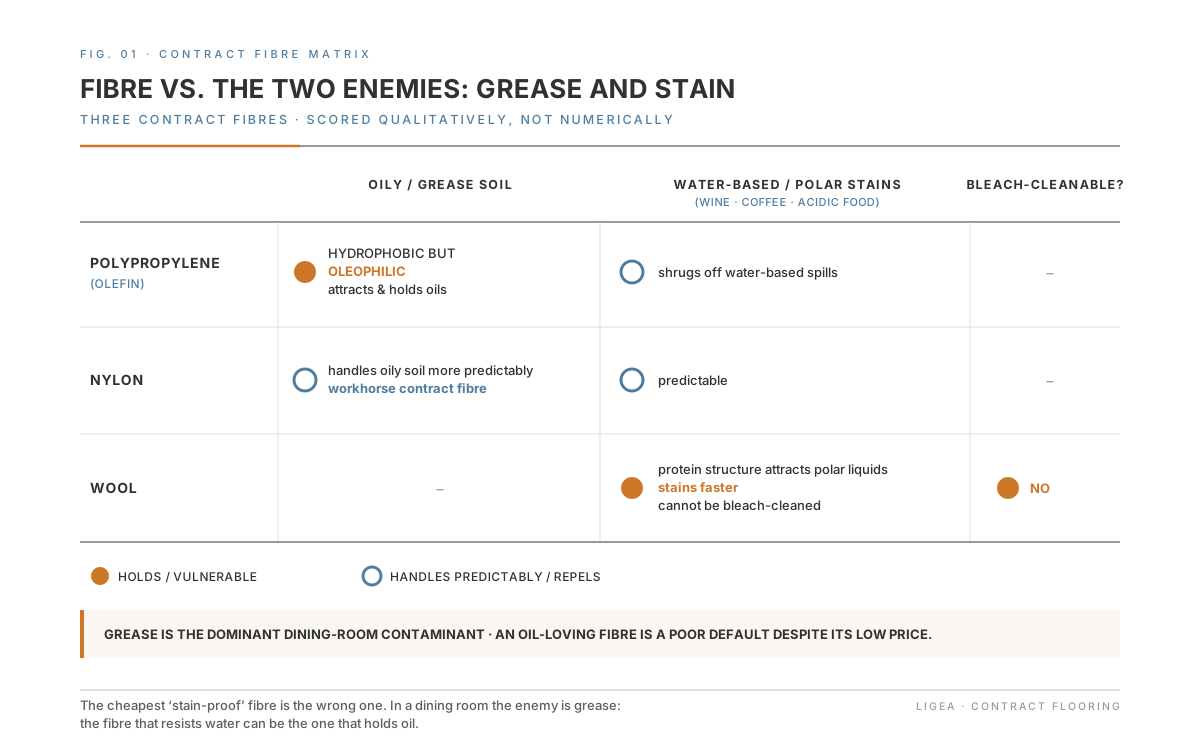
On grease, the counter-intuitive fact is that the cheapest "stain-proof" fibre is the wrong one. Polypropylene (olefin) is strongly hydrophobic and shrugs off water-based spills, but it is also oleophilic, meaning it attracts and holds oils, which are the dominant contaminant in any dining room (oil-sorbent research). For a floor whose worst enemy is grease, an oil-loving fibre is a poor default despite its low price. Nylon handles oily soil more predictably and is the workhorse contract fibre. Wool brings inherent flame resistance (IWTO) and a lanolin coat that repels dry soil, but its protein structure attracts polar liquids, so it stains from wine, coffee and acidic food colour faster than synthetics and cannot be bleach-cleaned.
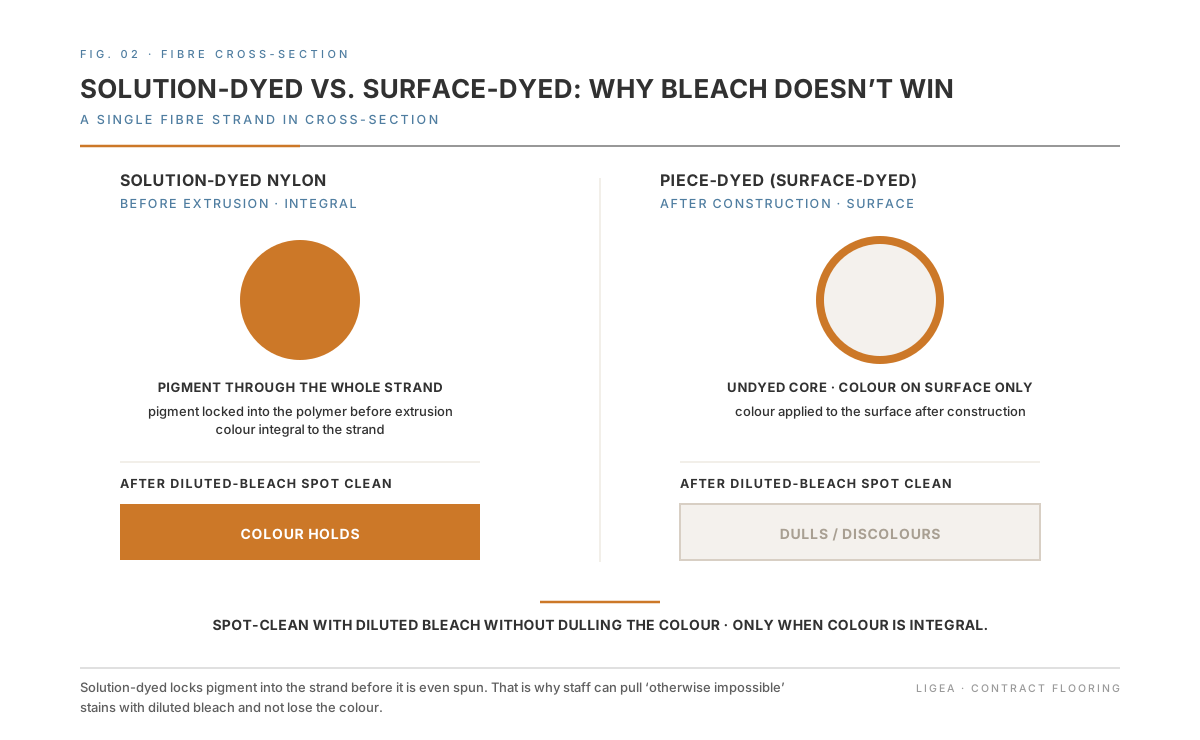
The second choice is how colour is fixed, and for aggressive cleaning regimes it is decisive. In solution-dyed nylon, pigment is locked into the polymer before the fibre is even extruded, so colour is integral to the strand rather than applied to its surface. The practical payoff is that staff can typically spot-clean a quality solution-dyed nylon with diluted bleach to pull otherwise stubborn stains without dulling the colour, though bleach-tolerance varies by manufacturer and should be confirmed on the product warranty, not assumed from the dye method alone. Piece-dyed carpet, coloured after construction, stains more readily and discolours under bleach. This distinction, solution-dyed versus surface-dyed, is the most repeated spec rule among the cleaning professionals who actually maintain these floors.
A related warning concerns topical stain guards. Fluorocarbon (PFAS) repellents wear off with traffic and cleaning, and they are now being regulated out: Maine's textile PFAS restriction took effect on 1 January 2026 (Maine DEP), and California's organic-fluorine limit for textiles drops from 100 ppm to 50 ppm on 1 January 2027. The durable answer is stain resistance built into the floor itself, through the choice of fibre, a well-fixed dyeing process and a dense construction, not a sprayed-on finish that the third deep clean removes. Where cleaning is genuinely aggressive, solution-dyed yarn adds a further margin. Colour that has to last under daylight is best specified with a lightfastness rating as well, tested to ISO 105-B02 or AATCC 16, so fade resistance is a stated number rather than a hope.
02The Honest Hygiene Question
Operators often assume carpet is inherently less hygienic than hard floor in a food setting. The evidence is more nuanced than the instinct. The Carpet and Rug Institute cites studies finding no scientific link between carpet and asthma or allergies, with carpet acting as a passive filter that traps particles out of the breathing zone; airborne particle counts are often lower over carpet than over hard floors (CRI).
The honest caveat is that this holds only with disciplined maintenance. A neglected F&B carpet genuinely harbours grease and odour, and routine vacuuming, which removes 90–95% of dry soil by weight, is the cheapest and most-skipped line of defence (CRI). The realistic conclusion for buyers is neither "carpet is dirty" nor "carpet is fine," but "carpet is fine where the operator commits to a cleaning rhythm, and risky where they will not." Spec the floor to match the housekeeping you will actually get.
03Spot-Clean Protocols Built for Grease
The cleaning method has to match the contaminant, and grease is the one most cleaners get wrong. Oil and grease resist water-based cleaners; they need dry or organic solvents, or a d-Limonene-type spotter, to break the bond. A water-based cleaner on a grease stain simply spreads it.
The professional protocol order is consistent across sources: scrape or blot solids first, blot liquids with a dry white cloth rather than rubbing, work from the perimeter inward to avoid spreading the ring, test any solvent in an inconspicuous spot, let it dwell briefly, then blot and swap saturated cloths. Speed is everything: the longer a stain sits, the higher the chance it becomes permanent.
Beneath the spot-cleaning sits a deeper-clean strategy. Hot-water extraction (often called steam cleaning, though no live steam is involved) is the dominant restorative method, and for greasy rooms practitioners favour a two-phase programme: an aggressive first restorative extraction with a degreaser pre-spray to break the grease, then a transition to lower-moisture interim maintenance whose fast dry time lets the venue reopen the next day. Two methods to avoid: bonnet or spin cleaning, which voids many manufacturer warranties, and over-wetting, which risks delamination of the backing.
04Acoustics: Designing a Buzz, Not Silence
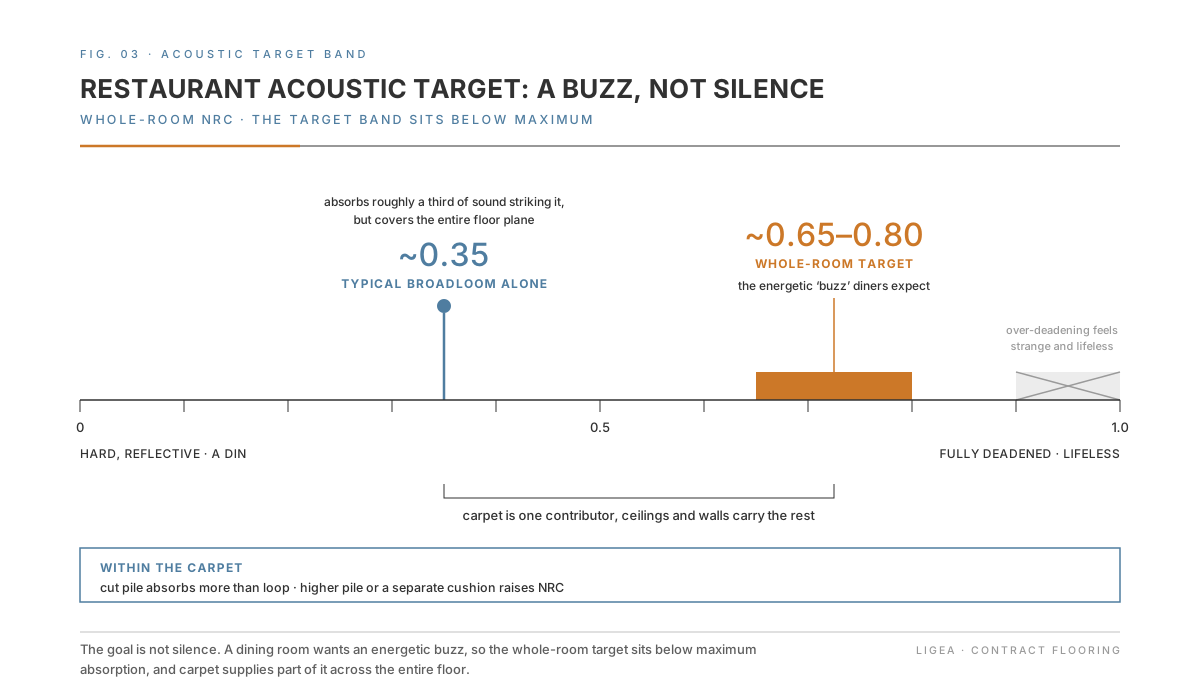
Acoustics are the single best argument for carpet in dining, and the figures are worth knowing precisely. A typical broadloom carpet has a Noise Reduction Coefficient (NRC) of around 0.35, meaning it absorbs roughly a third of the sound striking it. That sounds modest, but carpet's advantage is that it covers the entire floor plane, so even a moderate NRC meaningfully cuts the reverberation that turns a busy room into a din.
The design target for a restaurant is not maximum absorption. A whole-room NRC of roughly 0.65–0.80 is the usual aim, because diners expect an energetic "buzz", and over-deadening a dining room feels strange and lifeless. Carpet is one contributor; ceilings and walls carry the rest. Within the carpet itself, cut pile absorbs more than loop, and higher pile or a separate cushion raises NRC further.
Carpet's other acoustic role is structure-borne: footfall, scraped chairs and dropped cutlery. Here carpet with underlay is the most effective floor treatment because it attacks impact noise at the source, where hard tile offers almost none. One designer's rule is non-negotiable: address acoustics in early design, because retrofitting a noisy room after opening is, as one trade source puts it, "outrageously expensive."
05Fire, Format and the Threshold Detail
Three more specification points decide whether a restaurant floor passes inspection and survives operationally.
Fire. Floor coverings in egress paths are judged on critical radiant flux under ASTM E648 (equivalent to NFPA 253). The thresholds are Class I at ≥ 0.45 W/cm² and Class II at 0.22–0.44 W/cm² (ASTM E648). General commercial spaces commonly require Class II, while exit corridors and egress routes often require Class I, which is relevant for restaurant lobbies and service corridors. In the EU the equivalent system is EN 13501-1, which classifies floor coverings from Afl down to Ffl with an added smoke index (s1/s2); fire engineers commonly specify Cfl-s1 for public hospitality areas and the stricter Bfl-s1 for escape routes and enclosed public spaces (RISE). Exact requirements vary by member state and occupancy, so confirm the achieved rating on the product documentation, since it depends on the full construction, not the fibre alone.
Format. For F&B, carpet tile carries a quiet operational advantage: an individual grease-soaked or damaged tile can be lifted and swapped from attic stock without closing the room, whereas broadloom usually means a patch or a section. Broadloom still wins on seamless, custom-woven luxury and pattern scale. Many rooms split the difference: broadloom or rugs in the dining core for warmth and acoustics, with the worst grease zones detailed differently.
Thresholds and slip. The real trip risk in a restaurant is not the carpet field but the transition to hard floor. Under ADA guidance, a change in level of 6 mm (¼ inch) or more is a trip hazard; up to 6 mm may be untreated, and up to 13 mm only if bevelled at a slope no steeper than 1:2 (US Access Board). Accessible carpet should be a firm, low-profile construction (level loop or low cut pile, pile height ≤ 13 mm, on a firm cushion or none), which also rolls trolleys better than deep plush. Where carpet meets a wet hard-floor zone such as an entrance or server station, the adjacent hard surface should meet a dynamic coefficient of friction (DCOF) of ≥ 0.42 for interior wet areas (TCNA).
One upstream move protects everything downstream: entrance matting. Industry guidance credits roughly 12–15 ft of walk-off matting with capturing 85–90% of tracked-in soil and moisture, with a 15–25 ft zone recommended at the busiest entries (Carpet and Rug Institute). It is the cheapest way to keep grease and grit off the dining carpet in the first place.
06Where ligea Comes In
We prefer to dye the yarn ourselves, because it leaves the colour completely free: every shade is matched to Pantone TCX, NCS, RAL or a physical sample and confirmed on a strike-off before production. Where the cleaning regime is extreme, a solution-dye palette is available as an option. For most dining rooms that means woven Axminster in 80/20 wool-nylon or 100% wool, with matt and gloss zones that help hide traffic lanes, and EN 13501-1 up to Bfl-s1 where the code asks for it; print is the alternative where the scheme wants soft gradients.
Because we work with several producers, we can normally start production directly: 2–4 weeks for print and 4–8 weeks for Axminster once design, colour, strike-off and mockup are signed off.
---
ligea engineers contract surfaces for hospitality projects worldwide, matched to your design, your construction and your budget. If your next floor has to survive a full service and still look composed, see our surfaces or book a 15-minute spec call.