
Wool vs Nylon vs Blends: How to Choose Contract Carpet Fibre
A buyer's guide to contract carpet fibre (80/20 wool-nylon, 100% nylon and solution-dyed) covering durability, appearance retention, inherent flame resistance, look and cost.
Every hospitality carpet decision eventually narrows to one quiet question on the spec sheet: what is the floor actually made of? It is easy to treat fibre as a line item (wool here, nylon there, a blend to hedge), but that one choice sets the project's fire classification, how the floor looks in five years, how it cleans, and a cost picture that varies enormously with the grades on the table. The headline contest is wool against nylon, with the 80/20 blend sitting between them as the supposed safe answer. It is worth knowing what each fibre genuinely buys you before the value engineering starts cutting.
01The Fire Story: Why Wool Is "Inherently" Flame Resistant
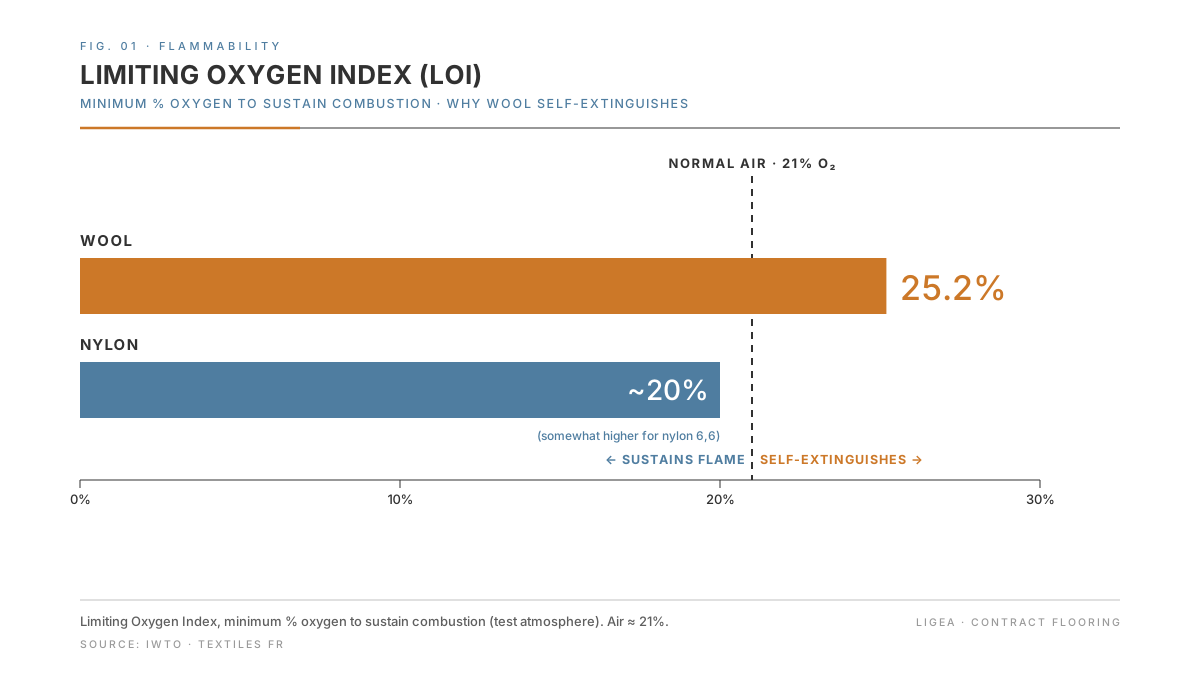
This is the one technical fact about wool that holds up under scrutiny. Flammability of a fibre is captured by its Limiting Oxygen Index (LOI): the minimum percentage of oxygen, measured in a controlled oxygen/nitrogen test atmosphere, needed to just sustain combustion. Normal air is about 21% oxygen. Wool sits at roughly 25.2% LOI, the highest of the common natural fibres, while nylon is around 20% (somewhat higher for nylon 6,6) (IWTO). Because wool needs more oxygen than ordinary air provides, it does not readily sustain a flame; it self-extinguishes. (Specialist flame-resistant fibres such as modacrylic and PVC sit higher still, so wool's lead is among ordinary natural fibres, not an absolute maximum.)
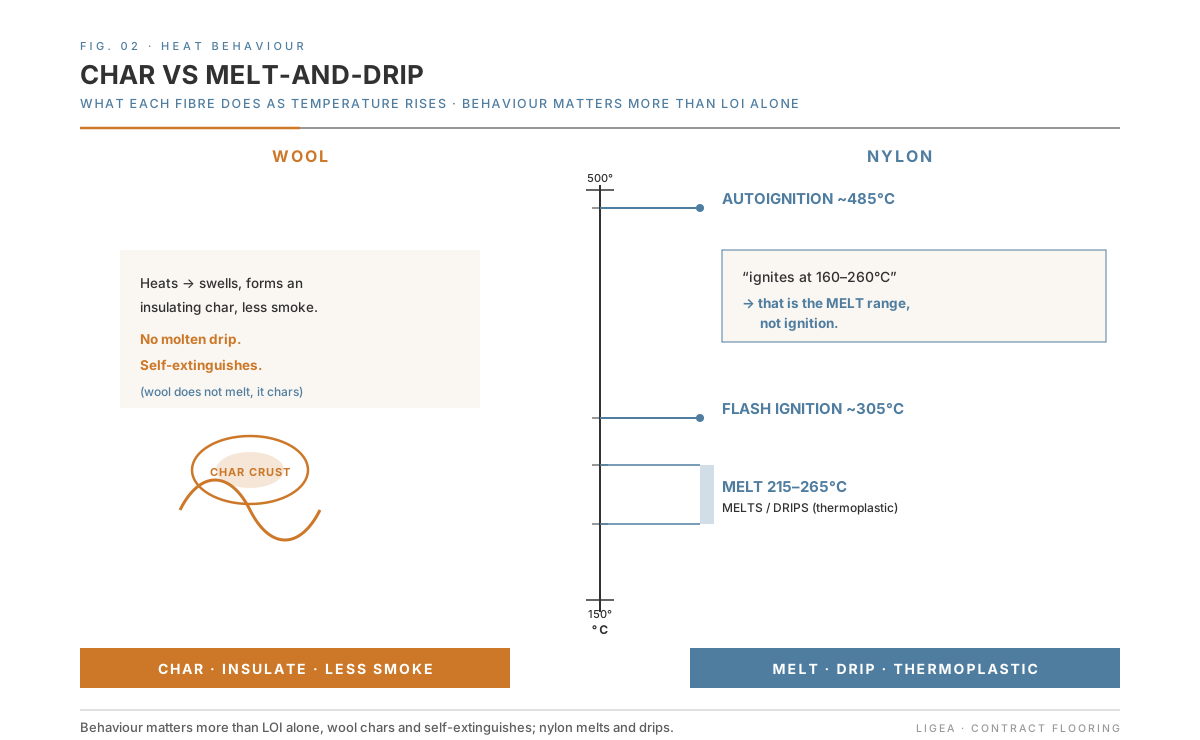
Just as important is how it behaves. Wool's nitrogen content, bound moisture and cross-linked structure cause it to swell and form an insulating char when heated, rather than melt and drip, and it tends to produce less smoke than synthetics. Nylon, by contrast, is thermoplastic: depending on the type it melts in the range of roughly 215–265°C (nylon 6 around 220°C, nylon 6,6 around 255–265°C). One widely repeated figure deserves care: sources sometimes quote nylon "igniting" at 160–260°C, but that is its melting range, not its ignition point, which is far higher (flash ignition around 305°C, autoignition near 485°C for nylon 6,6). The honest summary is that wool's real safety advantage is self-extinguishing behaviour and no molten drip, not a simple "ignites later" claim.
The practical upshot for specifiers: wool can often reach demanding floor classifications without chemical flame-retardant treatment, where a synthetic may need help. In the EU, floor coverings are rated under EN 13501-1 (the "fl" suffix), with the radiant-panel method of EN ISO 9239-1 as the principal flooring test; hotel corridors and escape routes typically call for Bfl-s1, where "s1" caps smoke production (RISE). In the US the equivalent is ASTM E648 / NFPA 253 critical radiant flux, with Class 1 (> 0.45 W/cm²) required in many corridors and exits, on top of the federal "pill test" (ASTM D2859) every carpet must pass (ASTM E648). Whichever market you build in, confirm the classification on the documentation, not from the fibre alone, since the achieved rating depends on the whole construction (pile weight, density, backing), not the fibre in isolation.
02Durability and Appearance Retention: Two Different Things
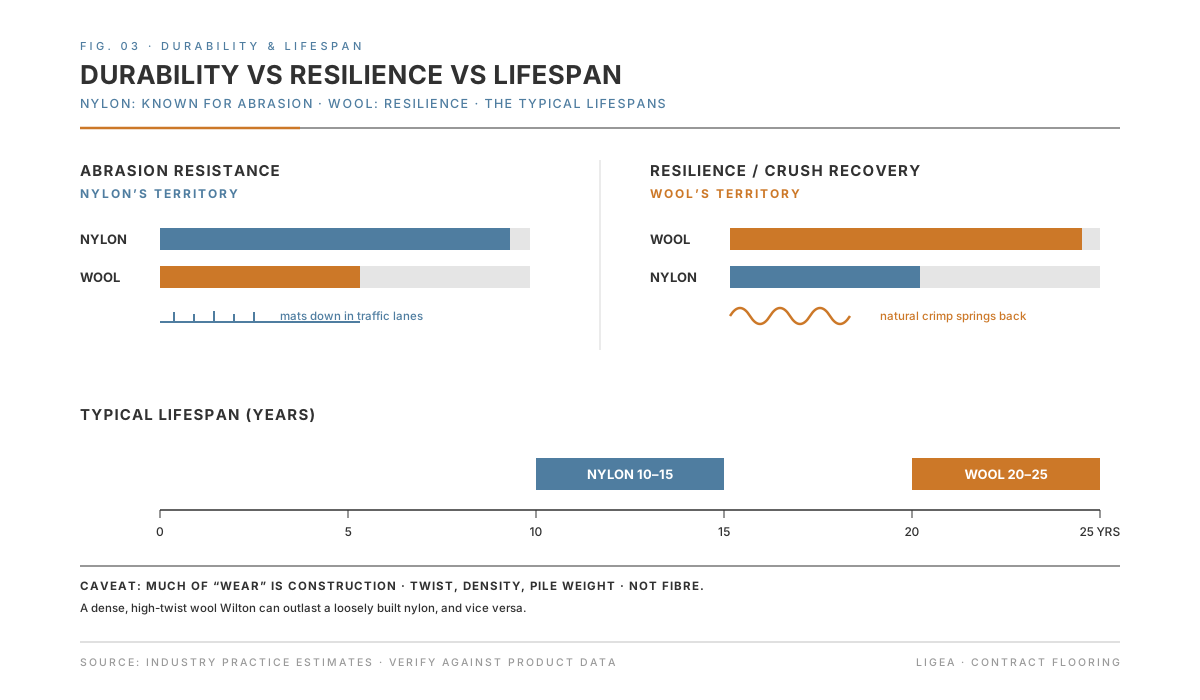
Buyers tend to collapse "durable" into one idea, but two distinct properties are in play, and wool and nylon split them.
Abrasion resistance is the property nylon is best known for. It is widely marketed as the toughest of the common carpet fibres, and the nylon share in an 80/20 blend is added, by long market convention, for strength and wear; in practice the construction around the fibre decides as much as the fibre itself. Resilience, recovery from crushing and furniture compression, is wool's. Wool's natural crimp lets the fibre stretch and spring back, so it tends to recover from crush better than synthetics, which are more prone to mat down and flatten in traffic lanes. Over a full life cycle, trade rules of thumb credit well-built wool floors with 20–25 years against roughly 10–15 years for nylon: construction-dependent estimates rather than fibre physics, and in branded hotels the 5–7-year soft-goods cycle usually replaces the carpet long before either limit.
There is an important caveat that cuts across fibre choice: much of what looks like "wear" is really construction. Crushing and traffic-lane matting show up fastest in plush, low-twist cut pile regardless of the fibre on the label. Higher twist levels and denser constructions resist flattening, so a dense, higher-twist wool Wilton can outlast a loosely built nylon in a corridor, and vice versa. Fibre is one variable; pile weight, density and twist are the others.
03Does the 20% Nylon in 80/20 Actually Earn Its Place?
The default luxury contract spec is 80% wool / 20% nylon, and the standard justification is that the nylon "reinforces" the wool for durability without sacrificing its look or fire performance. It is worth knowing that this dogma has been directly challenged. A lab study from the WoolSafe Organisation, reported by Cleanfax, compared 100% wool against an 80/20 blend under recognised wear and soiling protocols and reported that 100% wool held its pile thickness better in the critical early years, while the 80/20 blend showed faster loss of pattern clarity, more flattening, and trapped more soil, keeping higher residual soil even after cleaning. Its conclusion was that the nylon delivered no durability extension and performed worse on appearance retention (WoolSafe Organisation study, reported in the trade press).
Two honest caveats. WoolSafe is a wool-aligned body, so weigh the source. And the study isolated fibre composition (not density, twist or face weight), so it does not overturn the construction-quality argument above. The practitioner consensus on trade forums remains that pure wool alone "is not very hard wearing" and that the 20% nylon is added for strength, which is why 80/20 stays the trade default. The useful takeaway is not that the blend is wrong, but that "80/20 is automatically tougher than pure wool" is not a settled fact, and the answer depends on where the floor lives.
04Solution-Dyed Nylon: The Third Option for Light and Bleach
When the enemy is sunlight or aggressive cleaning rather than footfall, the relevant choice is not wool versus nylon but how the nylon is coloured. In solution-dyed nylon, pigment is added at the extrusion stage so colour runs through the fibre rather than being applied to its surface. That tends to make it highly resistant to fading, UV and bleach or cleaning-chemical spills; many solution-dyed products can be cleaned with diluted bleach without colour loss (Carpet & Rug Institute). It is the rational pick for sunlit lobbies and atria, and for food-service floors that see harsh cleaning cycles. One caveat worth flagging: "solution-dyed" is not automatically a guarantee of bleach-proofing: quality varies between products, so it is a property to verify, not assume.
05Look and Cost: The Trade-off You Feel and the One You Pay
Aesthetically, the fibres read differently underfoot and in photographs. Wool has a matte, subdued surface with a natural depth: its scaled, irregular fibre scatters light, which is the warmth designers prize and synthetics try to imitate. Nylon's rounder, smoother filament reflects more light, giving a subtle sheen that reads clean and modern but can look slightly plastic and tends to frizz as it wears, losing loop-pile crispness. A capable woven construction can also blend matte wool with a touch of nylon sheen for deliberate textural contrast within a single design.
Then there is the bill, and here the honest answer is that there is no fixed multiplier between the two fibres. The spread inside each fibre is as wide as the gap between them: New Zealand wool sits far above blended wools, and a premium branded nylon can cost more than a mid-grade wool. Comparing "wool vs. nylon" on price only works once the actual grades are on the table. Woven Axminster and Wilton for luxury hospitality sit at the top of that range: Axminster for intricate multi-colour patterns in lobbies, ballrooms and casinos; Wilton for dense, hard-wearing corridors with fewer colours. The discipline most operators eventually adopt is to decide on life-cycle cost, not material price: a 20–25-year wool floor in a suite against a 10–15-year nylon in a convention hall is not the same calculation. One operational footnote that protects the investment either way: wool needs pH-neutral cleaning, because alkaline detergents damage the fibre, and is more vulnerable to acidic spills (wine, food, pet stains) than treated nylon.
06Where ligea Comes In
We choose fibre per area, not per project. Axminster comes in 80/20 wool-nylon as the usual rule or in 100% wool, and the two can sit side by side in one design: 80/20 for matt zones next to 100% nylon for gloss is one of the effects only a woven floor can do. Print runs on nylon and suits soft, gradient-led designs.
We prefer to dye the yarn ourselves, which keeps the colour free; a solution-dye palette is available where a cleaning regime calls for it. Every shade is matched to Pantone TCX, NCS, RAL or a physical sample and confirmed on a strike-off, and bulk production runs roughly 2–4 weeks for print and 4–8 weeks for Axminster once design, colour, strike-off and mockup are signed off, plus freight by route.
---
ligea engineers contract surfaces for hospitality projects worldwide, matched to your design, your construction and your budget. Whether the brief calls for wool, nylon or a blend, see our surfaces or book a 15-minute spec call.