
Pattern Repeat and Cut-Loss: Estimating Patterned Carpet for Corridors and Ballrooms
How to read pattern repeat and estimate cut-loss on patterned broadloom for corridors and ballrooms — the repeat-allowance quantisation, why waste runs 10–25% (and 20–30% for big medallions), seam placement, and the numbers behind an honest order quantity.
The single most expensive number on a patterned-carpet order is the one nobody measures: the cut-loss buried inside the pattern repeat. Specify a plain broadloom and your waste is a function of room geometry — awkward, but predictable. Add a pattern, and you introduce a quantisation rule that silently rounds every drop up to the next full repeat. On a corridor it costs a few percent. On a ballroom with a metre-plus medallion it can add a quarter to a third again on top of the net floor area — and if the estimate didn't carry it, someone eats the shortfall, the re-order or the dye-lot mismatch. This guide is about reading the repeat, costing the cut-loss honestly, and laying the drops so the pattern flows and the waste sheet stays sane.
01What a Pattern Repeat Actually Is
A pattern repeat is the distance over which a carpet's motif completes one full cycle and starts again. It has two dimensions that behave very differently in an estimate. The length repeat runs down the roll, in the direction the broadloom comes off the loom or print line; the width repeat runs across it. Because broadloom is woven or printed to a fixed roll width — imperial looms commonly produce 12 ft, 13 ft 6 in or 15 ft — the width repeat is usually engineered so that one roll width equals a whole number of pattern cycles. A pattern-aware estimate treats each full roll width as one complete pattern cycle and lets the length repeat do the heavy lifting in the cut.
The length repeat is where the money is, and it splits into two families that change how much you have to buy.
- Set match (also called a straight or full-drop match): the motif lines up side-to-side across the seam at the same point on the repeat. You "drop" the next breadth alongside the first and the pattern reads continuous.
- Drop match (half-drop or quarter-drop): the motif on one edge sits part-way down the repeat relative to the other edge, so two breadths laid edge-to-edge do not align across the seam unless you shift the second breadth down by a fraction of the repeat — a half-drop resolving only when the adjoining breadth is shifted roughly half a repeat along. That offset is dead material on every seam.
The reason this matters for estimating is simple: a drop match forces you to sacrifice up to a full repeat (or a defined fraction of one) at the start of each breadth just to bring the pattern into register. The bigger the repeat and the more breadths, the more that compounds.
02The Quantisation Rule — Why Repeat Drives the Order
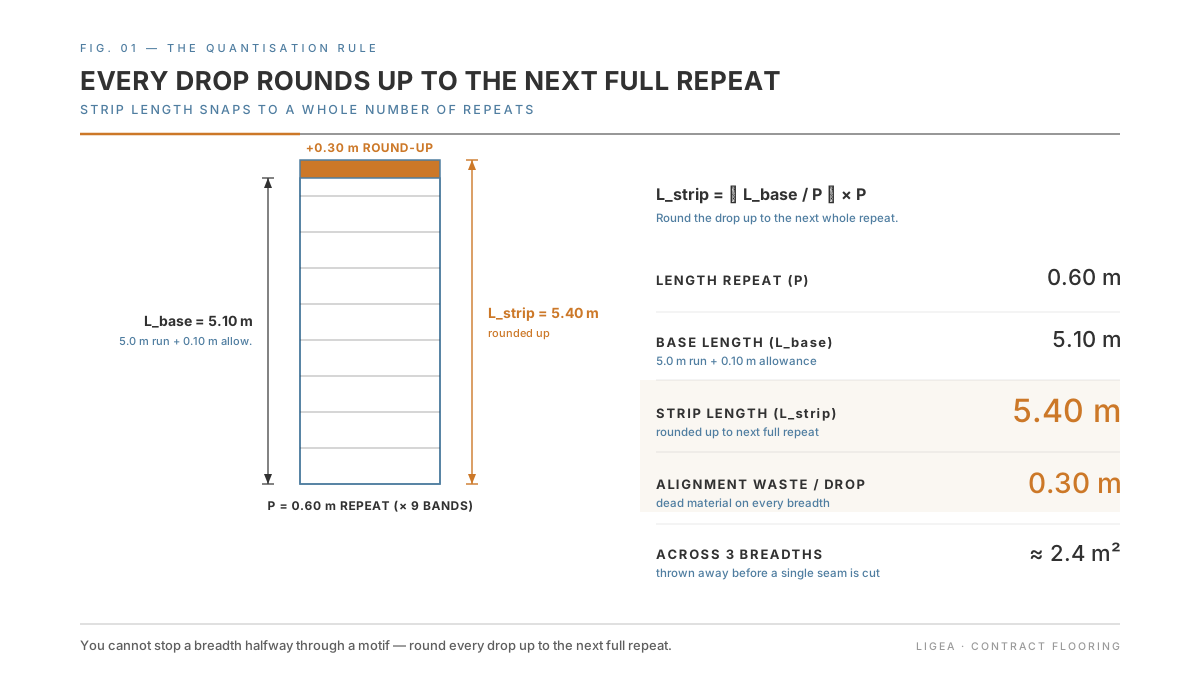
Here is the mechanic that catches people. To keep a patterned carpet matching across seams, every breadth (every "drop") has to be cut to a length that is a whole number of repeats — you cannot stop a breadth halfway through a motif and expect the next one to pick it up. So the usable length of each drop is rounded up to the next full repeat.
Formally, the strip length is the base length (room run plus trimming allowance) rounded up to the nearest repeat:
L_strip = ⌈ L_base / P ⌉ × P
where P is the length repeat and ⌈ ⌉ is round-up-to-whole. A worked example makes the cost concrete: a 5.0 m run plus a 0.10 m allowance (5.10 m base) against a 0.60 m repeat rounds up to 5.40 m per drop — 0.30 m of pure alignment waste on every breadth. Across three breadths that is roughly 2.4 m² thrown away before a single seam is cut.
Two consequences follow, and both should be in the bid, not discovered on site:
- 1. Waste scales with repeat size. A modest ~600 mm repeat barely moves the needle. A large-scale medallion of a metre or more rounds every drop up by a much larger slug. A common practitioner approximation treats the extra as roughly 0.1 × the repeat in inches as added waste — a 12-inch repeat adding on the order of a percentage point or so — but that linear rule breaks down at the large repeats used in ballrooms, where the round-up can swallow far more.
- 2. Drop match stacks on top of set match. Because a drop match also sacrifices a fraction of a repeat sideways to register the pattern across the seam, its cut-loss runs higher than a set match of the same repeat size.
03Realistic Waste Bands — 10–25%, and 20–30% for Big Medallions
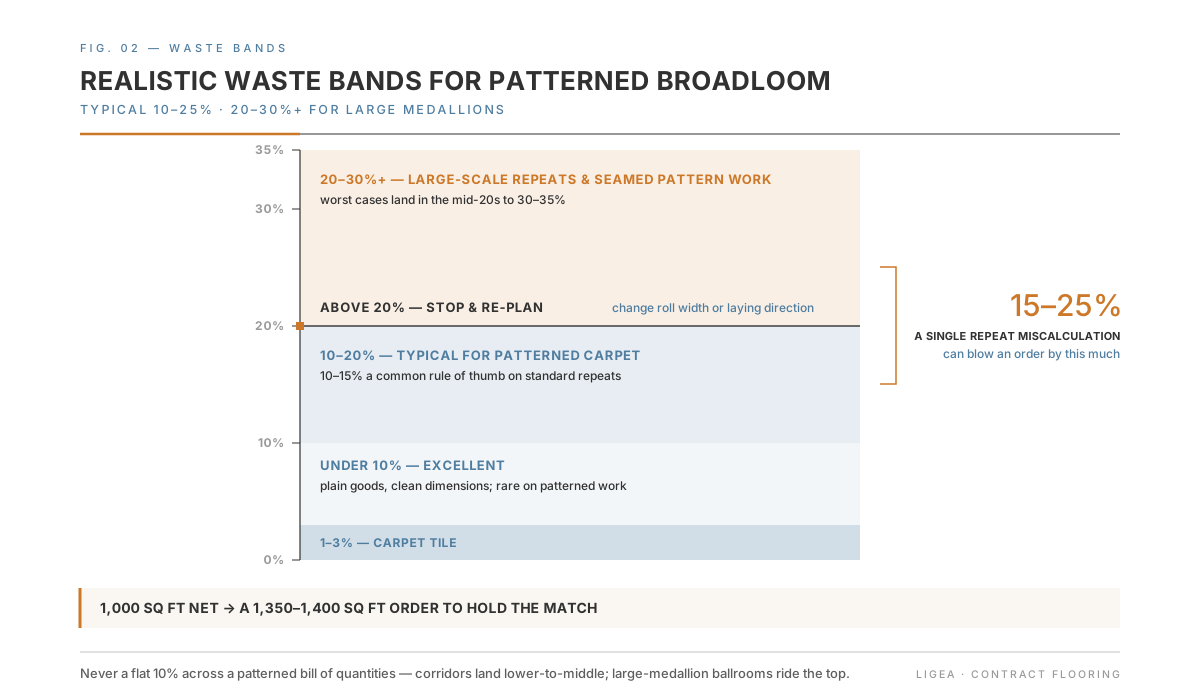
Numbers first, because this is where estimates quietly go wrong. For plain broadloom, a tidy rectangular room sits under ~10% waste; the broad working range across rooms and styles is roughly 5–25%, against a far tighter 1–5% for carpet tile — trade rules of thumb rather than codified standards. Layer a pattern on top and the bands shift up:
- Under 10% — excellent. Achievable with plain goods and clean dimensions; rare on patterned hospitality work.
- 10–20% — typical for patterned carpet or rooms with awkward proportions. Several long-standing trade rules of thumb land in the same place, advising 10–15% extra for pattern matching on standard repeats.
- Above 20% — stop and re-plan. Anything over 20% is a signal to change roll width or laying direction rather than just buy more carpet.
- 20–30%+ for large-scale repeats and seamed pattern work. Large medallions and bold repeats commonly push material requirements up by 20% or more, and practitioner accounts of heavily-seamed patterned jobs report waste landing in the mid-20s to 30–35% range in the worst cases — a 1,000 sq ft net area becoming a 1,350–1,400 sq ft order to hold the match.
The headline risk is asymmetric: a single repeat miscalculation can blow an order by 15–25%. Under-order and you trigger a re-cut from a different dye lot — visible, and in a ballroom, fatal. So the honest move is to carry the right band up front: corridors at the lower-to-middle end, large-medallion ballrooms at the top, and never a flat 10% slapped across a patterned bill of quantities.
04Corridors: Direction of Travel Decides Everything
A corridor reads as one continuous ribbon, so the estimate and the seam plan are the same conversation. Three rules carry most of the cut-loss and most of the risk.
Run the breadths — and the seams — parallel to the direction of travel, never across it. Broadloom roll widths (commonly ~3.66 m / 12 ft) are engineered so the pattern flows wall-to-wall down the run, which both minimises seams and hides the ones you keep, an approach reflected in the Carpet & Rug Institute's commercial installation standard, which calls for a seaming diagram that sets the pattern direction before the carpet is cut. Running breadths the long way also keeps the repeat round-up applied to fewer, longer drops rather than many short ones, which is materially cheaper.
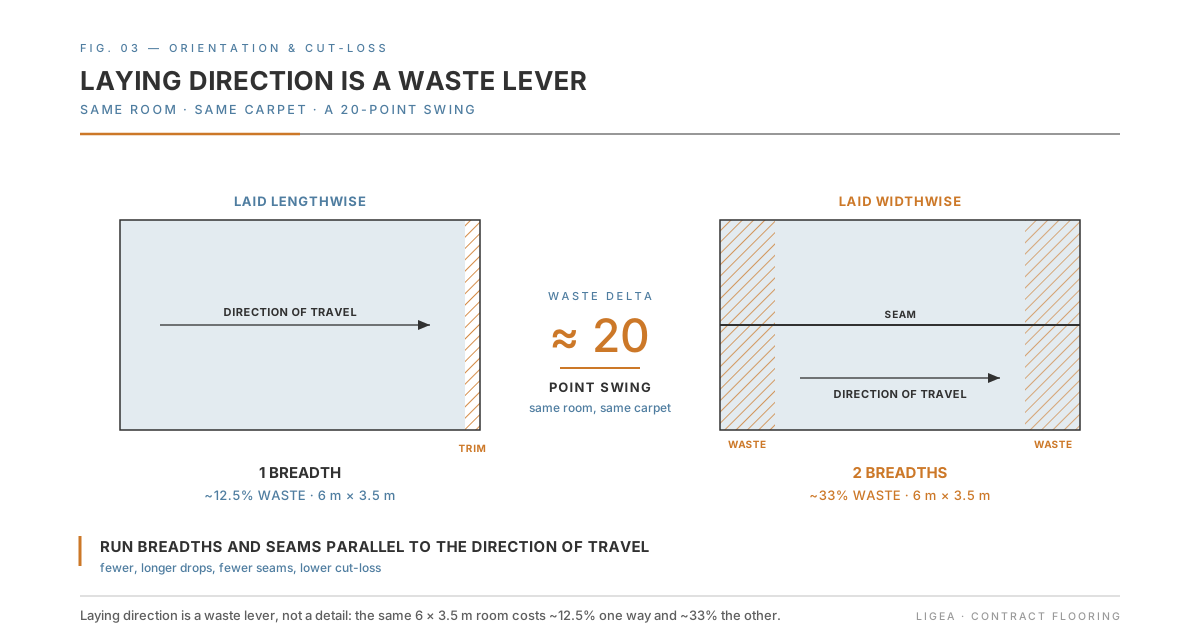
Laying direction is a waste lever, not a detail. A worked example of a 6 m × 3.5 m room is stark: laid lengthwise it needs one breadth at ~12.5% waste; laid widthwise it needs two breadths at ~33%. Same room, same carpet, a 20-point swing on orientation alone.
Borders mean a seam at every door — budget the cut-loss there. Corridor borders (typically ~150–250 mm) and the field carpet meet at thresholds and transitions, and each junction is a planned seam where the pattern has to register on both sides. Each of those breaks consumes alignment material; on a long corridor with many guestroom doors, those border seams are a recurring line item in the cut-loss, not a rounding error. Planning them onto the floor plan before ordering lets them fall in low-visibility lines along walls and thresholds, so the design reads continuous across each junction. As a practitioner rule of thumb, shorter, low-pile patterns tend to show seams more than deep textured goods, so keeping those junctions in least-trafficked sightlines matters most on tight loop constructions.
05Ballrooms: The Medallion Is the Estimate
A ballroom is the hardest case because the design intent — a large centred medallion, a framed field, a pattern that resolves to the room's axes and architectural features — fights the cut-loss directly. The bigger and more centred the motif, the more each drop must be positioned to a specific point on the repeat, and the more the round-up rule bites. Hospitality practice is to plan medallion and field alignment to stage, seating and circulation axes during specification, which means the estimator cannot just multiply area by a flat factor — the layout itself dictates where the waste lands.
Three things deserve explicit attention on a ballroom bill of quantities:
- Carry the 20–30% band, and model it from the actual repeat, not a default. A metre-plus repeat against the room's longest run can round every drop up by a substantial slug, and net-versus-ordered area compounds fast.
- Drop match multiplies it. If the medallion or field is a half- or quarter-drop, add the sideways register loss on top of the length round-up — the two are independent, and both are real.
- Order in one dye lot, full stop. A ballroom is the least forgiving place on earth for a lot mismatch, and large-floor pattern continuity depends on dye-lot control and installation sequencing. Under-ordering to "save" 5% and then re-cutting from a second lot is the most expensive economy in the trade.
06The Field Truth: Tolerances, and Who Warrants the Match
Here is what separates a clean estimate from a clean installation: patterned broadloom is not geometrically perfect off the roll, and no mill warrants the pattern match. Mills treat four conditions as normal processing variation within tolerance — bow, skew (bias), elongation and trueness of edge — not as defects, and there is no single industry standard governing them; as a neutral industry body's guidance on bow, skew and trueness of edge puts it, with no industry standards for these pattern variations each producer develops its own manufacturing tolerances, measured on a pre-installation width of carpet.
The commonly cited working tolerances, useful to know before anyone calls a roll "defective":
- Pattern bow (wavy pattern lines across the width): commonly around 1 inch in 12 feet, though it varies by maker.
- Pattern skew / bias (one side running ahead of the other): no fixed industry number; most makers sit near 1.5 inches in 12 feet, with some allowing as much as 2 inches in 12 feet, and installers are generally expected to correct skew within that band during installation.
- Pattern elongation / run-off (repeat length drifting breadth to breadth): routinely 1 inch in 10 feet, or 1.5 inches in 15 feet.
- Trueness of edge: around 1/2 inch in 12 feet.
These figures are practitioner conventions rather than a codified standard. The practical consequences for a spec are firm: where possible, install patterned broadloom by stretch-in, since it gives the installer room to pull bow and skew into register — glue-down resolves the pattern less forgivingly. The Carpet & Rug Institute's installation standard sets out the mechanical stretching, stay-nailing and seam-matching procedures used to bring a pattern into register at seams and along walls. Dry-lay before bonding, confirm tolerances at order stage, and flag any out-of-tolerance condition before or during installation — because manufacturer warranties generally exclude carpet cut and installed with visible defects, a mismatch glued down and disputed afterwards is the buyer's problem, not the mill's.
07Where ligea Comes In
Every patterned-carpet order is two estimates pretending to be one: the net floor area the designer drew, and the cut-loss the repeat actually forces. Get the second wrong and the project pays for it as a dye-lot re-cut, a delayed opening or a ballroom medallion that doesn't centre. Holding both together — reading the repeat, costing the round-up honestly, and laying the drops so the pattern flows and the waste sheet stays defensible — is exactly the work we take off your desk.
At ligea we estimate patterned broadloom from the floor plan, not from a flat percentage. We read the length and width repeat, model the drop layout and seam plan to the direction of travel in corridors and to the medallion axes in ballrooms, and carry the right waste band — typically 10–25% on standard repeats, up to 20–30% where a large medallion forces it — so the order is right the first time and ships in a single dye lot. Because we work across multiple producers, we can match the pattern, the repeat and the roll width to the room rather than bending the room to one loom's geometry, and choose set or drop match deliberately rather than inheriting it. AI-assisted rendering lets the designer see the medallion centred and the corridor border resolved before anything is cut, so sign-off lands sooner and the repeat is confirmed on a physical strike-off before bulk. One partner, brief to delivery — the cut-loss costed honestly, the seams planned where they disappear, and the pattern flowing wall-to-wall.
Explore our surfaces and constructions, or talk to us about a patterned corridor or ballroom estimate.