
Face Weight vs Density: How to Actually Read a Carpet Spec
Face weight is the number everyone quotes and the one that misleads most. Here's how to read a contract carpet spec properly — face weight vs density, the formula behind durability, and the hospitality thresholds that matter.
There is one number that gets quoted in every carpet conversation, written on every sample tag, and used to win or lose more specifications than it should: face weight. "It's a 40-ounce carpet." Said with confidence, it sounds like a verdict on quality. It isn't. Face weight tells you how much yarn sits on the surface of the carpet — and almost nothing about whether that carpet will still look right after five years of rolling luggage and housekeeping carts.
The number that actually predicts that is density, and density is the one number most spec sheets don't print. This piece is a decode: what face weight really measures, why density is the better durability signal, how to calculate it yourself when it's missing, and the hospitality thresholds that separate a guestroom-grade construction from one that belongs in a corridor.
01What Face Weight Actually Measures
Face weight — also called pile weight — is the mass of the pile yarn per unit of carpet area, the yarn you can see and walk on, measured above and below the backing line but excluding the backing itself. In North America it is quoted in ounces per square yard (oz/yd²); in the rest of the contract world it is grams per square metre (g/m²). The conversion is straightforward: 1 oz/yd² is roughly 33.9 g/m², so a 40 oz/yd² carpet is about 1,356 g/m².
This is a real, standardised measurement, not marketing. It is the property tested under ASTM D5848, the standard test method for mass per unit area of pile yarn floor coverings — the method previously folded into the older D418 — and the same property appears in European classification as "pile mass." So far so good. The problem is not that face weight is wrong; it's that it is incomplete, and it gets used as if it were the whole story.
Here is the trap. The same weight of yarn can be packed tightly into a short, dense pile, or stretched thinly into a tall, loose one. The first holds its shape; the second crushes and mats. Face weight cannot tell the two apart, because it measures the yarn and ignores how it is arranged. The mechanism is well understood: a tall, shaggy pile with a high face weight crushes and mats easily under traffic, while a dense, low-pile carpet maintains its appearance much longer because the short, tightly packed fibres support each other.
There is a cruder trap underneath that one, and it survives because it works. A seller can quote total weight — pile plus backing plus everything — instead of face weight, because total weight is a bigger number that can make a thin carpet sound substantial. Buyer-side guidance warns that an 80 oz total weight can hide a face weight of only around 35 oz, the rest being heavy backing that does nothing for performance — so watch for the pitch "this is a great 80 oz carpet" without the word "face" in front of it. On a contract spec sheet, always confirm you are reading face/pile weight, not total or roll weight. The two are not interchangeable, and the gap between them is exactly where a weak construction hides.
02Density: The Number That Predicts Wear
Density is the relationship face weight leaves out: how tightly the yarn is packed into a given volume of carpet. Two constructions with identical face weight can have very different densities, and the denser one will almost always wear better. The reason is mechanical, not magical — densely packed fibres brace each other against the lateral crushing that footfall and wheeled loads apply, so the pile springs back instead of flattening into permanent traffic lanes.
The industry has a memorable way of stating this: carpet "does not wear out, it uglies out" — it rarely fails by abrasion alone; it gets replaced because it looks tired, matted and shaded long before the fibre is physically gone. The trade body is unambiguous about what drives that outcome: for a given carpet weight, lower pile height and higher pile yarn density yield the most performance — it is how densely the product is built, not the headline number, that decides how long it looks right.
This is why a lighter carpet can outlast a heavier one. The widely repeated rule of thumb — a 40 oz tightly twisted nylon can outperform a 50 oz loose polyester in a busy hallway — is the whole argument in one line. The heavier carpet loses because its yarn is doing less work per ounce. For any high-traffic hospitality area, density is the durability signal; face weight is a secondary check.
There is even a field test for it that needs no spec sheet at all: make a claw with your hand and push your fingers into the pile — the harder it is to reach the backing, the denser the carpet and the better it will perform. Useful for a sample on a desk; not a substitute for a number on a spec — which is where the formula comes in.
03How to Calculate Density When It's Missing
If a sample tag gives you face weight and pile height but no density, you can derive it. The standard calculation — the Carpet and Rug Institute's average pile yarn density, also called weight density — is:
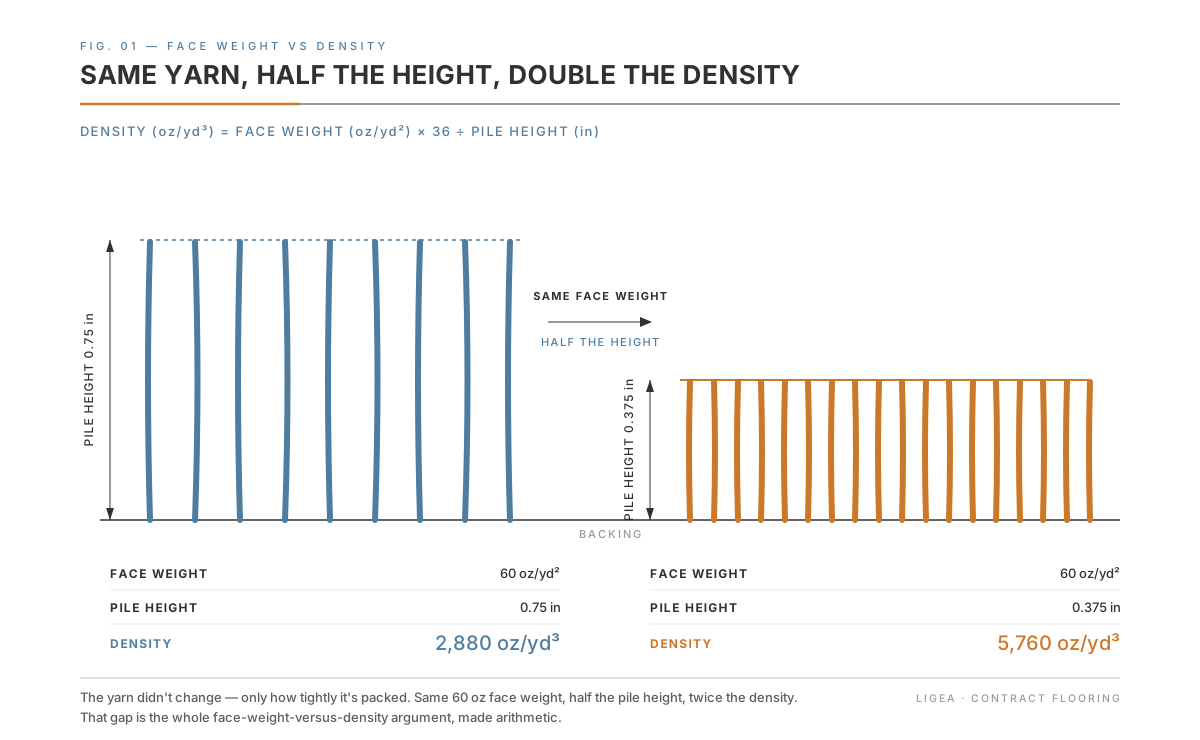
Density (oz/yd³) = Face Weight (oz/yd²) × 36 ÷ Pile Height (inches)
The 36 is a unit constant that converts the result into ounces per cubic yard, giving density a volume basis rather than face weight's area basis. Pile height goes in as a decimal: 3/8 inch is 0.375, 1/2 inch is 0.5.
Worked through: a 60 oz face weight at 0.75 inch pile height gives 60 × 36 ÷ 0.75 = 2,880 oz/yd³. Hold the face weight constant but shorten the pile to 0.375 inch and the same yarn yields 5,760 — twice the density from the identical amount of fibre, simply because it is packed into half the height. That single example is the entire face-weight-versus-density argument made arithmetic: the yarn didn't change, but the durability did.
A second route to the same idea is construction geometry. For tufted carpet, gauge is the spacing of needles across the width — 1/10 gauge means ten needles per inch — and stitch rate is the number of tufts per inch down the length; multiply them and a 1/10 gauge at 10 stitches per inch gives 100 tufts per square inch. Tighter gauge plus higher stitch rate means more tufts in the same area — physical density you can read straight off a construction spec without any arithmetic at all. For woven Axminster the equivalent is pitch × rows, which we covered in our corridor specification guide. Different looms, same principle: count the tufts, not the ounces.
One honest caveat. These rules of thumb and the 36-constant formula are widely used industry conventions for comparing constructions, not a single codified pass/fail standard, and pile height measured on a sample is approximate. Treat the calculated number as a strong relative indicator between two candidates, not an absolute grade — and where a real durability classification is needed, that lives in the standards below.
04The Hospitality Thresholds That Matter
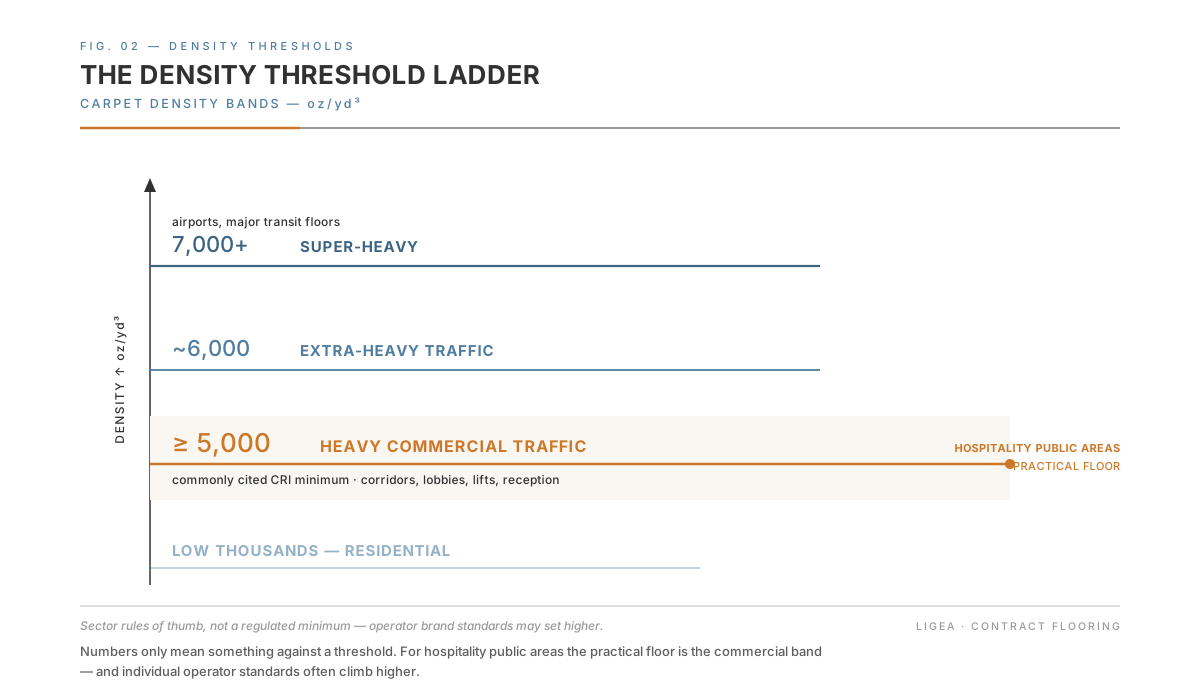
Numbers only mean something against a threshold. Here is where the commonly cited bands sit — and where to be careful with them.
On the density scale produced by that formula, the broad consensus runs roughly: a residential floor in the low thousands, with the Carpet and Rug Institute setting 5,000 oz/yd³ or more as the mark for extra-heavy commercial traffic, and higher figures again — commonly cited around 6,000 for extra-heavy and 7,000-plus for super-heavy traffic — used for the most punishing locations such as airports and major transit floors. For hospitality public areas — corridors, lobbies, lifts, reception — the practical floor is that commercial band, not the residential one. These figures are sector rules of thumb rather than a regulated minimum, and individual operator brand standards frequently set their own, sometimes higher, requirements, so read them as a starting filter rather than a finish line.
On face weight, the commonly seen range for contract carpet runs roughly 16 to 40 oz/yd² (about 540 to 1,360 g/m²), with heavier public-area constructions specified above that. The key discipline is to read face weight with density and pile height, never alone — a high face weight at a tall pile height is a warning sign, not a selling point.
The most rigorous answer, though, isn't a single weight or density number at all — it's a tested classification, and this is where Europe is explicit. Under EN 1307:2014, pile carpets are classified primarily on appearance-retention properties — the measured change in appearance under simulated traffic — with an additional surface pile density requirement layered in for carpets of ≥80% wool content. In other words, the European standard deliberately grades carpet on how it holds up, supported by density, and pointedly not on face weight. The resulting use classes run from Class 31 for moderate commercial use, through Class 32 for general commercial use, to Class 33 for heavy commercial use — with hotel rooms typically sitting at the lower end and high-traffic public areas such as reception halls, lifts and entrances at Class 33. It is the cleanest single signal a hospitality specifier can ask for, because the testing already did the durability reasoning that face weight skips. For public areas, Class 33 is the sensible minimum.
A few supporting properties round out a proper read of the spec. Twist level — the turns per inch in the yarn — is a quiet but real durability driver, since more twist generally means a more resilient pile, particularly in cut-pile construction, and heat-set twist is what stops cut-pile tips from blooming open into matting. Fibre sets the ceiling: nylon leads on commercial abrasion resistance, wool leads on appearance and shape retention, which is why the long-standing hospitality answer is the 80% wool / 20% nylon blend rather than loyalty to either. And tuft bind — the force needed to pull a tuft out of the backing — matters under the rolling loads corridors see, because a tuft that pulls is a repair, not just a wear mark.
05Reading the Spec Sheet, in Order
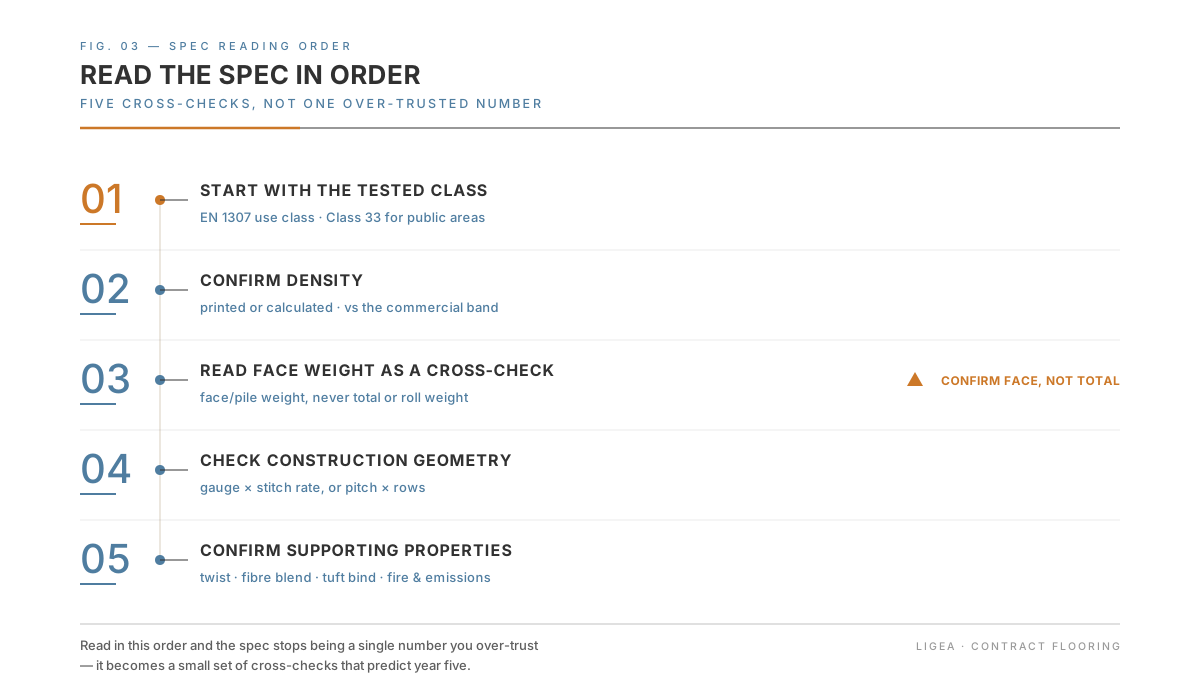
Put it together and a contract carpet spec reads in a sensible sequence:
- 1. Start with the tested class, not the weight. An EN 1307 use class (or the North American heavy/severe traffic tier) already encodes appearance retention. If it clears the class your area needs, the headline number is a detail.
- 2. Confirm density — printed, or calculated from face weight and pile height — against the commercial band for the area.
- 3. Read face weight as a cross-check, and confirm it's face weight, not total weight. A heavy face weight at a tall pile is a flag, not a feature.
- 4. Check the construction geometry — gauge and stitch rate, or pitch and rows — as a second density read.
- 5. Confirm the supporting properties: twist, fibre blend, tuft bind, and the fire and emissions pack the area requires.
Do it in that order and the spec stops being a single number you over-trust and becomes a small set of cross-checks that actually predict how the floor will look in year five.
06Where ligea Comes In
Most of the difficulty here isn't the arithmetic — it's that the one number on the tag is the one that misleads, and the numbers that matter are either buried, missing, or expressed in a system the brief doesn't speak. A designer shouldn't have to back-calculate density from a sample tag, reconcile oz/yd² against g/m², and second-guess whether "weight" meant face or total, all while holding the result against an operator's brand minimum.
That reconciliation is our work. At ligea we specify by construction and tested performance, not by a headline ounce figure — reading density, gauge or pitch-by-rows, twist, fibre and the appearance-retention class together, then matching the brief to the right construction and the right producer rather than to whatever one loom happens to make. We quote face weight in whichever system the spec uses, state density and use class alongside it, and confirm everything on a physical strike-off before bulk. Because we work across multiple producers, the construction is engineered to the area's real traffic demand — guestroom, corridor or reception — instead of being stretched to fit a single factory's range. You get a spec that reads correctly the first time, brief to delivery, across print, axminster, hand-tufted and braided.
That is the difference between being quoted a number and being specified a carpet that lasts.
Working a live spec and not sure the weight on the tag tells you what you need? Explore our surfaces or book a 15-minute spec call.