
Carpet Backing and Underlay for Contract Floors: A Specifier's Guide
Action-back, PU, jute, woven and tile backings plus underlay — how each affects acoustics, comfort, moisture and install on contract hospitality floors.
A carpet specification usually lives or dies on the part nobody photographs. The face — the pile, the pattern, the colour — wins the design review. But the layer underneath decides whether the floor still looks and sounds right in year five, whether footfall carries to the suite below, and whether the adhesive lets go six months after handover. On contract floors, backing and underlay are not an afterthought to the aesthetic; they are the performance spec. Get them wrong and the most beautiful Axminster in the building will ripple, open at the seams, or telegraph every cart wheel down the corridor.
Here is what a buyer or specifier should understand before the construction drawings are frozen.
01The Backing Dictates the Install Method — Not the Other Way Round
The single most common field mistake is treating backing as interchangeable. It isn't. The backing is engineered for a specific installation method, and pairing them incorrectly is what installers flag again and again on trade forums.
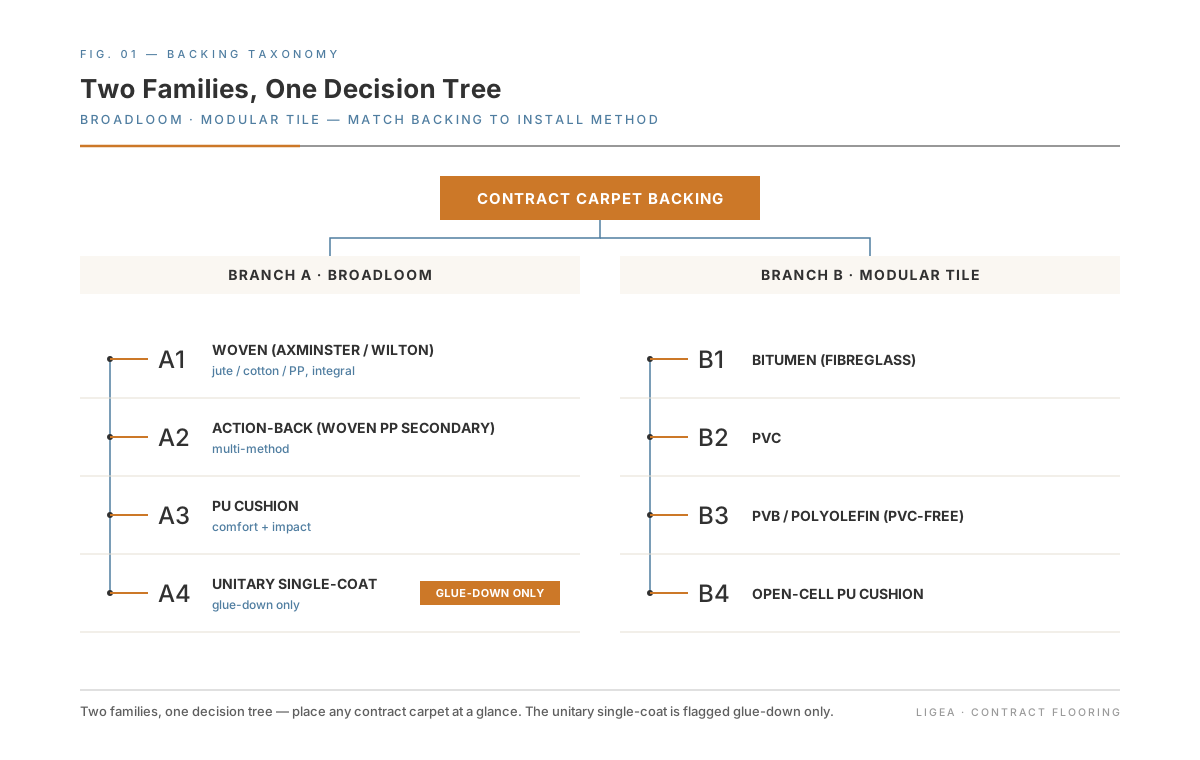
Broadly, contract carpet backings fall into a few families. Woven constructions — Axminster and Wilton — interlace pile and backing in a single weaving operation, which gives strong dimensional integrity and durability (though jute-backed weaves stay moisture-sensitive in wet conditions); the foundation and backing yarns are typically jute, cotton or polypropylene, woven in integrally rather than added as a separate secondary layer. Most modern commercial woven carpet also carries a thin latex back-coating as a finishing step — for edge-fray protection and dimensional stability rather than as the primary means of holding the pile in place, unlike tufted constructions, where a heavier latex or adhesive backing does that structural work. The hospitality workhorse face is often an 80% wool / 20% nylon blend, long valued as a durable, prestige construction for heavy-traffic hotels, casinos and cruise interiors — though for the most extreme abrasion floors solution-dyed nylon is generally rated more hard-wearing. Natural jute is prized for strength but is moisture-sensitive — it can rot or shrink if it gets wet — which is why synthetic action-back alternatives exist.
Action-back is a woven polypropylene secondary backing — a common, moisture-resistant choice for tufted broadloom where natural jute is not suitable. It is multi-method: in commercial work it is most often glued down, though it can also be stretched in over a cushion. Polyurethane (PU) cushion backing improves underfoot comfort, impact-noise isolation and — with a closed-cell structure — appearance retention versus a hardback, and is commonly specified in education and hospitality. For floors with heavy rolling loads — carts, wheelchairs, beds — a firm or hard backing is usually preferred over a soft cushion.
The trap: a heavy single-coat "unitary" backing is built for glue-down only and is not meant to be stretched in or double-stuck. Action-back goods, by contrast, can be installed either way — most often glued down, but also stretched in over a cushion — so the method has to be matched to the product. Install the wrong pairing and you invite loss of dimensional stability, tuft-bind or seam failure. Decide the install method and the room's demands first; the backing follows.
02The "Right" Install Method Is Partly a Question of Geography
One thing that catches international project teams off guard: there is no single global convention for how broadloom goes down. The institute taxonomy gives three families — stretch-in (tackless, where the carpet is tensioned over a perimeter gripper onto a separate cushion), direct glue-down, and double-glue/double-stick (cushion bonded to the slab, carpet bonded to the cushion). The decisive difference for the underlay logic in this guide is that stretch-in and double-glue both sit on a separate cushion layer that delivers the comfort, acoustics and longer service life, whereas direct glue-down bonds the carpet straight to the subfloor with no cushion at all (Carpet and Rug Institute).
Which of those a market reaches for first is partly cultural, not just technical. In the UK, stretch fitting over gripper and a separate underlay is deeply entrenched — entrenched enough to be codified in a national code of practice for installing textile floor coverings, which sets out stretch as well as single- and double-stick methods and the underlay each needs (BS 5325, BSI). In practice, specifiers often find the same stretch-in-plus-underlay habit running deep in markets such as Japan, where it remains a common residential and light-commercial convention rather than a code requirement — treat that as practitioner convention, not a hard rule. Across much of the contract world, by contrast, heavy-traffic hospitality and commercial floors default to glue-down or double-stick, because a bonded assembly resists rolling loads, large-area dimensional movement and seam stress in a way a stretched floor does not.
The practical implication for a cross-border hospitality spec is twofold. First, if the install is stretch-in, the underlay is not optional — it is the entire performance layer, and its density and thickness have to be specified as deliberately as the carpet (more on that below). Second, when a design developed for one market is rebuilt in another, confirm which method the local installers will actually use: a goods choice that assumes glue-down can fail if it is stretched in over a pad it was never engineered for, and a stretch-in scheme loses all of its comfort and acoustic argument the moment someone value-engineers the underlay out and glues the carpet straight to the slab.
03Carpet Tile Backings Are a Different Decision Entirely
Modular tile has its own backing taxonomy, and the choice is mostly about traffic, acoustics and end-of-life. Bitumen (fibreglass-reinforced) gives high dimensional stability for heavy traffic but is heavy, inflexible, and can emit low VOCs when new. PVC is lighter and more rigid, moisture-tolerant and easy to cut, but stiffens in cold and offers little comfort or acoustic benefit. PVB (recycled windscreen interlayer) and polyolefin/thermoplastic backings are the PVC-free routes; some polyolefin systems are notably lighter and closed-loop recyclable, and were among the first flooring products to be certified Cradle to Cradle. At the premium end, open-cell PU cushion tile backing offers strong sound absorption and underfoot recovery and helps protect the fibre over a long service life.
Two myths are worth retiring. First: "hardback tile plus a separate underlay saves money." On contract jobs it usually does the opposite — it adds labour, complicates raised-access-floor uplift (both layers must come up), and risks seam mismatch from differential compression. If you want comfort and acoustics under tile, specify an integral-cushion tile, not a hardback over loose pad. Second: felt backing feels like cushion at handover but compresses and loses thickness over time, degrading both acoustics and durability — a budget compromise, not a performance one.
04The Acoustic Numbers Are the Strongest Argument for Cushion
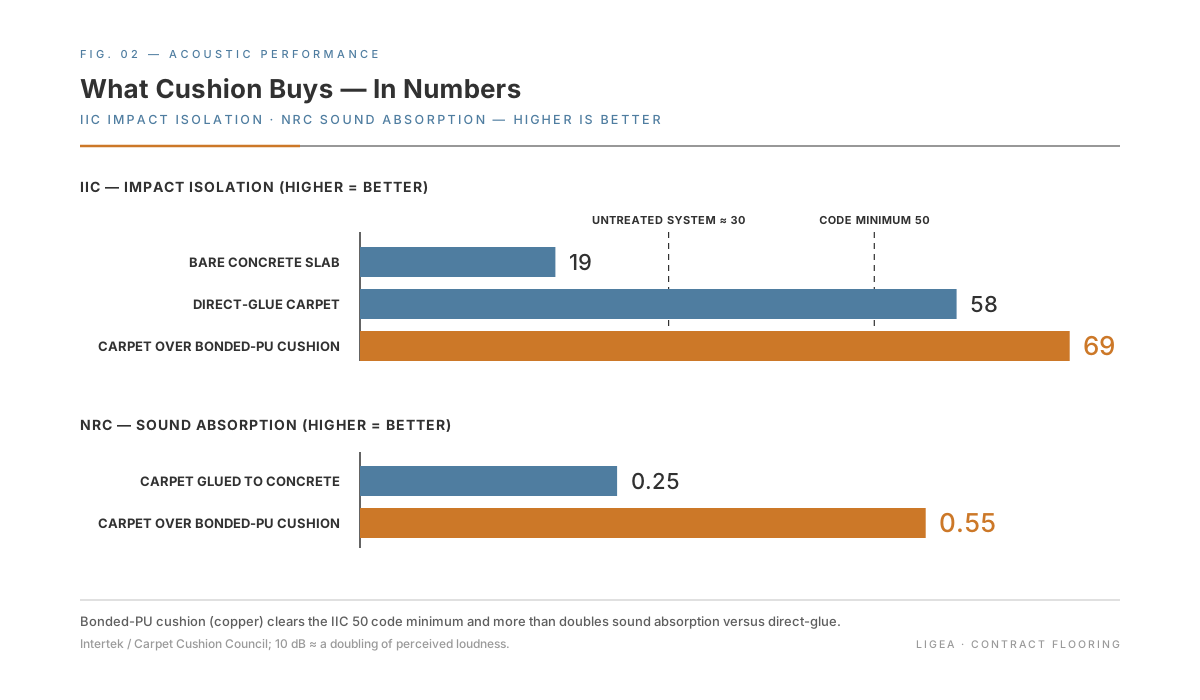
When a developer questions the cost of cushion, the defensible case is built on standards-based test data, not vendor decibel claims. An Intertek study for the Carpet Cushion Council measured a commercial cut-pile carpet glued directly to concrete at an NRC (sound absorption) of about 0.25; the same carpet over a bonded-PU cushion in a double-glue assembly reached 0.55 — more than double (Carpet Cushion Council).
Impact isolation between floors tells the same story. A bare concrete slab measured IIC 19; direct-glue carpet lifted it to 58; carpet over bonded-PU cushion reached 69. For context, an untreated floor system sits around IIC 30, the typical multifamily code minimum is IIC 50, and a 10 dB change is roughly a doubling or halving of perceived loudness. Carpet is the only floor finish that meaningfully cuts both airborne and impact noise without a built-up assembly — and the cushion is what turns "quieter" into a number a developer can put in a spec.
Be sceptical of marketing figures such as "reduces impact noise up to 30 dB" or "extends carpet life 50%." They are vendor claims, rarely tied to a stated ISO or ASTM lab method. The Intertek/Carpet Cushion Council and CRI numbers are the ones that survive scrutiny.
05Density Beats Thickness — and Over-Padding Voids Warranties
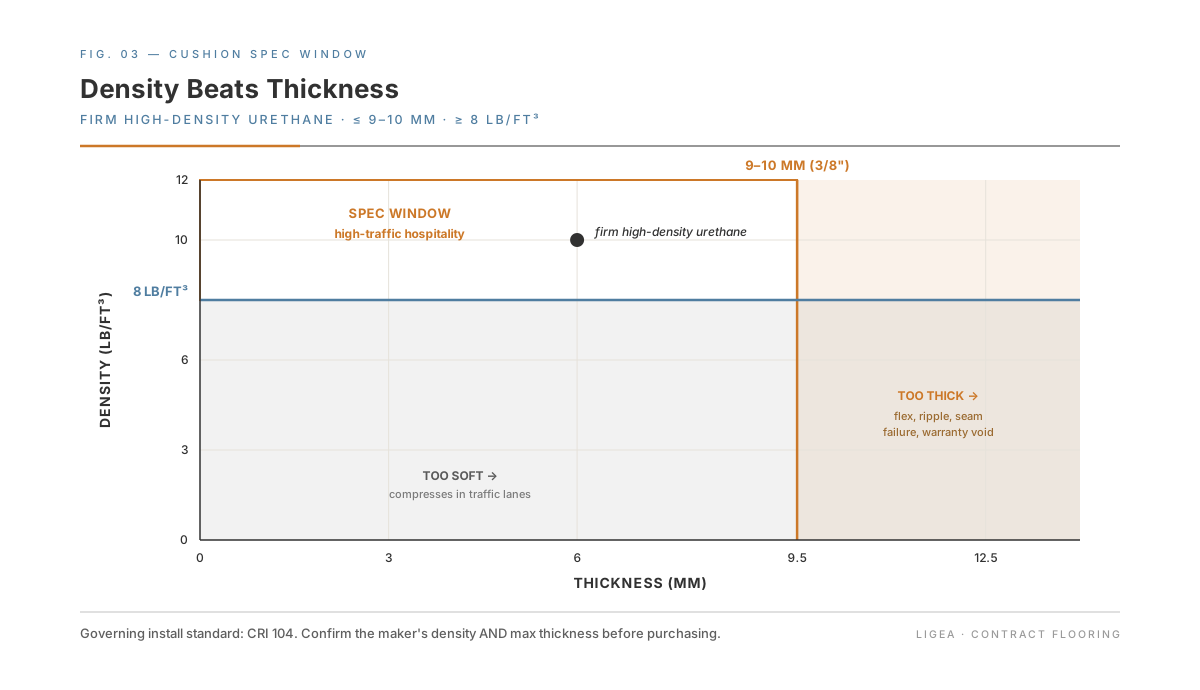
The most persistent field wisdom on separate cushion is counter-intuitive to clients: thicker and softer is worse, not better. A pad that is too soft or too tall lets the carpet flex more than its backing can tolerate, stretching seams and producing wrinkles, ripples and premature failure — and it commonly voids the carpet warranty.
The numbers practitioners cite: commercial and Berber-type carpet wants a firm cushion no thicker than 3/8 inch (≈9–10 mm), and most manufacturers specify a minimum density as well as that maximum thickness — high-traffic hospitality areas typically call for 8–10 lb/ft³ high-density urethane (CRI FAQ). Lightweight foams feel pleasant at handover but compress under load and lose their acoustic performance fast in traffic lanes. The governing install standard for the commercial assembly is CRI 104 (CRI 104). The rule for any contract job: confirm the maker's specified density and maximum thickness before purchasing, because the warranty hinges on both.
Note too that one spec rarely fits a whole floor. Rolling-load zones — desks with castor chairs, food-cart routes — want firm hardback or PVC-backed tile, not thick cushioned broadloom that the wheels cut through. The CRI rolling-chair test loads an office chair to 150 lb against the specimen for exactly this reason (CRI FAQ).
06Moisture Is the Failure Mode That Kills Contract Jobs
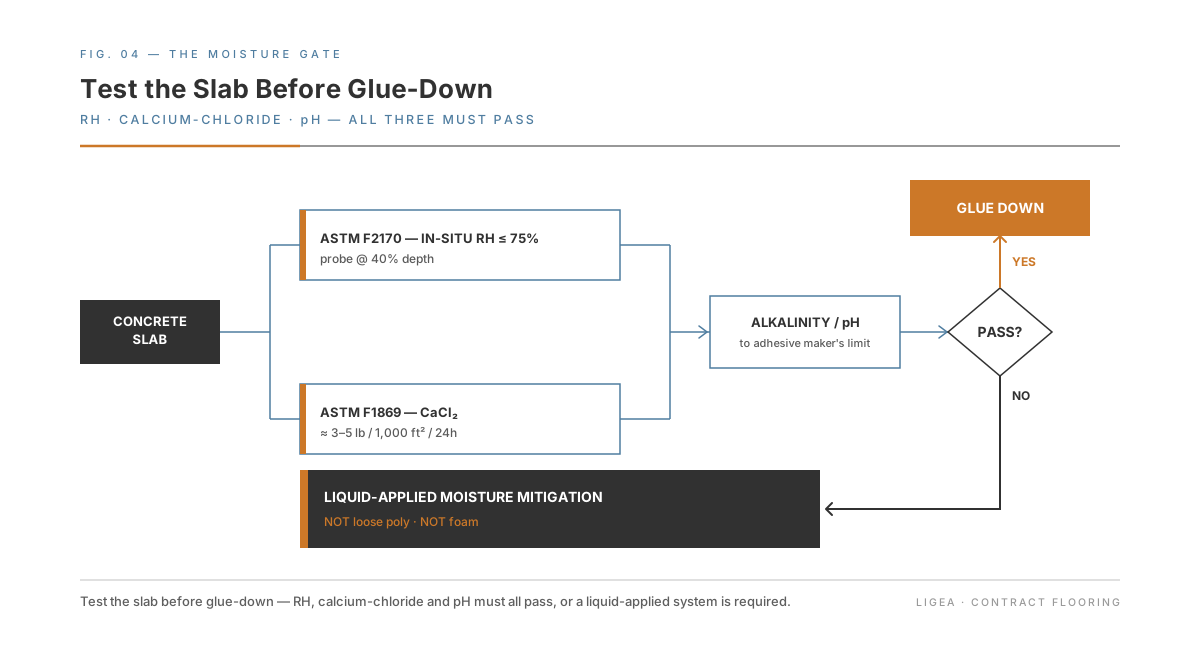
If one step gets skipped under schedule pressure and then sinks a floor, it is subfloor moisture testing. Excess moisture and alkalinity re-emulsify adhesive, causing blistering, bond failure and delamination — and no backing forgives it.
The defensible protocol: a concrete slab's internal relative humidity should not exceed 75% under ASTM F2170 (an in-situ probe at 40% of slab depth), now the manufacturer-preferred method (ASTM F2170). The older ASTM F1869 calcium-chloride test measures surface vapour emission, with a common industry limit around 3–5 lb per 1,000 ft² per 24 hours (ASTM F1869). Alkalinity (pH) is a leading adhesive-failure cause, which is why CRI 104 requires moisture and pH testing to the adhesive maker's limits before glue-down.
A common gotcha worth flagging to the design team: foam underlay is not a vapour barrier, and a loose poly sheet under glue-down prevents the adhesive from bonding — so a glue-down floor over a damp slab needs a liquid-applied moisture-mitigation system the adhesive can actually grip. Some modular backings are also designed as a moisture strategy in their own right, either wicking vapour to the seams or carrying an integral top-down barrier.
For European spec credibility, the classification framework is EN 1307, where Class 33 covers heavy contract use — airports, hotel reception halls, lifts and high-traffic circulation — with add-on ratings for castor-chair suitability (EN 985), stairs and acoustic performance (Centexbel).
07Where ligea Comes In
Backing and underlay are where a beautiful design quietly becomes a buildable, durable floor — and that translation is exactly the work we do. We start by reading the designer's vision and the developer's budget as one brief, then match it to the right construction: a woven build where guestroom durability and refined edge binding matter, a printed nylon route where a photographic gradient leads the scheme, and the corresponding broadloom-roll, cut-and-bound or modular-tile format with a backing suited to the install method and traffic. Because we work across multiple producers rather than a single loom or print line, the backing, weight and format follow the room's real demands instead of one factory's catalogue — and AI-assisted rendering compresses the approval rounds so the technical decisions are settled before anything is cut. The goal is simple: a floor that survives the moisture test, the acoustic target and year five, without the spec quietly compromising the design that won the review.
Talk to us about your project — explore ligea Surfaces or get in touch.