Carpet and Indoor Air Quality in Hotels: Facts, Myths and What to Specify
VOC off-gassing, Green Label Plus, the dust trap-vs-reservoir debate, allergens and humidity — the IAQ facts hotel specifiers should require, separated from myth.

Few specification debates carry as much inherited baggage as carpet and air quality. A designer presents a woven floor that anchors the whole guestroom scheme, and someone around the table — an owner, an operator, a wellness consultant — says the word "off-gassing" and the conversation stalls. The instinct is decades old, and it is mostly out of date. But the honest answer is not "carpet is fine, relax." It is more interesting than that: the evidence genuinely cuts both ways, and the deciding variable is rarely the flooring category itself. For a hotel, where humidity swings room to room and housekeeping is always under time pressure, knowing which concerns are real and which are folklore is what separates a defensible spec from a nervous one.
Here is what a buyer or specifier should actually understand before writing carpet — or ruling it out — on an IAQ basis.
01The VOC Story Is Largely a Legacy Concern
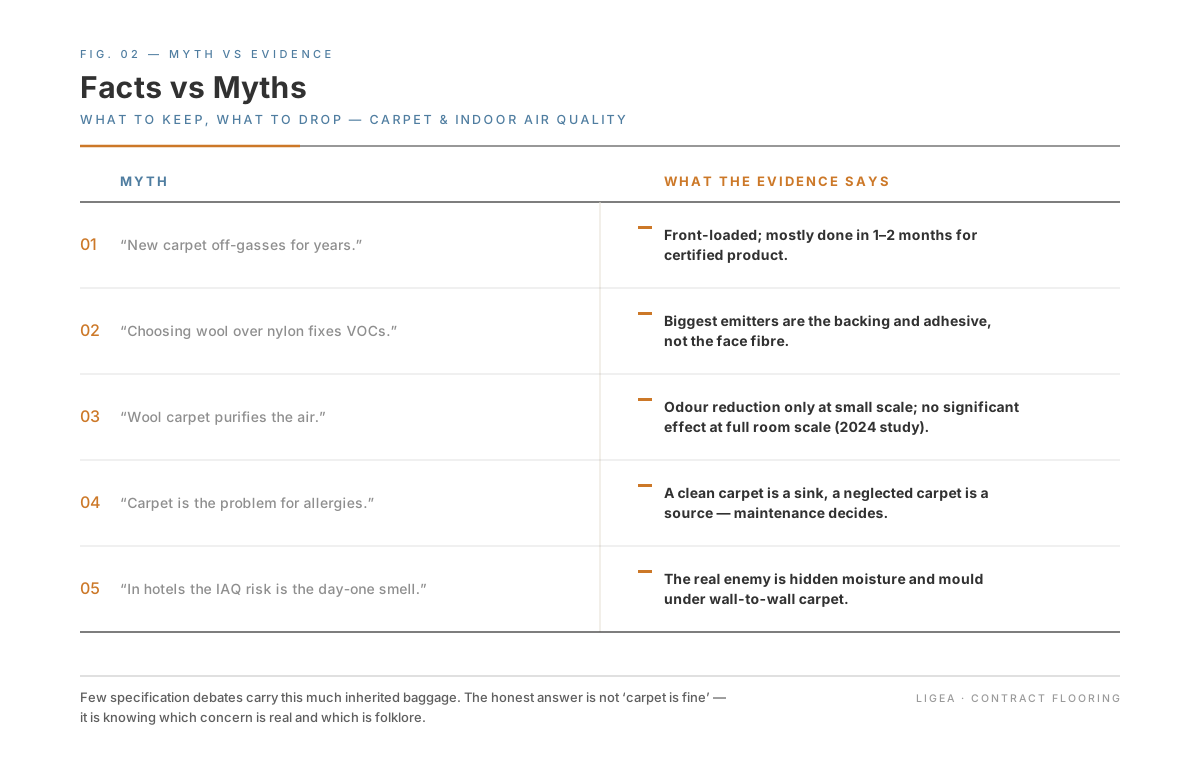
The "new carpet smell" is a real chemical event, and it is worth naming precisely because vague low-VOC marketing rarely does. The characteristic odour comes mainly from 4-phenylcyclohexene (4-PCH), a byproduct of the styrene-butadiene latex used to bond a carpet's secondary backing to the pile, alongside trace styrene and formaldehyde from adhesives. The important detail for specifiers: the biggest emitters are the backing and the installation adhesive, not the face fibre — the EPA notes that new carpet systems off-gas VOCs from the adhesives that bond face fibres to backing materials and from the glue used to install them (US EPA). Choosing wool over nylon does little for VOCs if the backing system and glue are ignored.
The decay curve is reassuring. Emissions peak in the first days, fall sharply over the first weeks, and the bulk of noticeable off-gassing is done within one to two months; only very low-level backing emissions trail off beyond that (peer-reviewed review, Applied Sciences). The blanket claim that "new carpet off-gasses for years" is mostly myth for certified product.
And most commercial carpet is certified. The de-facto credential is Green Label Plus, run by the Carpet & Rug Institute, which tests carpet against the California Department of Public Health (CDPH) Standard Method using a 14-day chamber test and screens for thirteen named chemicals including 4-PCH, formaldehyde, styrene, benzene and toluene (CRI testing protocol). The CDPH formaldehyde benchmark behind it is a modelled concentration of 9 µg/m³ (CDPH Standard Method v1.2). Measured by emissions, modern commercial carpet sits among the lowest-VOC flooring categories — the toxic-off-gassing image largely predates the 1992 Green Label and 2004 Green Label Plus reforms. The catch worth knowing: a Green Label Plus certificate is usually issued against the backing system, not the individual style or colourway, so several styles can share one certificate. The right question to an account manager is "which certified backing does this use," not "is this exact colour certified."
02The Dust Trap Versus Reservoir Debate Is Real — and Unresolved
This is the argument every specifier eventually has, and it deserves an honest hearing rather than a brochure line. Two respectable camps disagree.
The filter camp, led by industry bodies, frames carpet as a passive trap that holds dust, dander and pollen in the pile and out of the breathing zone until it is vacuumed away. A widely cited study by the German Allergy and Asthma Association found average fine-dust concentration in rooms with smooth flooring was roughly twice as high as in carpeted rooms — carpet cutting airborne dust by about half, because hard floors let settled particles re-loft with every footstep and air current. The Carpet & Rug Institute also notes that the 2020 asthma management guidelines published in the Journal of Allergy and Clinical Immunology contain no recommendation to remove carpet (CRI).
The reservoir camp is equally credentialled. A peer-reviewed review in Indoor Air (Becher et al.) is the strongest counterweight: it reports mite-allergen concentrations in dust from carpeted floors 6 to 14 times higher than from smooth floors, associates bedroom carpet with elevated asthma odds, and concludes there is "no peer-reviewed evidence that modern carpets are now unproblematic," urging caution in children's bedrooms and schools (PMC review).
Both can be true at once, and that is the useful synthesis. Carpet immobilises particles, so day-to-day airborne levels can be lower — but it also accumulates a reservoir that becomes a liability if cleaning is inadequate. As practitioners put it: a clean carpet is a sink, a neglected carpet is a source. The flooring category is not the deciding variable. Maintenance is.
03In Hotels, the Real Enemy Is Moisture — Not Off-Gassing

For a hospitality audience this is the most defensible and least-discussed point. The headline IAQ risk in a hotel is not the day-one smell of a re-carpeted floor; it is hidden moisture and mould under wall-to-wall carpet in a building with room-to-room humidity variation.
The biology is unforgiving. Dust mites cannot survive below roughly 50% relative humidity and die within a week or two when kept there; they thrive above about 55% RH at typical room temperatures (University of Kentucky Entomology). Keeping HVAC at under 55% RH is the single most effective allergen control available — and it is an engineering decision, not a flooring one. The specific hospitality failure mode is that wall-to-wall carpet can conceal a dampened area underneath that no one sees until odour and spores have built up — the EPA flags the underside of carpets and pads as a place hidden mould can grow (US EPA). Removing carpet in studies measurably reduced both mite allergen and ergosterol, a marker of fungal load — direct evidence that carpet can harbour mould when conditions allow (PMC review). The counter-argument that keeps carpet specified in guestrooms is sound too: it remains the only finish that meaningfully controls footfall and inter-room noise, and it reads as warmth and luxury that hard surfaces sacrifice. The point is not to fear carpet — it is to manage humidity and design for cleanability so the floor never becomes the problem.
One popular line deserves a caveat: "wool carpet purifies the air." A 2024 sensory study by the Bluyssen group found wool could reduce odour only in a small-scale set-up where the wool covered both floor and walls and the odour source sat in direct contact with the fibres; the authors did not demonstrate a comparable effect at realistic full-room scale (Indoor and Built Environment, Najafabadi et al. 2024). Wool is genuinely lower-VOC by material, but treat the broad air-cleaning claim as unproven at room scale.
04Cleaning Is the Factor That Actually Decides the Outcome
Because maintenance is the swing variable, the cleaning regime is part of the specification, not an operational afterthought. The evidence points one way. A true HEPA-filter vacuum captures 99.97% of particles down to 0.3 microns — the hardest particle size to trap (US EPA) — and field studies confirm HEPA vacuuming reduces dust-mite allergen loading in carpet. A controlled study found that HEPA vacuuming combined with dry-steam or hot-water extraction substantially cut both allergen and contaminant loading (PMC study). The recommended layered plan for high-traffic contract floors is daily HEPA vacuuming in lobbies and corridors, interim encapsulation, and periodic deep hot-water extraction. Without that regime, any IAQ advantage carpet offers simply evaporates — which is precisely why the reservoir critique lands hardest in buildings where cleaning is under-resourced.
Two practical SOPs map cleanly onto hotel operations. First, ventilate aggressively for 48 to 72 hours after installation, with low-VOC certified adhesives or a stretch-in method that avoids wet glue entirely (NYC Health). Second, keep newly re-carpeted rooms out of inventory for at least 72 hours — longer for sensitised guests. These are cheap, defensible, and they retire the off-gassing objection before a guest ever notices it.
05What Specifiers Should Actually Require
Translate the evidence into the FF&E schedule, and the checklist is short. Require Green Label Plus for carpet and cushion, or the equivalent FloorScore certification — both certify compliance with the CDPH Standard Method v1.2 (SCS FloorScore). For green-rating alignment, both LEED v4/v4.1 and WELL v2 reward low-emitting flooring tested to the CDPH chamber method (WELL Standard, VOC reduction). For a broader sustainability tier, NSF/ANSI 140 rates carpet at Silver, Gold or Platinum (NSF). Green Label Plus is so widely held across the commercial carpet market that it is best treated as the floor of a credible spec, not the ceiling — for premium hospitality goods it is table stakes rather than a differentiator. On chemistry, screen out PFAS-based stain finishes and prefer backing systems that minimise 4-PCH and styrene. And write the maintenance and humidity targets into the spec itself: HEPA vacuuming plus a deep-extraction cycle, HVAC held under 55% RH. That last line does more for guest air quality than any certificate.
06Where ligea Comes In
Indoor air quality is where a beautiful floor either earns the owner's confidence or loses it — and getting it right is a sourcing and detailing problem as much as a design one. We start by reading the designer's vision and the developer's budget as one brief, then match it to the right construction and the right certified backing: a woven build where guestroom durability and refined edge binding lead, or a printed nylon route where a photographic gradient carries the scheme — each routed to a producer whose emissions credentials and format (broadloom roll, cut-and-bound rug or modular tile) suit the room's real demands. Because we work across multiple producers rather than a single loom or print line, the backing, weight and certification follow the brief instead of one factory's catalogue, and AI-assisted rendering compresses the approval rounds so the technical questions — emissions, cleanability, humidity tolerance — are settled before anything is cut. The aim is a floor that survives the wellness review and year five alike, without the spec quietly compromising the scheme that won the room.
Talk to us about your project — explore ligea Surfaces or get in touch.