
Hospitality carpet trends 2027.
We looked at 370 hotels and hotel projects, from projects still in planning to hotels that opened in 2025 and 2026, and read the colours and floors of 898 interior pictures. Terracotta is the accent of the moment, dark rooms are back, the curve shapes the furniture but rarely the rug, green stays on the walls, and the carpet is mostly a rug on wood or stone that carries pattern.
Key findings
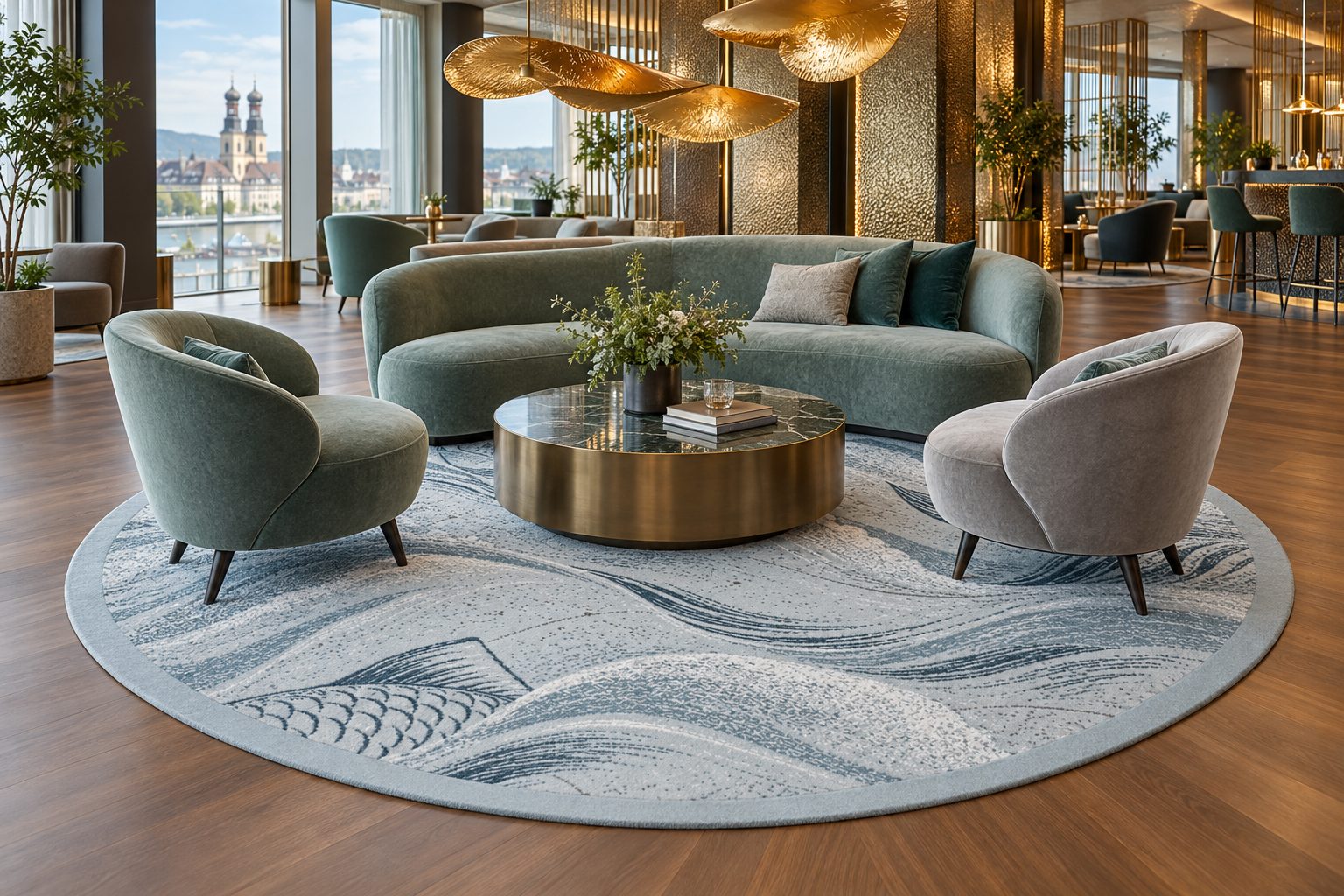
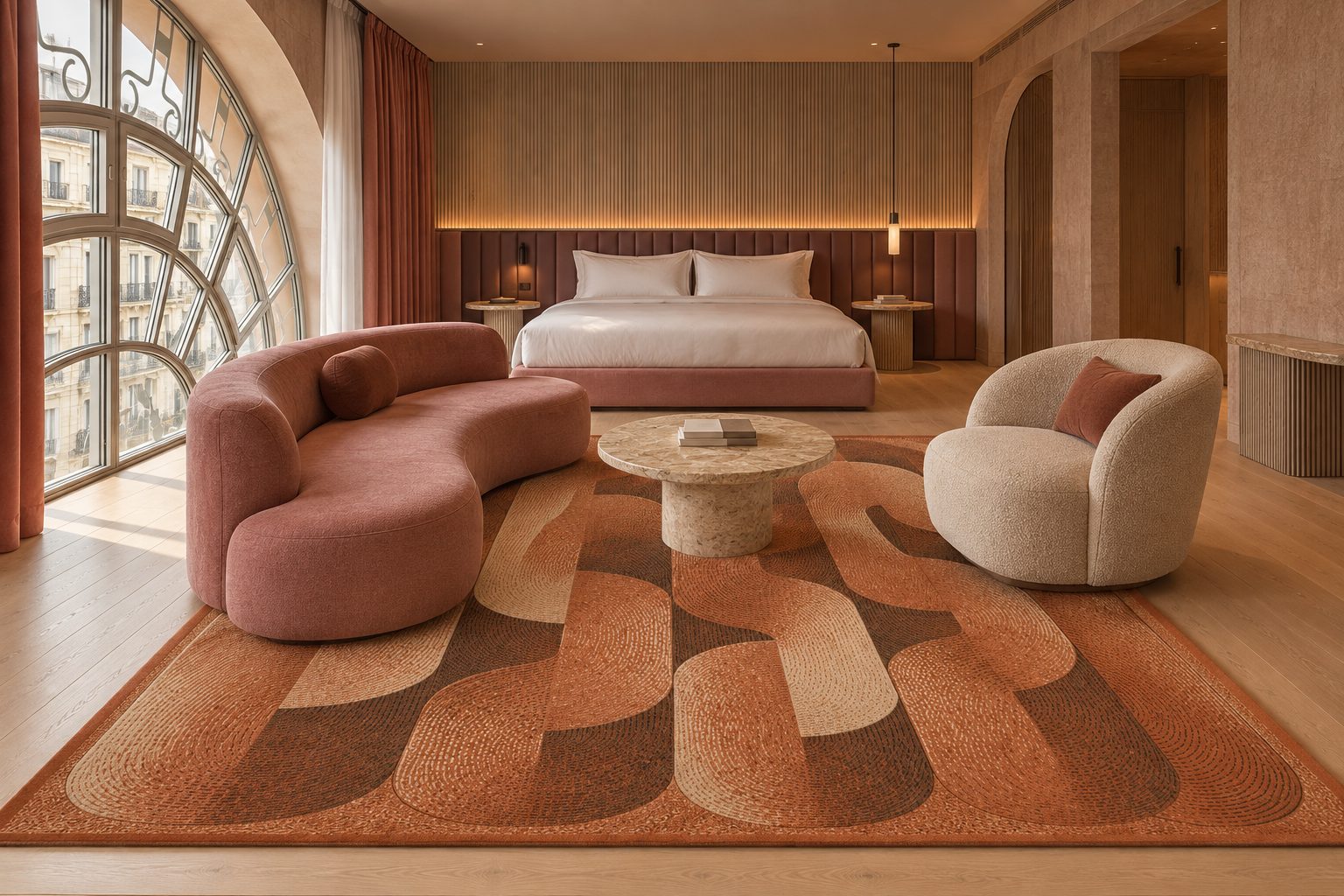
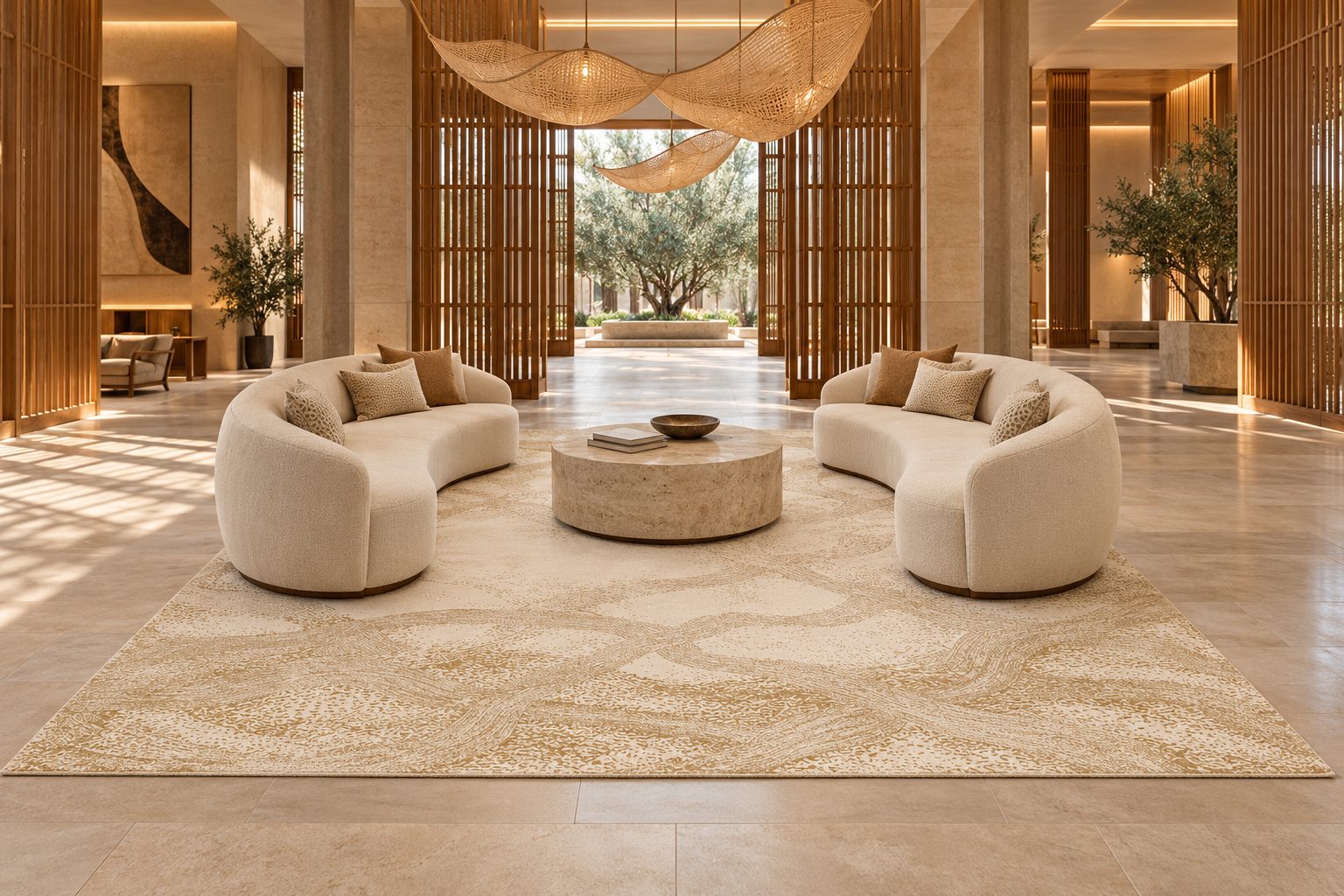
- The room curves, the rug mostly does not. Curved sofas, round tables and arches shape about one in three interiors, yet only about one in seven rugs is round or free-form.
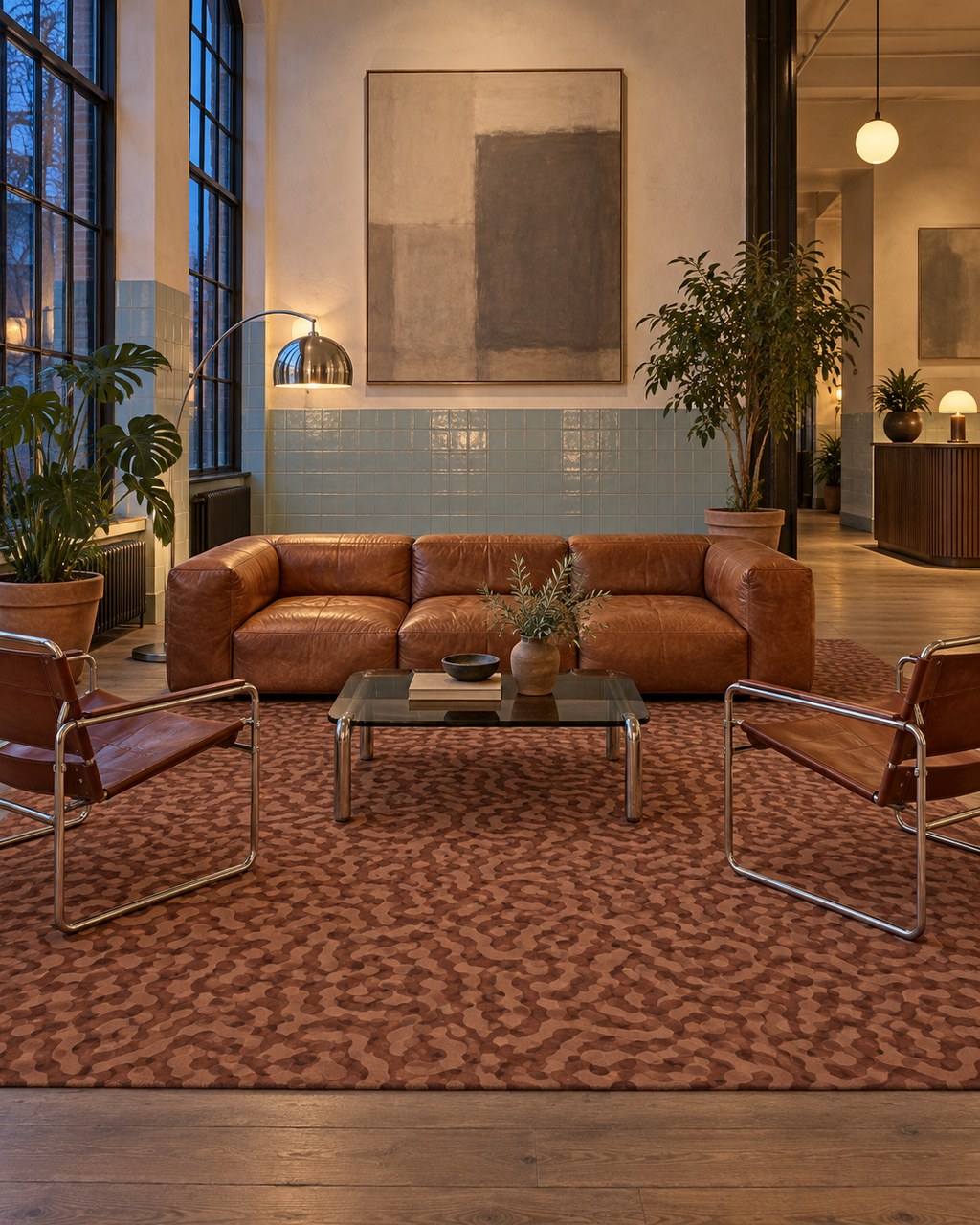
- Terracotta and rust are the accent of the moment. They show in about one in five interiors, and in about one in three of the upscale hotels that opened in 2025 and 2026.
- Green stays on the walls. Olive, sage and bottle green appear on walls, velvet and stone, but hardly reach the floor. The calm base underfoot stays sand, taupe and warm brown.
- Dark rooms are back. About one interior in six is dark, led by the bar in walnut and brass. In the hotels that opened in 2025 and 2026 it is one in four.
- The carpet is mostly a rug. Where the floor can be seen, a rug on wood, stone or terrazzo is about four times as common as wall-to-wall carpet, and about four in five lobbies and lounges have one.
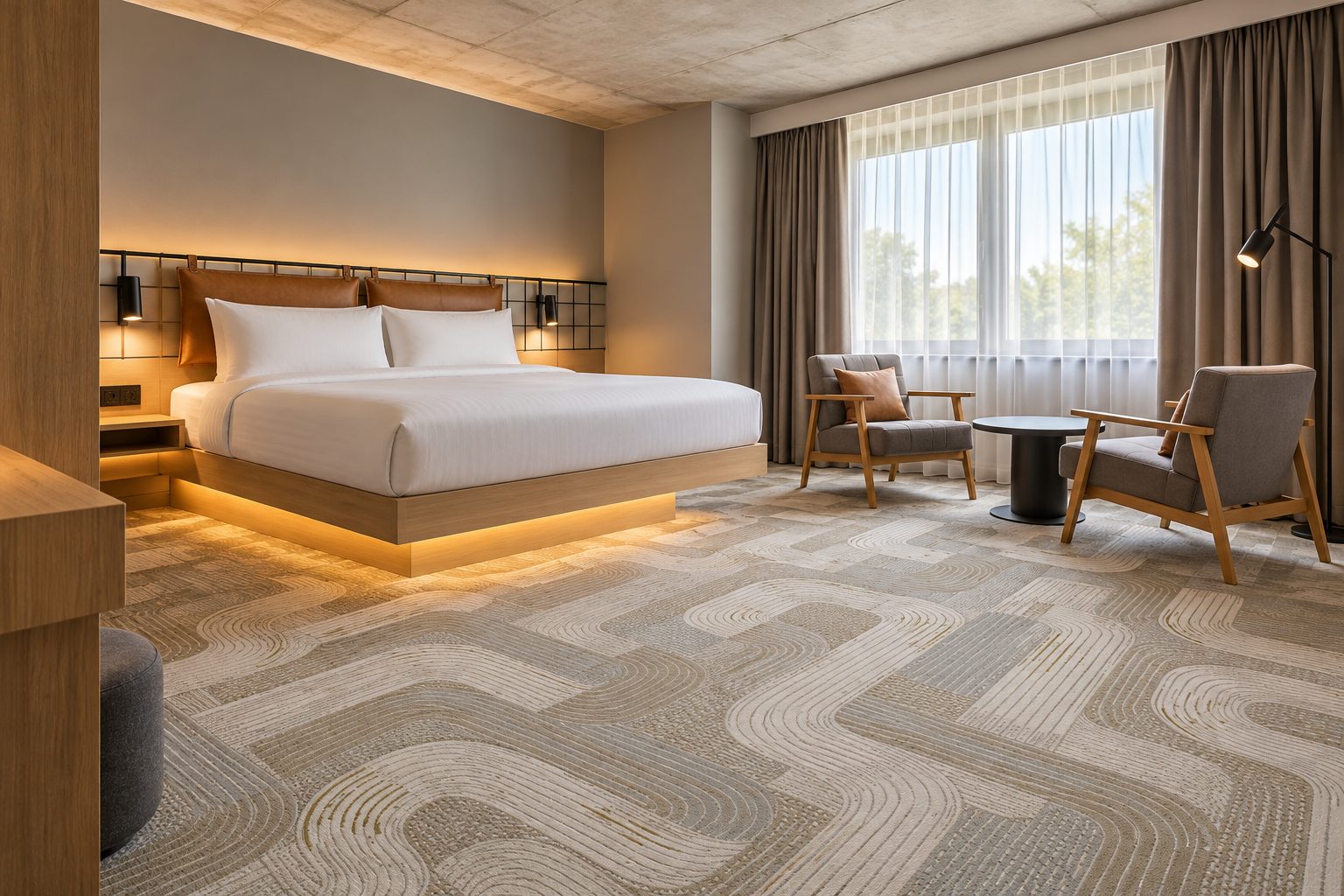
- Where there is a carpet, it usually carries pattern. Upscale hotels keep the guest room calm and put the pattern in the lobby and the bar; midscale, lifestyle and economy hotels pattern the guest room as well. Only the quiet luxury look keeps the floor mostly plain.
- Geometry leads the patterns. Chequerboards, grids and stepped fields come first; botanical motifs are rare on the floor.
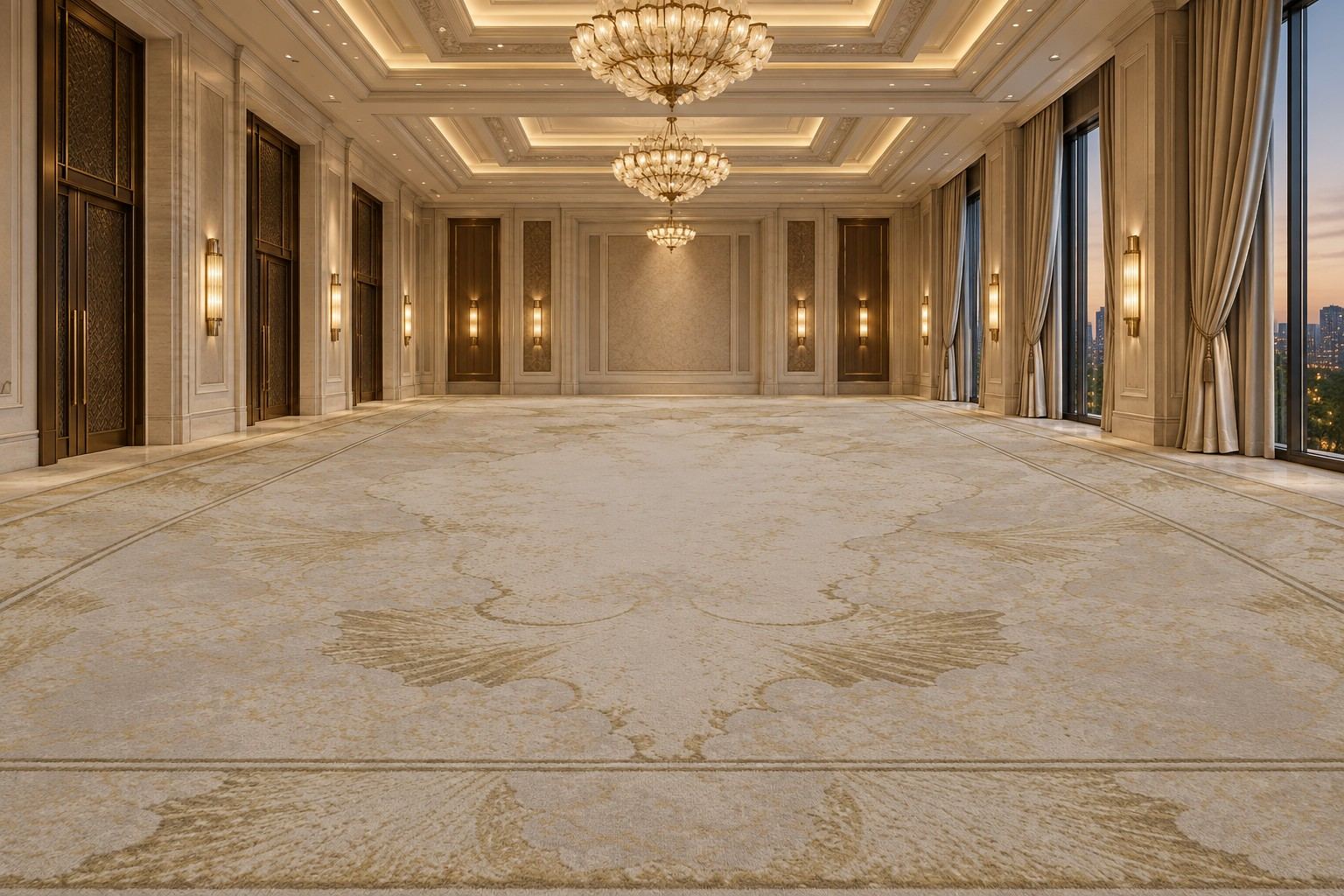
- Ballrooms and meeting rooms still belong to wall-to-wall carpet. Almost all of it is patterned, mostly as a large, free abstract drawing in calm colours.
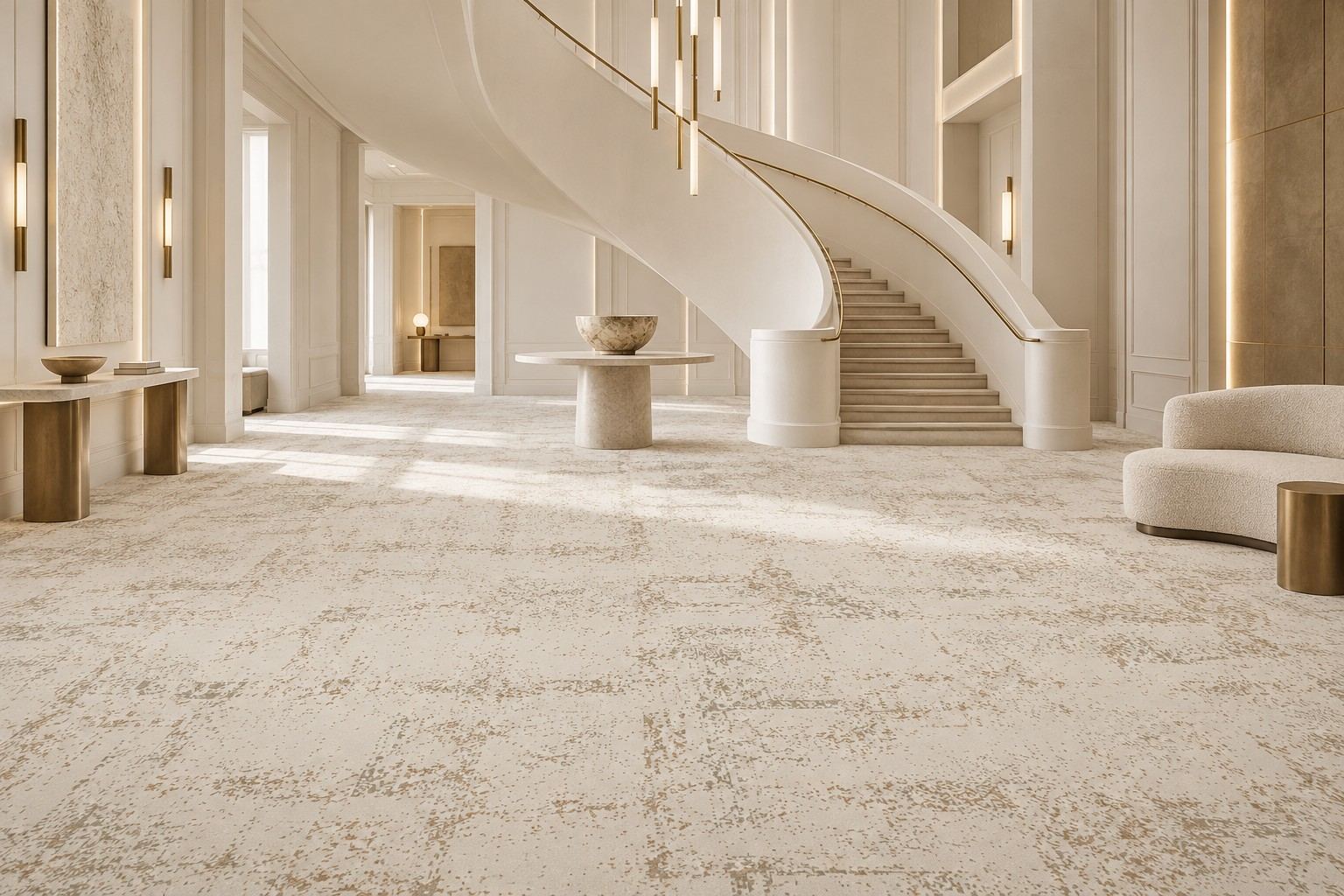
Method. Sample: 370 hotels and hotel projects with 898 interior pictures, reviewed in September 2026, in two parts. Pipeline: 150 catalogued projects in planning, construction or renovation, one picture per project; 8 exterior views are left out, which leaves 142 interiors, and 75 renderings of 19 projects still in planning add the planning stage (143 projects, 199 pictures). Two catalogued projects are a bar and a restaurant without guest rooms; they carry no hotel segment. New openings: 238 hotels in six samples with 702 pictures, described below; 11 hotels appear in both parts, and a picture used in two samples counts once in the totals. We looked at every picture and judged floor type, pattern, motif and shape by eye, with the same criteria for every sample; pictures in which the floor cannot be seen are left out of the floor figures. Colours were measured in CIELAB as six clusters per picture, with the lower half of the picture as the floor zone (dark: mean lightness below L* 35; accents from 5% of the picture). Upscale hotels that opened in 2025 and 2026 (107 interiors), midscale and lifestyle hotels that opened in 2025 to 2027 (153 interiors) and projects still in planning (75 interiors) were read the same way for comparison. A further 70 interiors of quiet luxury hotels were chosen on purpose for one style (the Aman look); they describe that look, not the luxury segment, and about half are renderings. In addition, 104 interiors of economy and select service hotels that opened in 2025 and 2026 (about half European; Moxy and Motel One counted with midscale) and 137 pictures of corridors, ballrooms and meeting rooms, almost all from one hotel group and read by room type, complete the comparison. The brand lens rests on 228 pictures of 67 new hotels and of the latest prototypes of twelve select service and lifestyle brands, chosen by brand; photographs of opened hotels of brands that already belong to the midscale or economy sample also count there (20 and 13 hotels), prototype pictures and renderings do not. Colour codes are the nearest Pantone TCX to the measured values, a screen approximation; binding colours are matched on physical poms at strike-off. Images in this report show ligea designs, visualised in rooms; a list of the hotels is available to project partners on request.
Download the full report
The complete report adds profiles of all ten design languages, the measured colour of 142 rooms, a comparison of 370 hotels and hotel projects from planning to opening, from quiet luxury to economy and from lobby to ballroom, where the trends appear by region and space type, and a chapter on constructions, lead times and fire ratings. The download link appears as soon as you submit the form, and we send it to you by e-mail as well.
Ten design languages
No single style leads. Five design languages are almost equally common, each found in roughly one interior in seven, and more than one interior in three belongs to the dark bar, the colourful postmodern or the maximalist world.
| Design language | Interiors | Share | Materials and palette |
|---|---|---|---|
| Dark bar: wood and brass | 21 | 15 % | Walnut, bronze, leather, velvet in petrol, olive and oxblood |
| Colourful postmodern | 22 | 15 % | Colour-block walls in sage, terracotta, mustard and navy; terrazzo, art |
| Quiet oak | 20 | 14 % | Light oak, linen, bouclé, cane, calm forms |
| Cream glamour and curves | 18 | 13 % | Cream marble, crystal, curved bouclé sofas, brass |
| Grand heritage | 19 | 13 % | Stucco, walnut, bordeaux, gold, Art Deco revival |
| Lime, stone and vaults | 10 | 7 % | Lime plaster, arches, terracotta, timber beams |
| Maximalism and pattern | 10 | 7 % | Floral velvet, leopard, chinoiserie, gallery walls |
| Rattan and tropics | 8 | 6 % | Teak, rattan, louvres, leaf patterns |
| Palace and orient | 7 | 5 % | Arcades, plaster, mashrabiya, gold |
| Mountain and lodge | 7 | 5 % | Solid wood, stone, leather, kilim |
01 · Strong signalThe curve
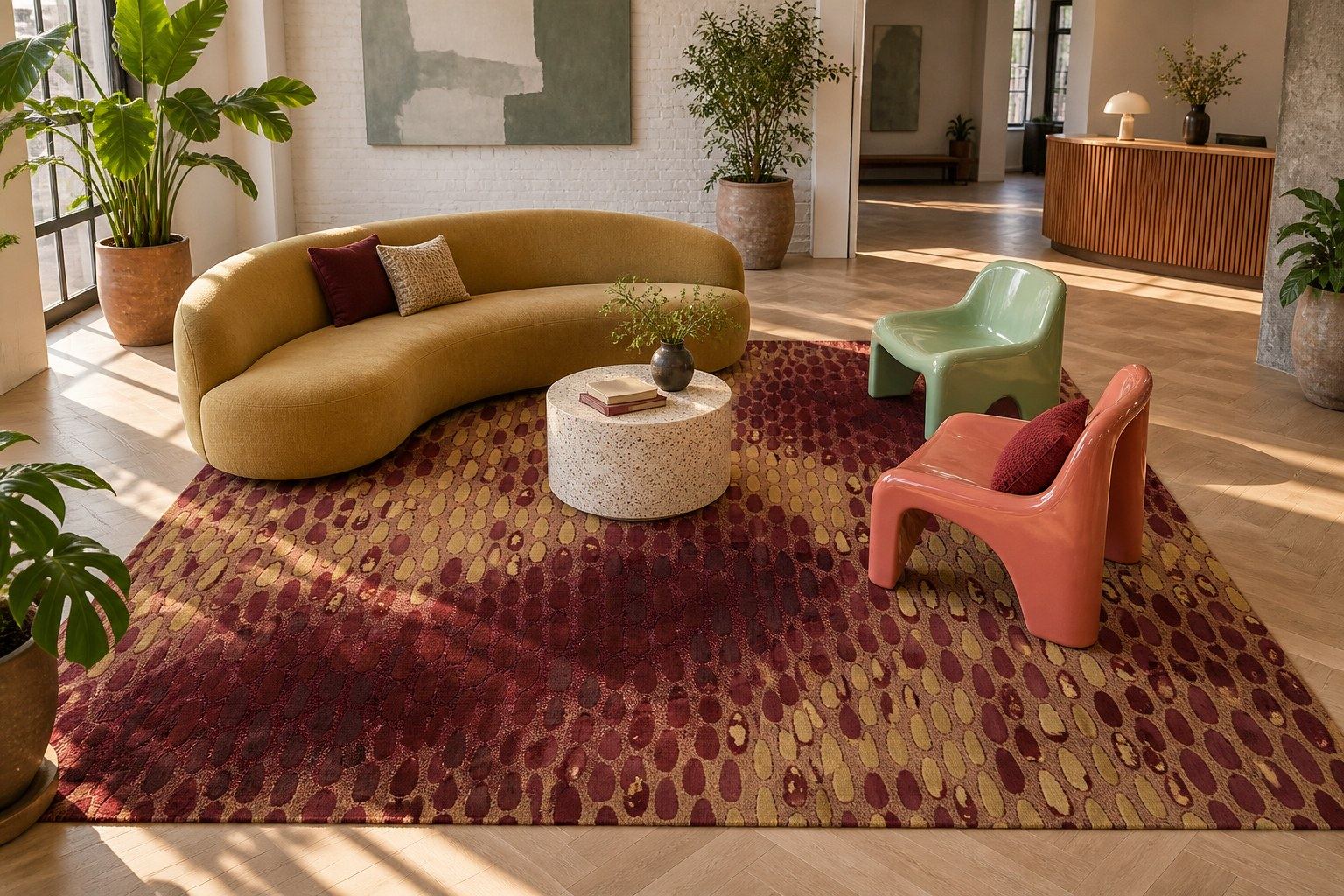
Curved sofas, round tables, arches and vaults run through about one in three interiors, from cream glamour to quiet oak, and through almost half of the renderings of hotels still in planning. The floor has not caught up: only about one in seven rugs is round or free-form. The answer is a round or oval rug, or a rectangle whose drawing picks up the curve.
02 · Strong signalTerracotta and rust
Terracotta and rust are the accent we met most often, on lime-plastered walls, upholstery and ceramics. The colour grows on the way from plan to opening: rare in the renderings, about one in five interiors in the pipeline, about one in three in the hotels that opened in 2025 and 2026. On the floor it works best as a mid-tone ground, not only as an accent line.
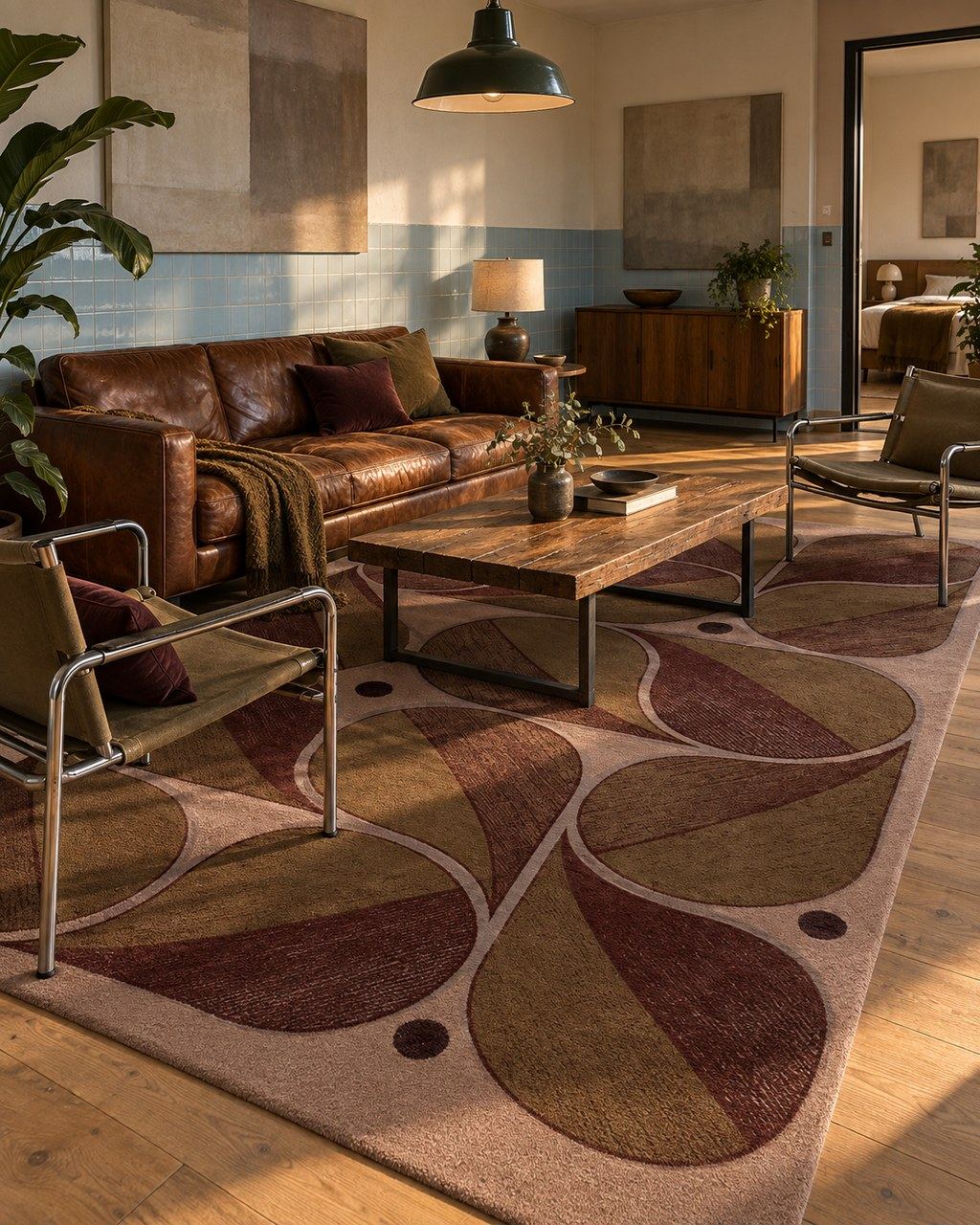
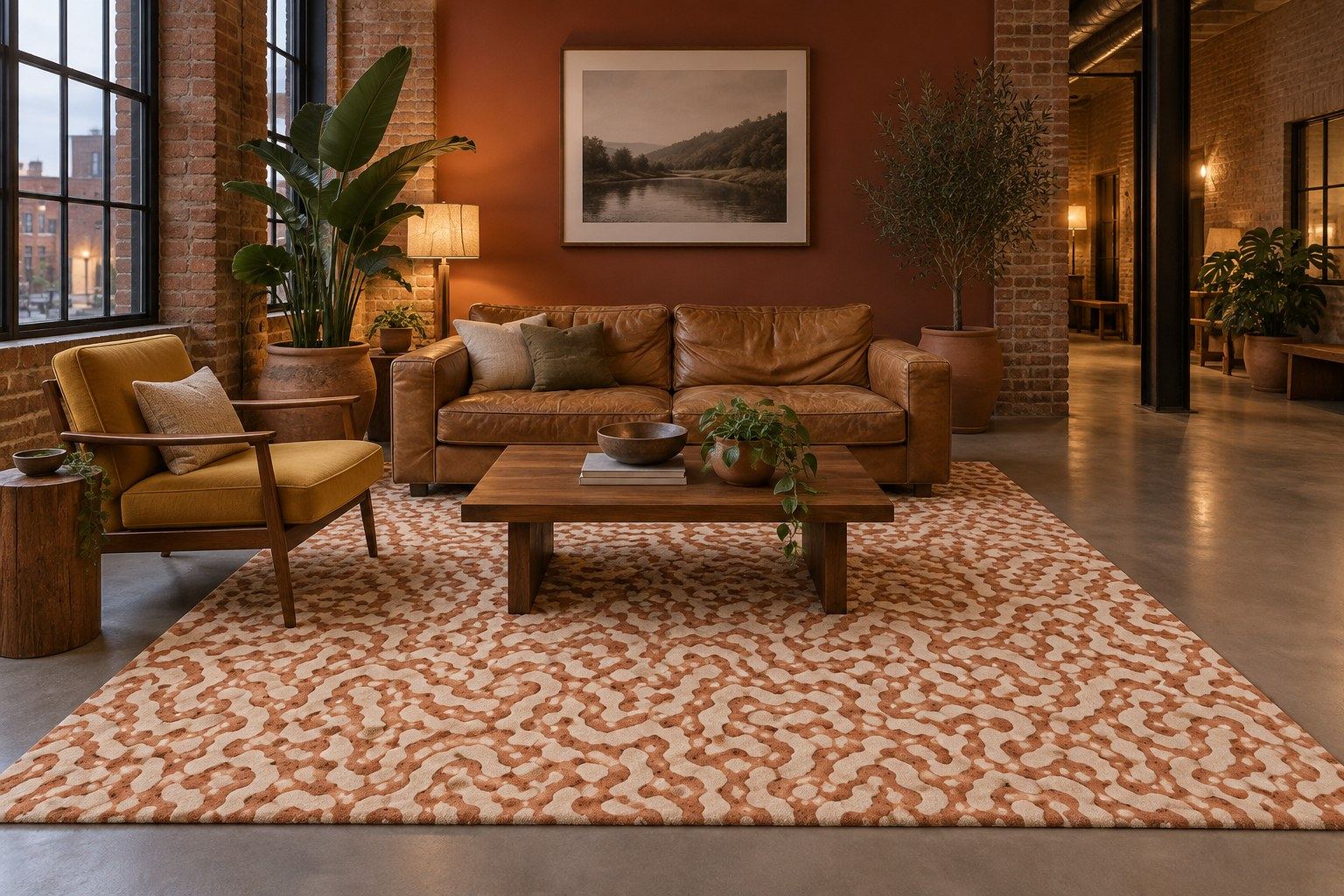
03 · Medium signalGreen on walls and upholstery, rarely on the floor
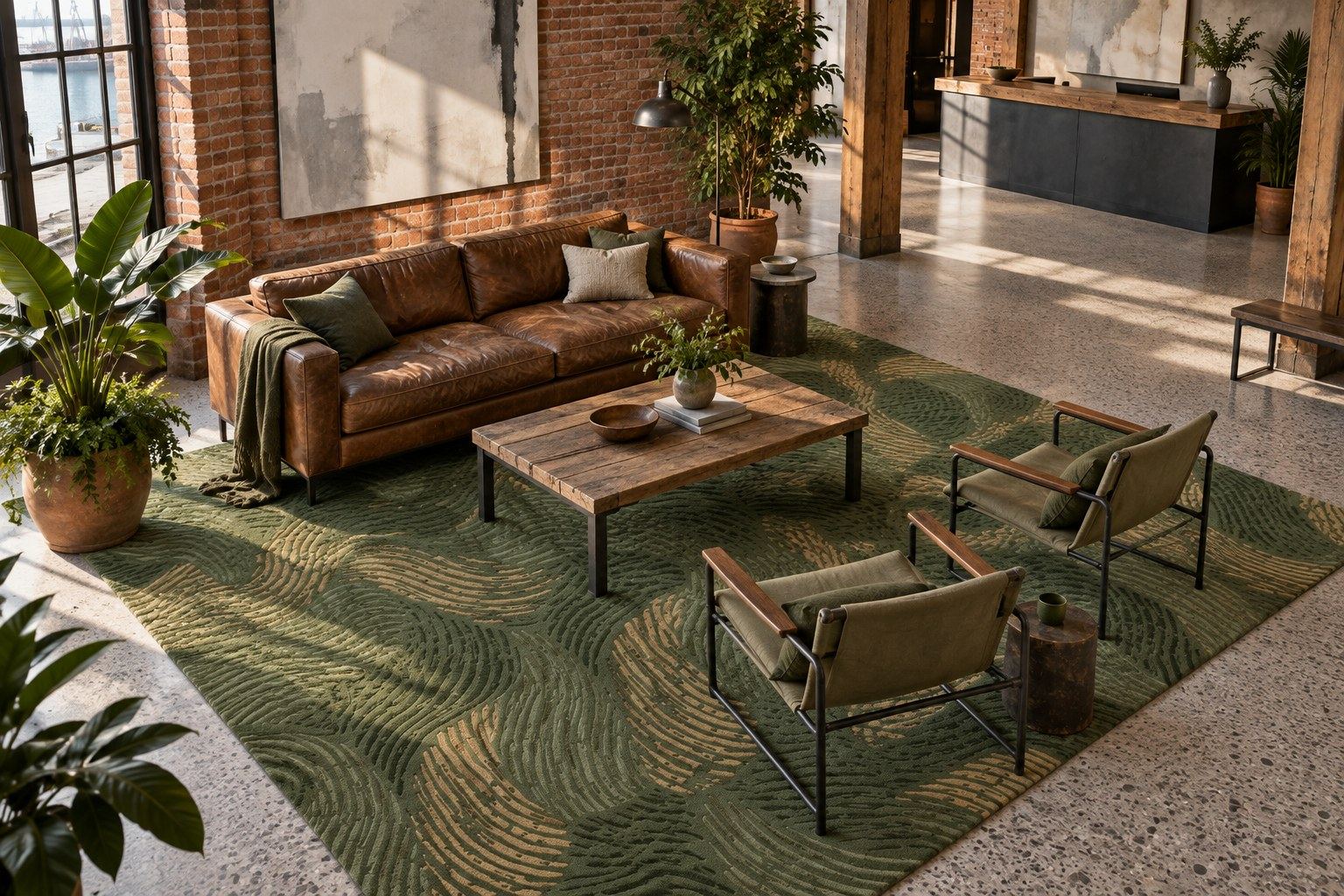
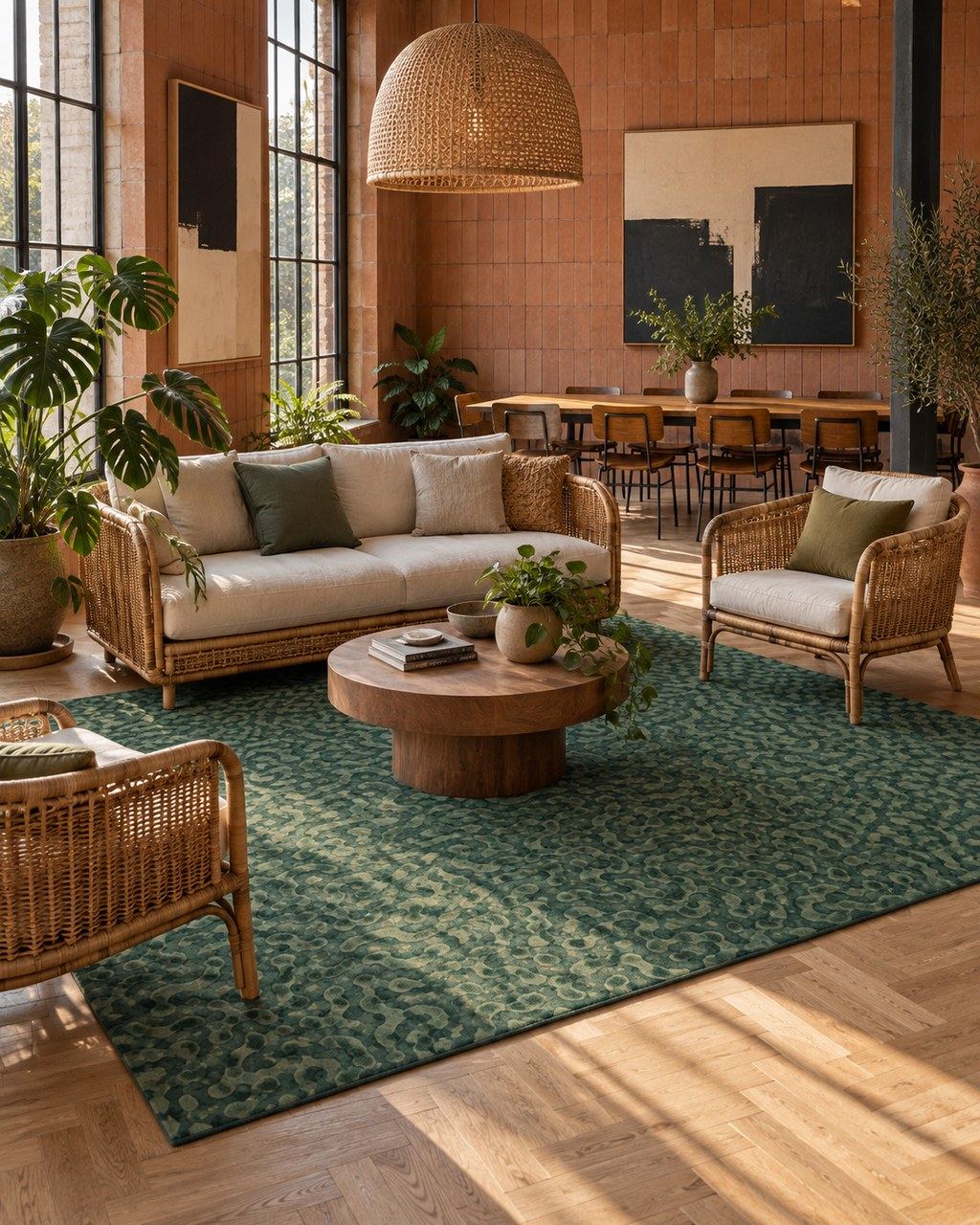
Olive, sage, bottle green and green marble belong to the walls, velvet and stone of these rooms. A green accent is still uncommon, about one in eleven interiors among the new openings, and it hardly reaches the floor, which stays neutral or warm. A green carpet ground is therefore a deliberate contrast to the walls, not a copy of the market.
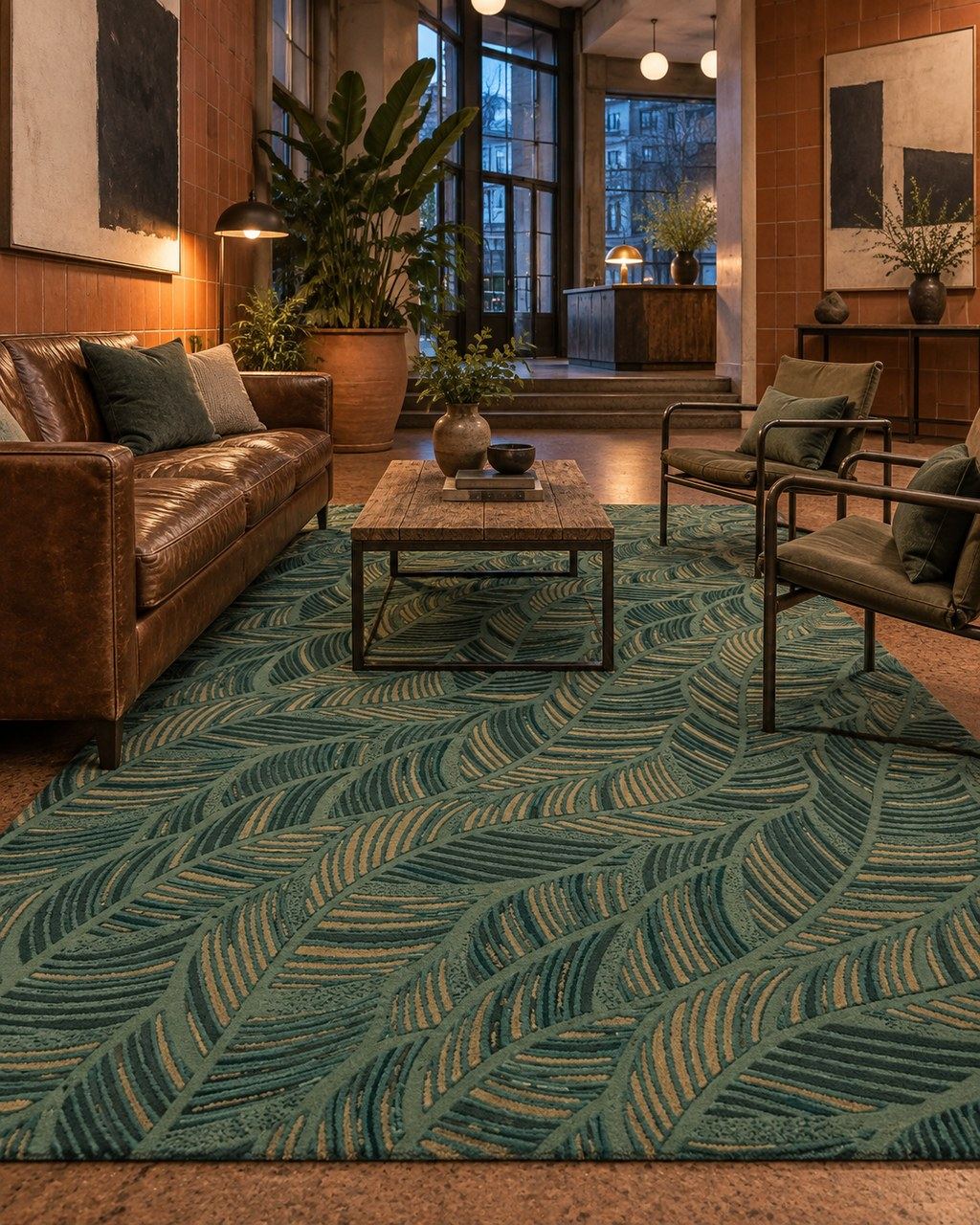
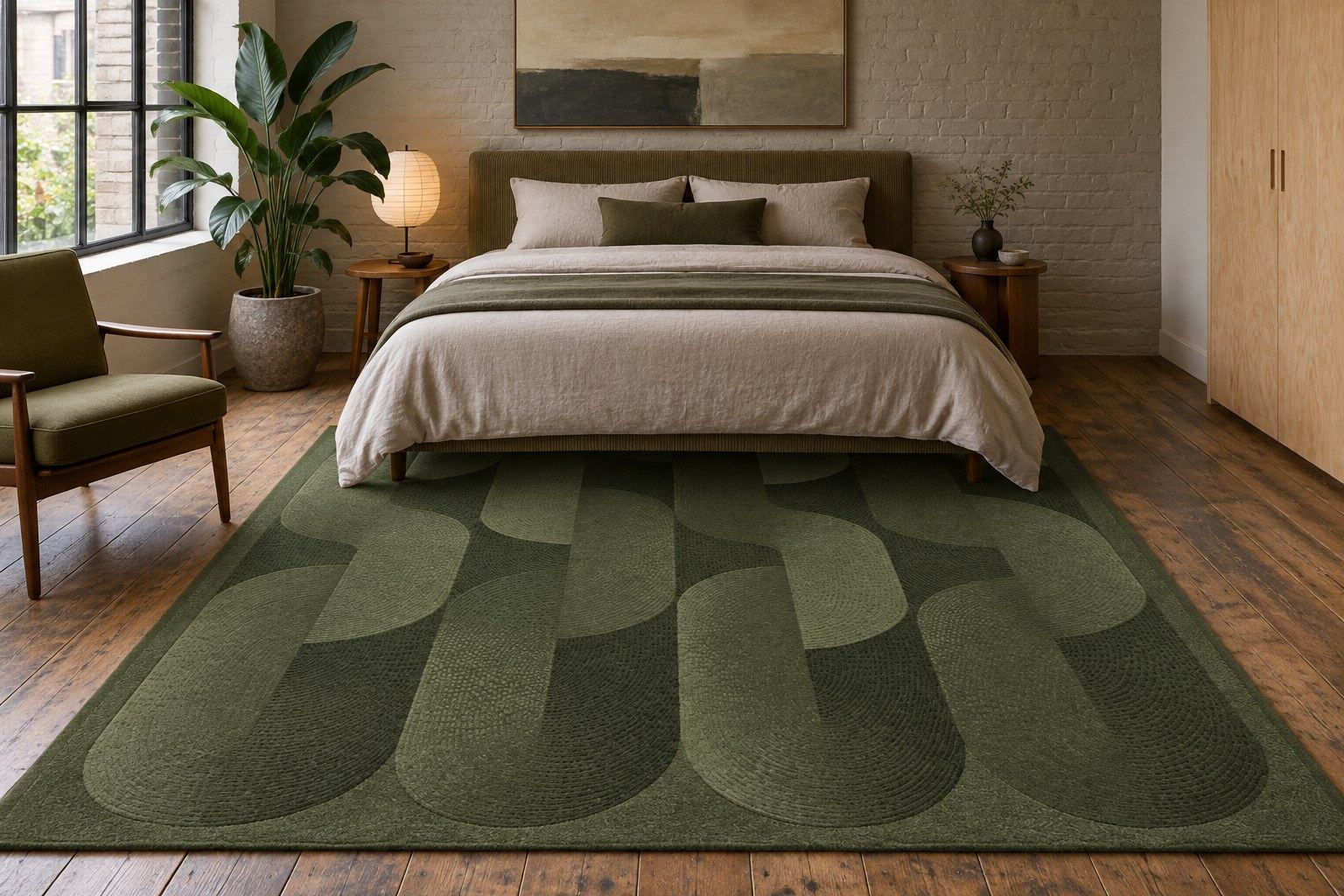
04 · Strong signalDark grounds return
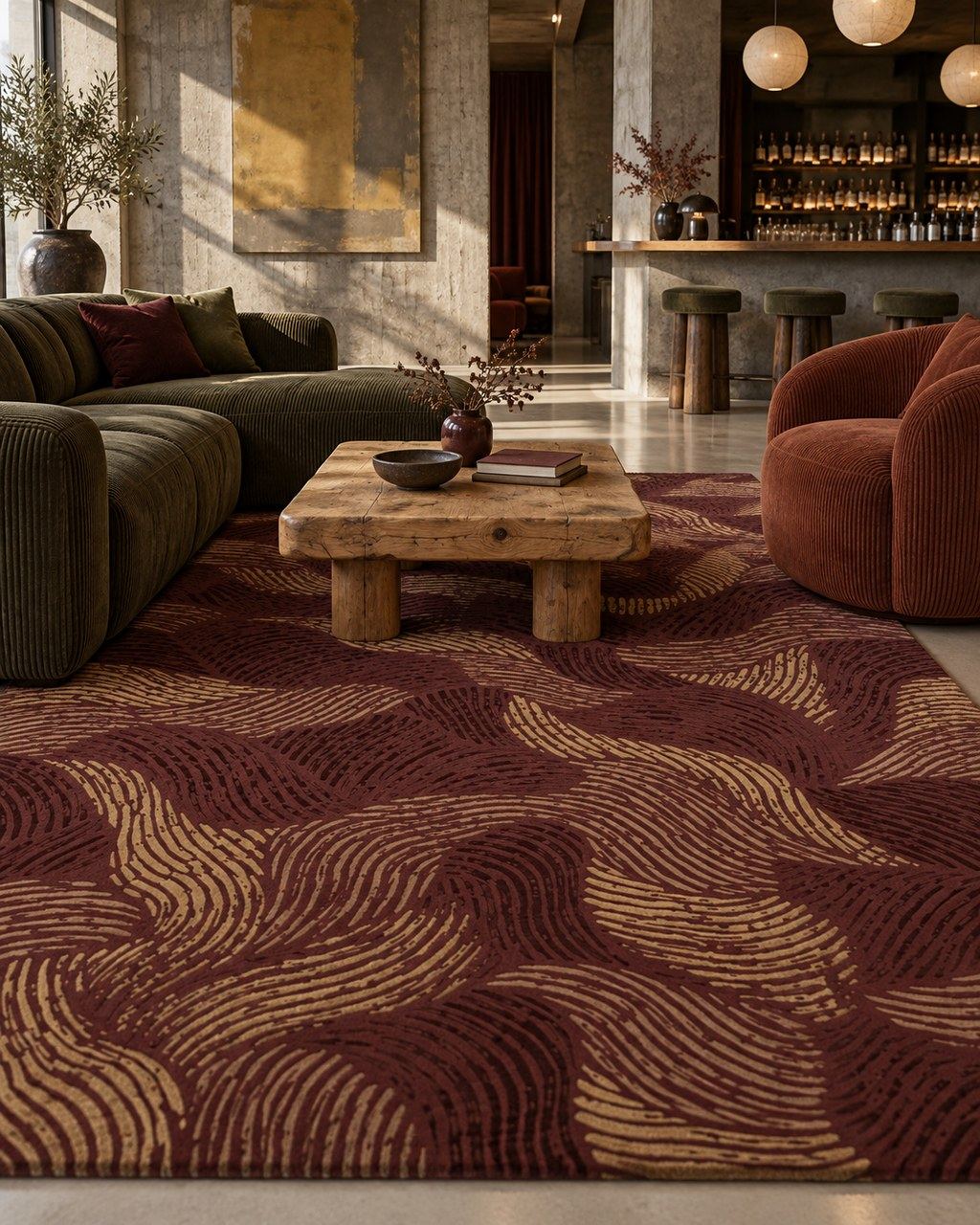
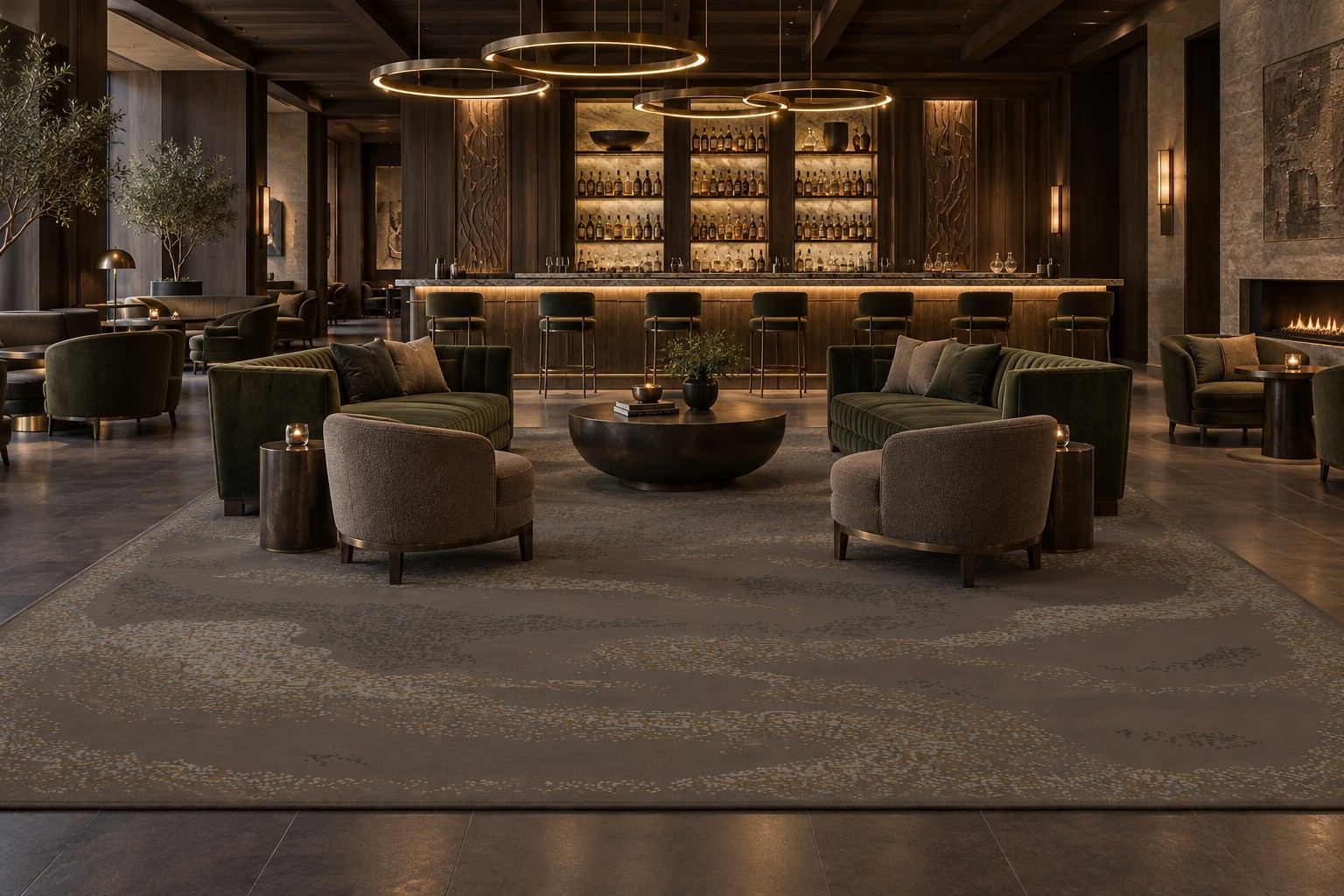
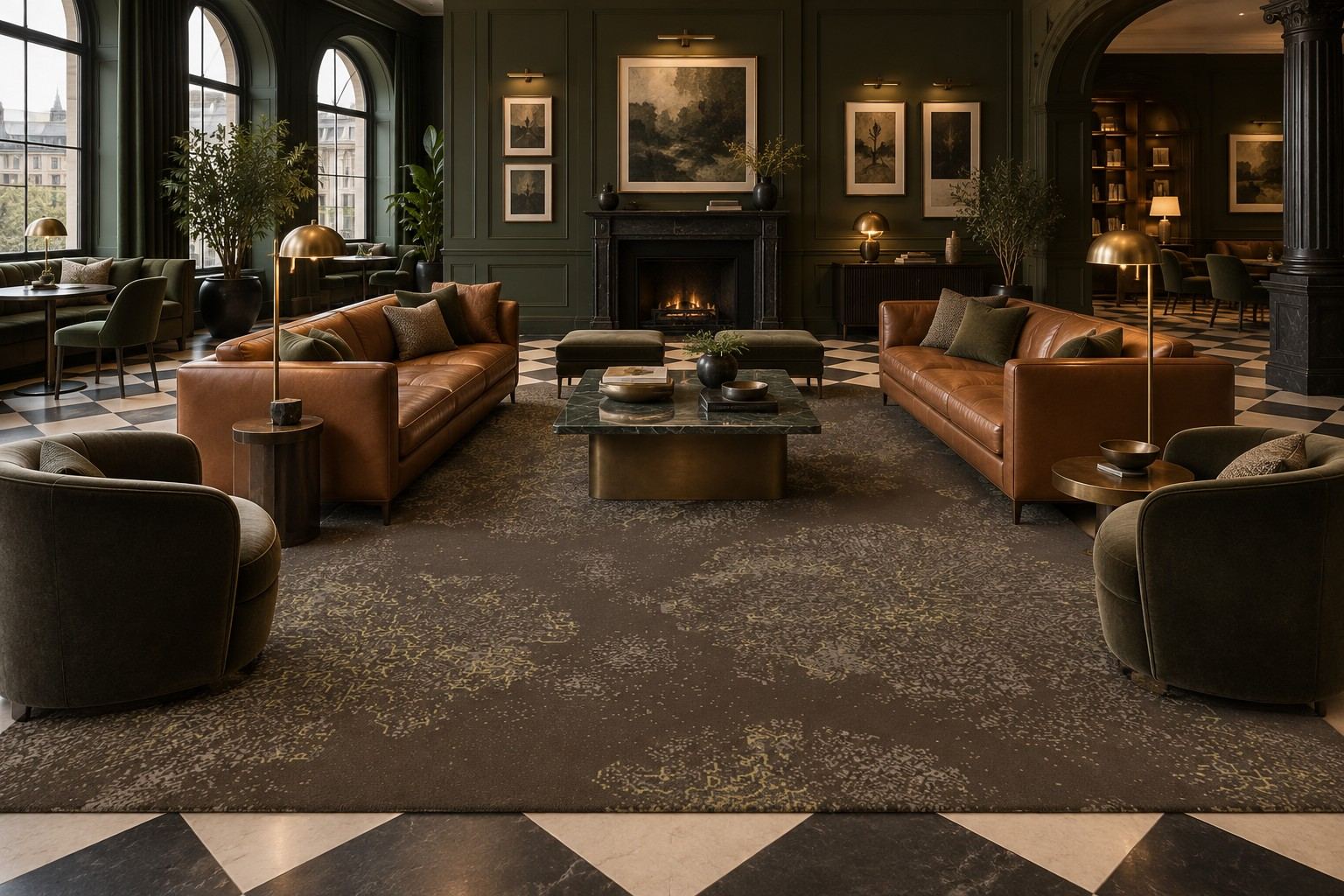
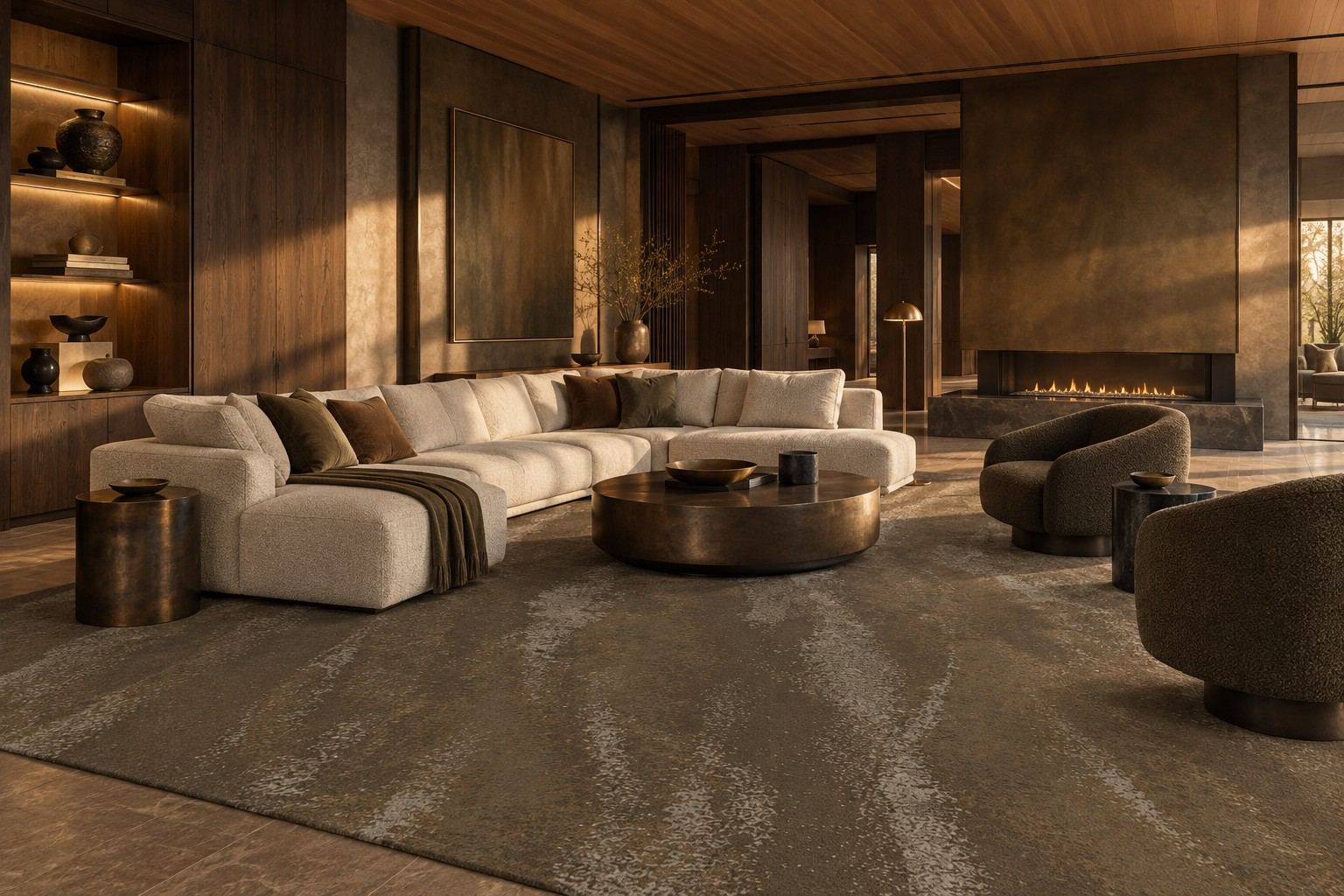
About one interior in six is dark: espresso, charcoal, night blue, walnut and brass, led by the dark bar. Rooms darken on the way to opening. Hardly any rendering is dark, but one in four of the hotels that opened in 2025 and 2026 is. Where these rooms have no dark carpet, they fall back on stone or tile.
05 · Strong signalThe rug on wood and stone
The carpet of today's hotel interior is mostly a rug on wood, stone or terrazzo. Where the floor can be seen, rugs are about four times as common as wall-to-wall carpet, and about four in five lobbies and lounges have one. The rug zones large open floors. Wall-to-wall carpet lives elsewhere: in ballrooms, meeting rooms and corridors (chapter 10).
06 · Medium signalPattern or texture: the room decides
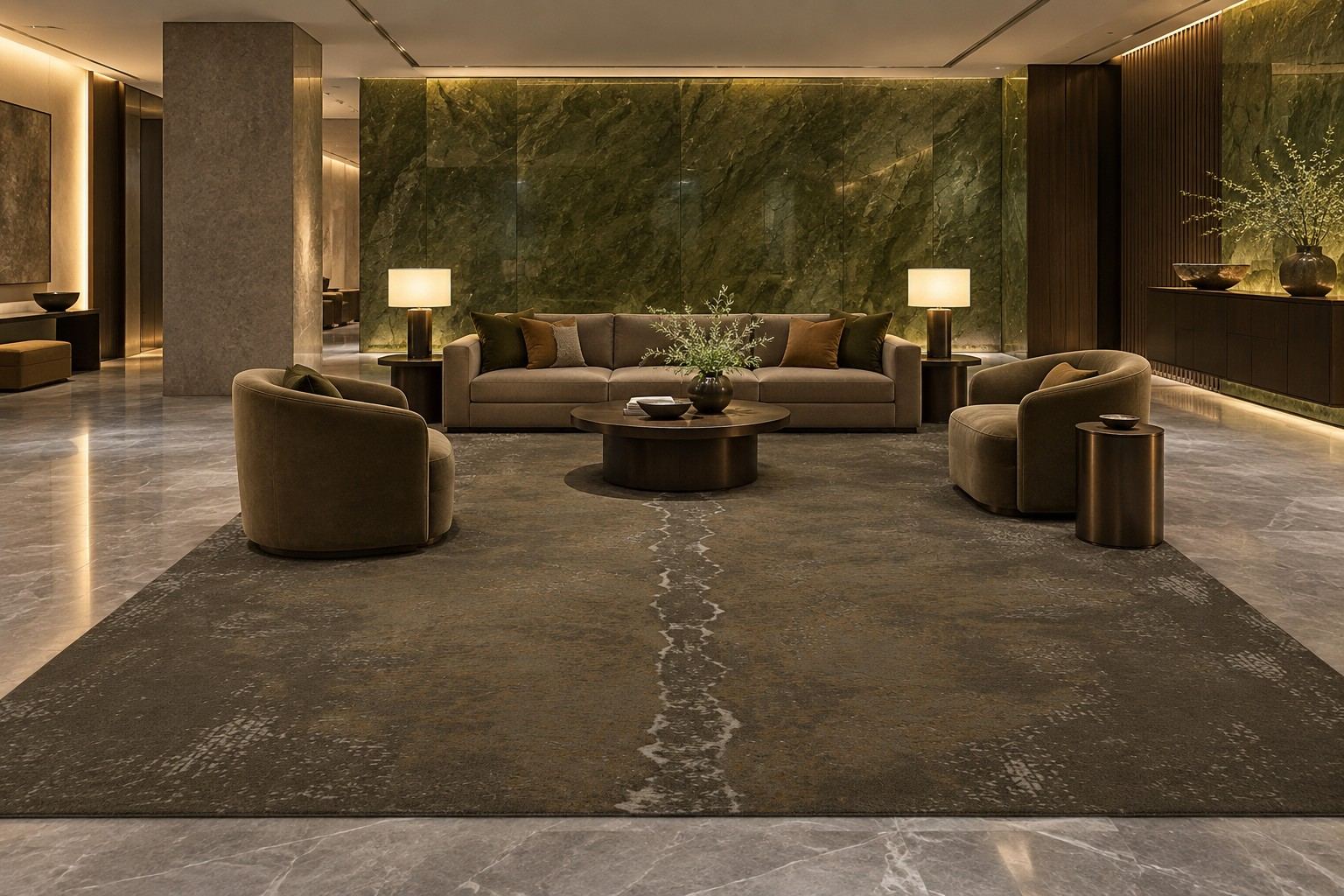
The floor is not going quiet: more than half of the visible carpets and rugs carry pattern. The newest upscale hotels decide by room, with pattern in lobbies, lounges, bars and restaurants and calm in the guest rooms. Midscale and lifestyle hotels pattern most of their carpets, the guest room included, where pattern hides wear and gives a standard room its character. Texture belongs where the room is calm: in the guest room and in quiet, timber-led interiors, where relief, cut and loop, carving and tonal depth carry the design.
07 · Strong signalChequerboard and large geometry
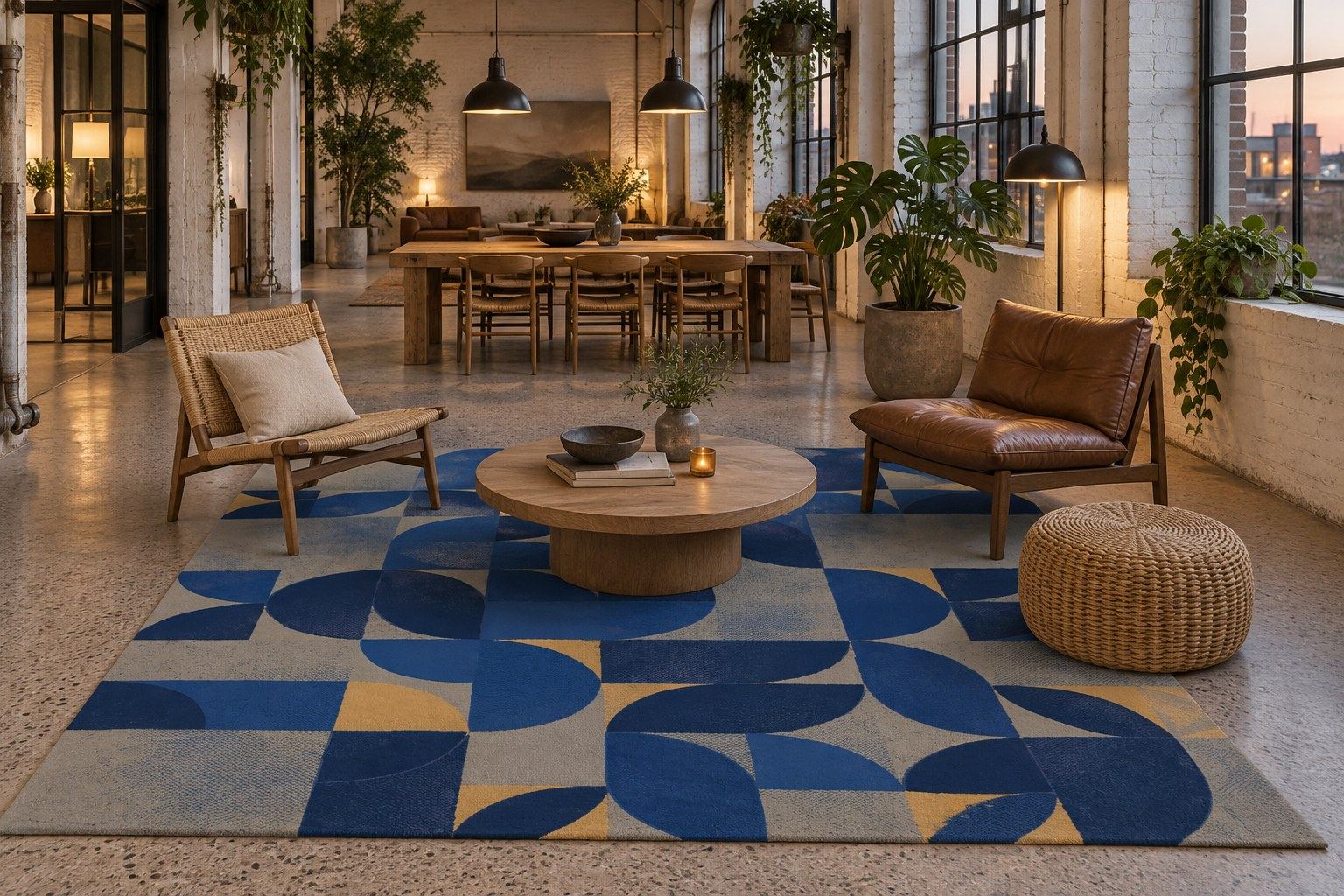
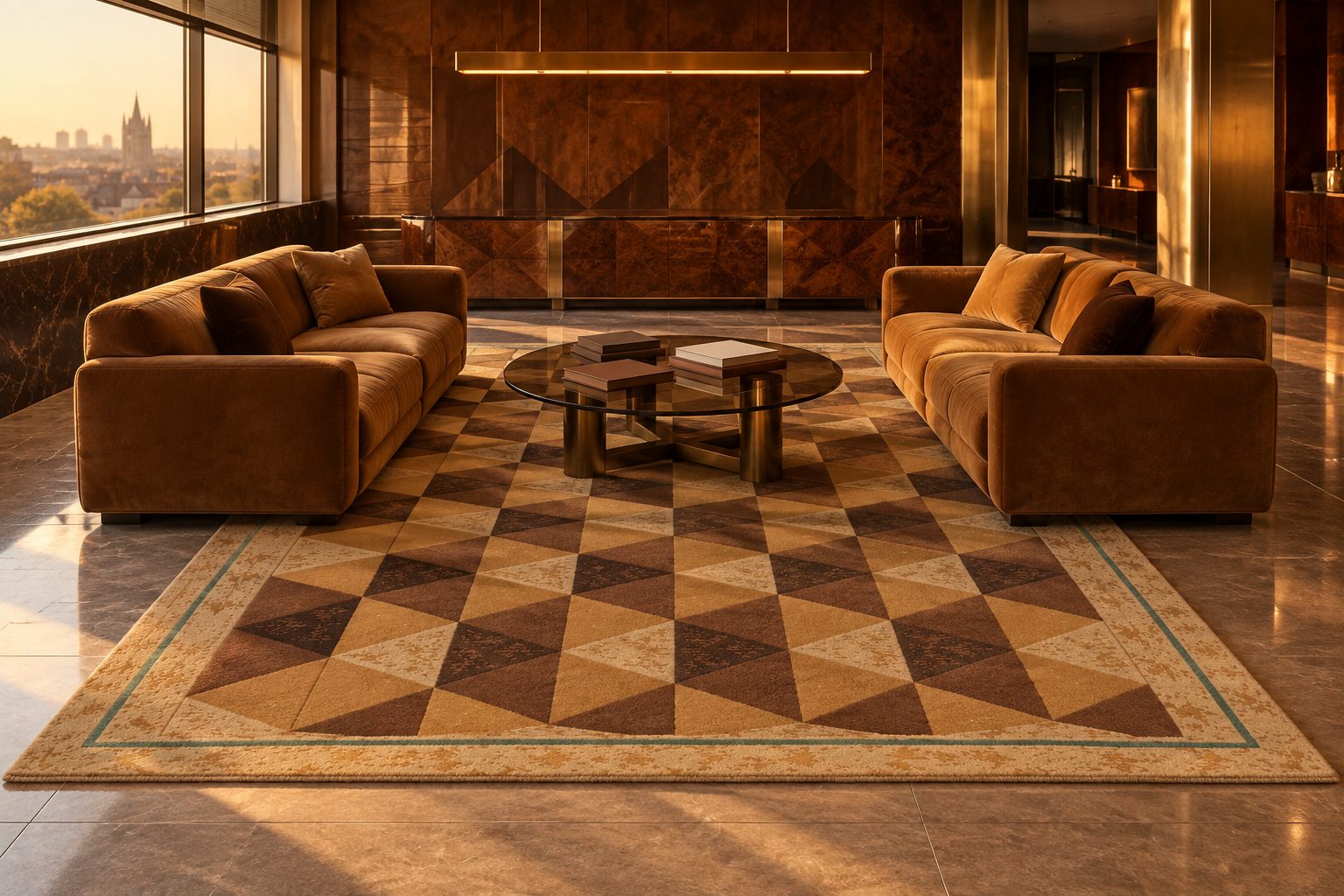
Geometry is the motif we saw most on the floor. Chequerboards, grids, stripes and large-scale geometry make up almost half of the patterned carpets, in the pipeline and in the new openings alike. It shows most in colourful postmodern and heritage interiors, often in two strong colours.
08 · Medium signalBotanical, softened
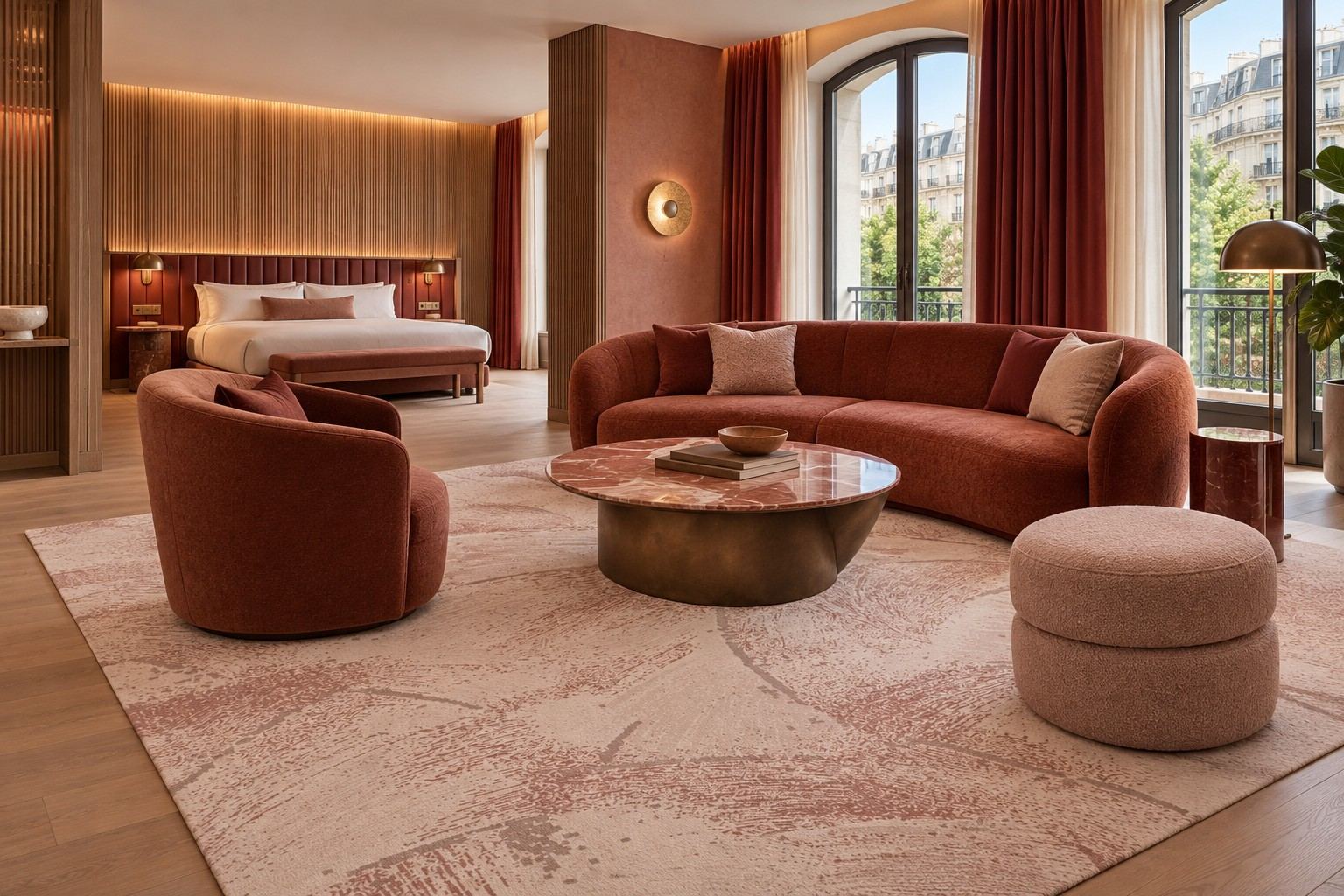
Nature shows up less as a literal leaf and more as organic line, seed and plume forms on muted grounds. On the floor, botanical motifs stay rare. Rattan and tropical interiors use leaf pattern directly, in green or rust rather than cream.
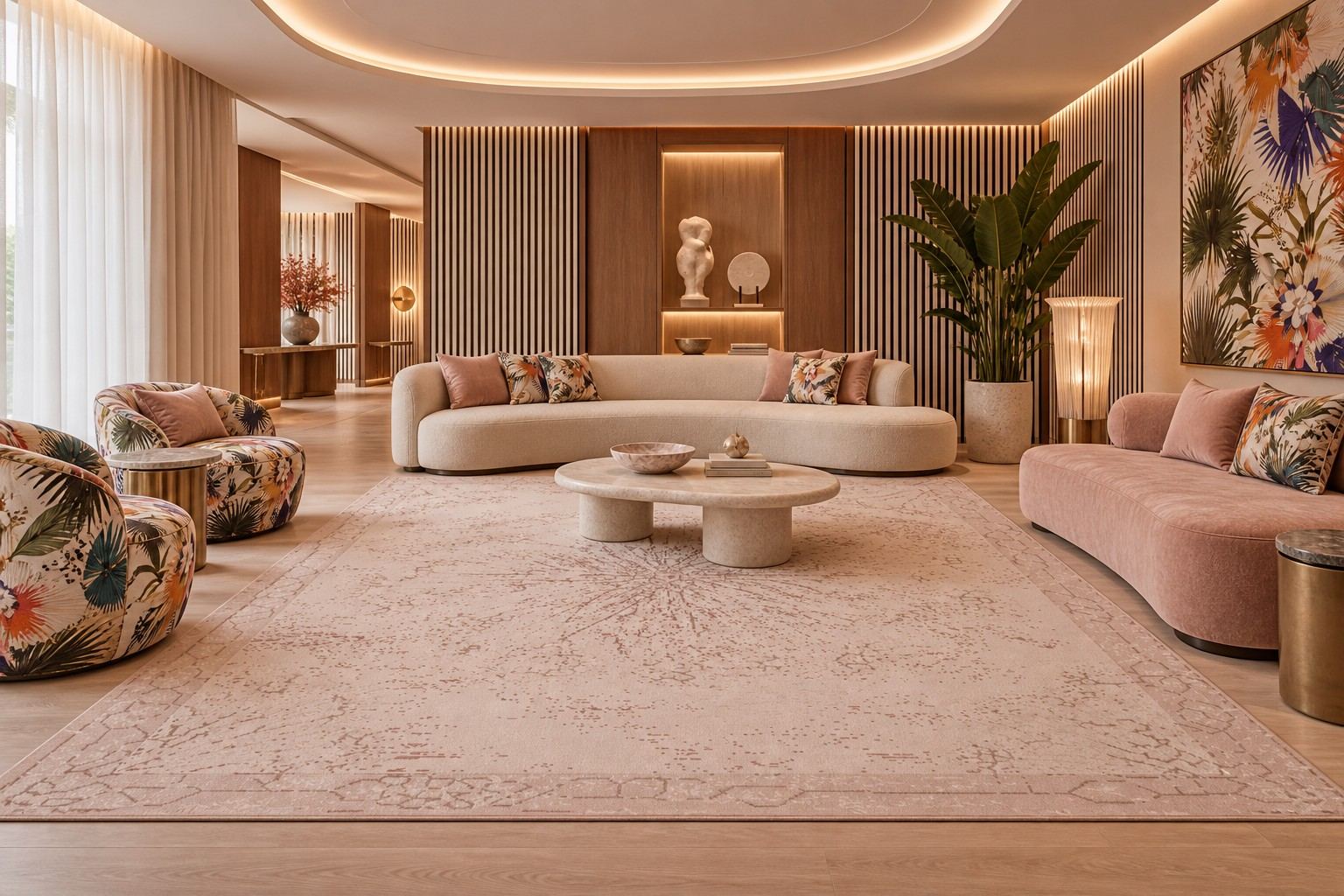
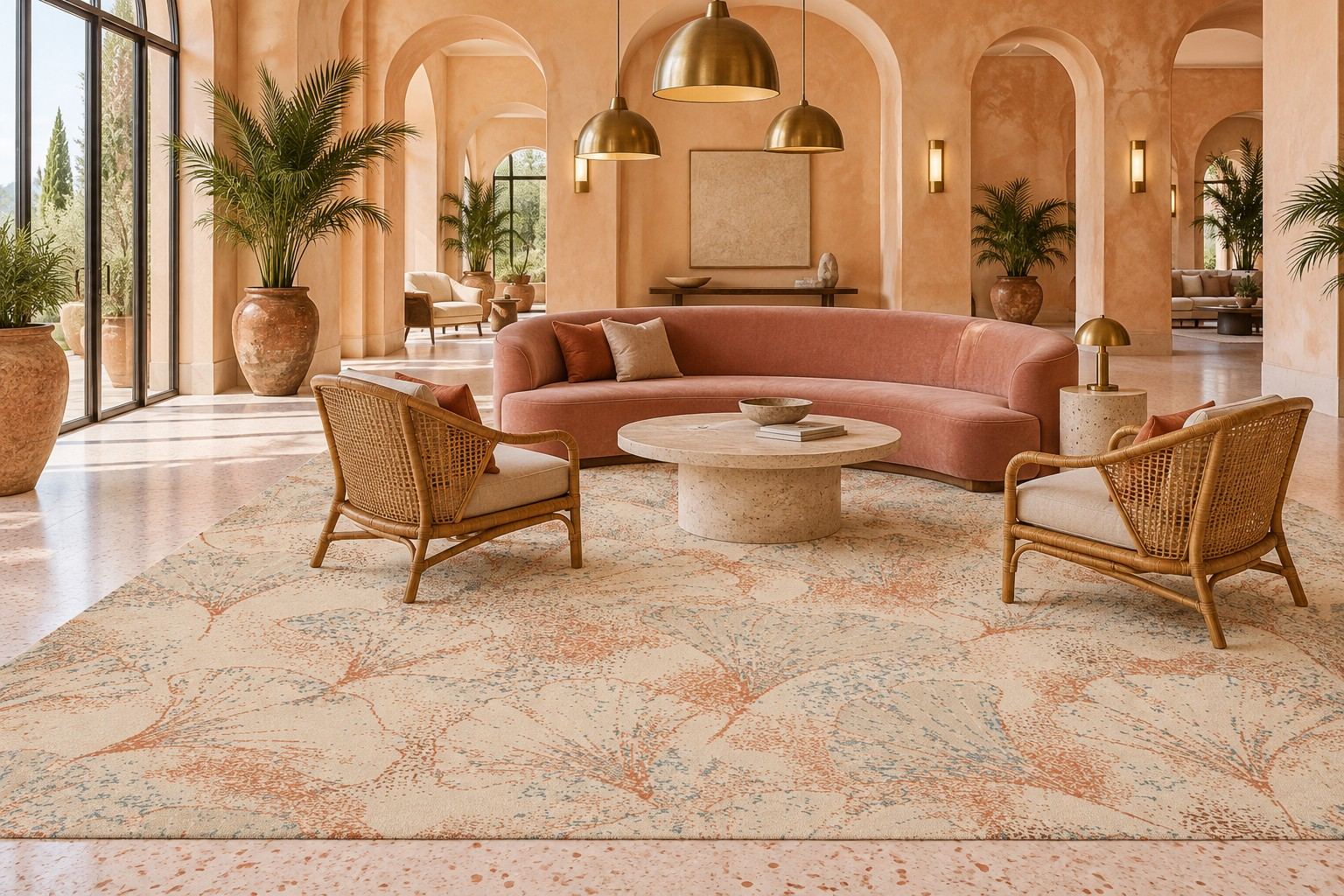
09 · Medium signalFrom quiet luxury to economy: one floor, four segments
Across the hotels that opened from 2025, the guest room carpet goes from plain to patterned as you move down the market. In openings chosen for the quiet luxury look of brands such as Aman, about one in four guest room carpets is patterned; in upscale hotels about one in three; in midscale, lifestyle and economy hotels about four in five. The build of the floor changes with it: the quiet end lays rugs on timber and stone, the economy end lays the most wall-to-wall carpet and leaves most lobbies and breakfast rooms on hard floor. Colour separates the ends too. The quiet end is warm through sand and honey, upscale hotels carry terracotta in about one in three rooms and midscale hotels in about one in five, economy rooms are light and cool. The quiet luxury pictures were chosen by style and do not stand for the luxury segment; the economy pictures are about half European and partly one brand. With photographs only, the direction is the same.
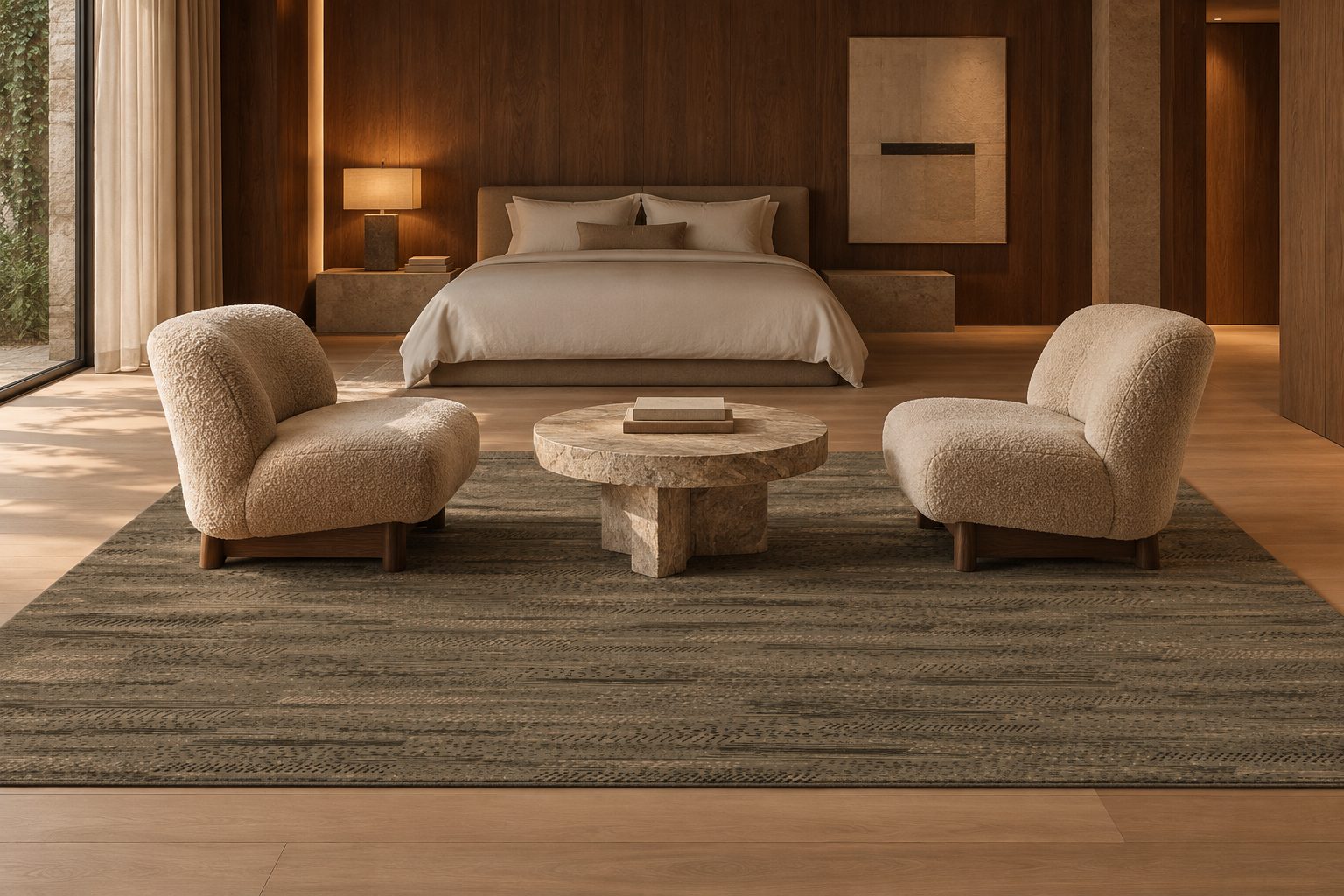
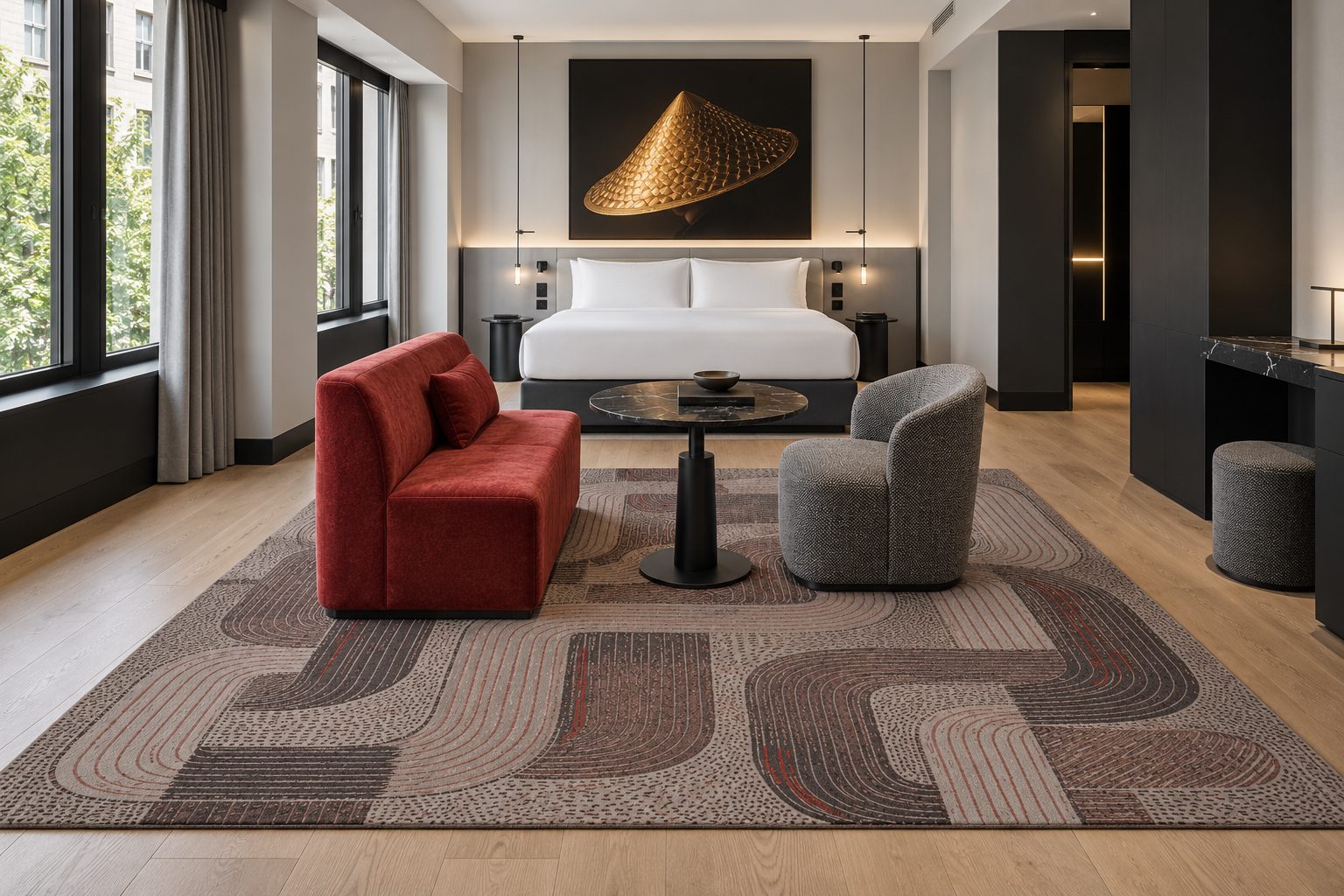
10 · Medium signalWhere the square metres are: corridors, ballrooms, meeting space
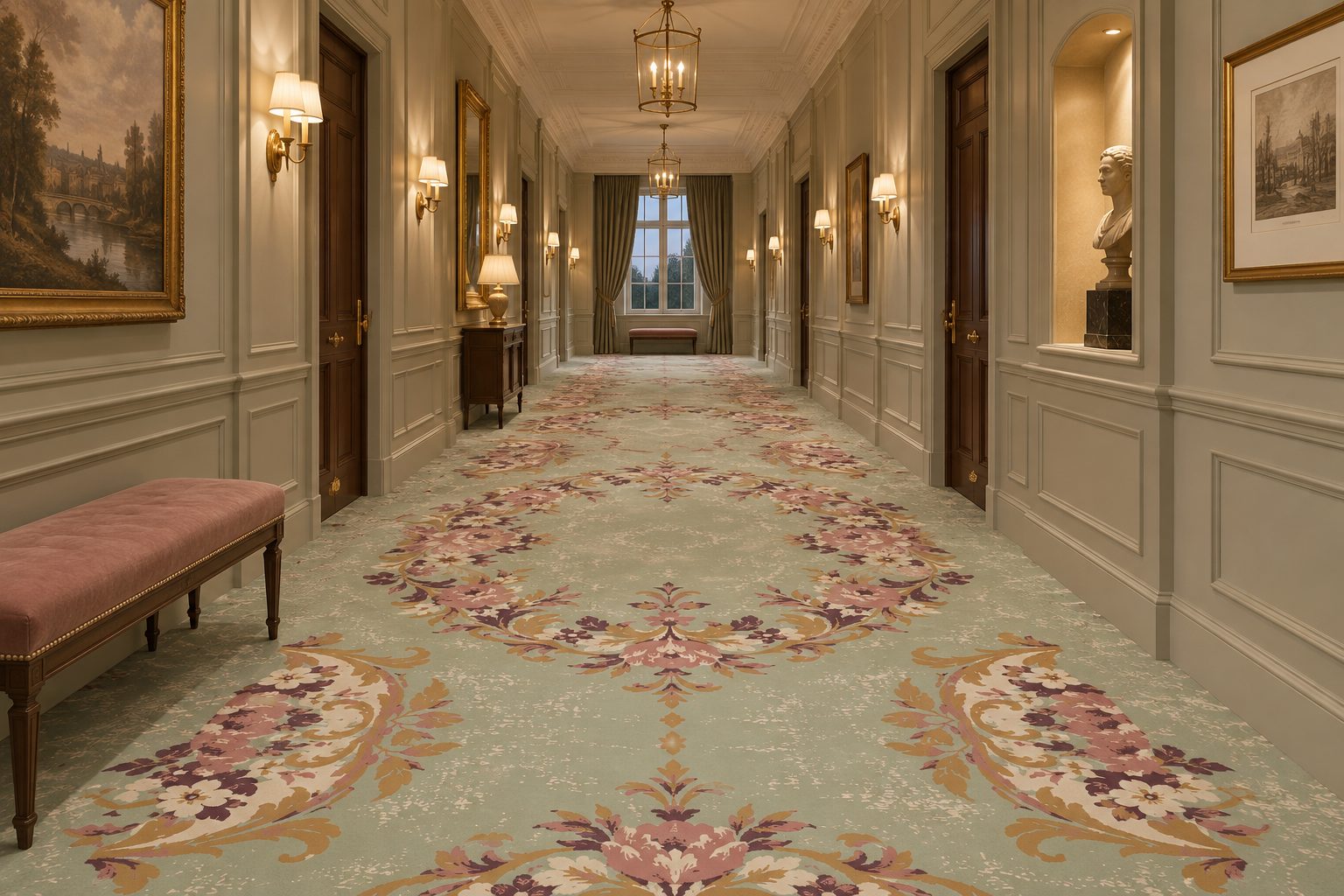
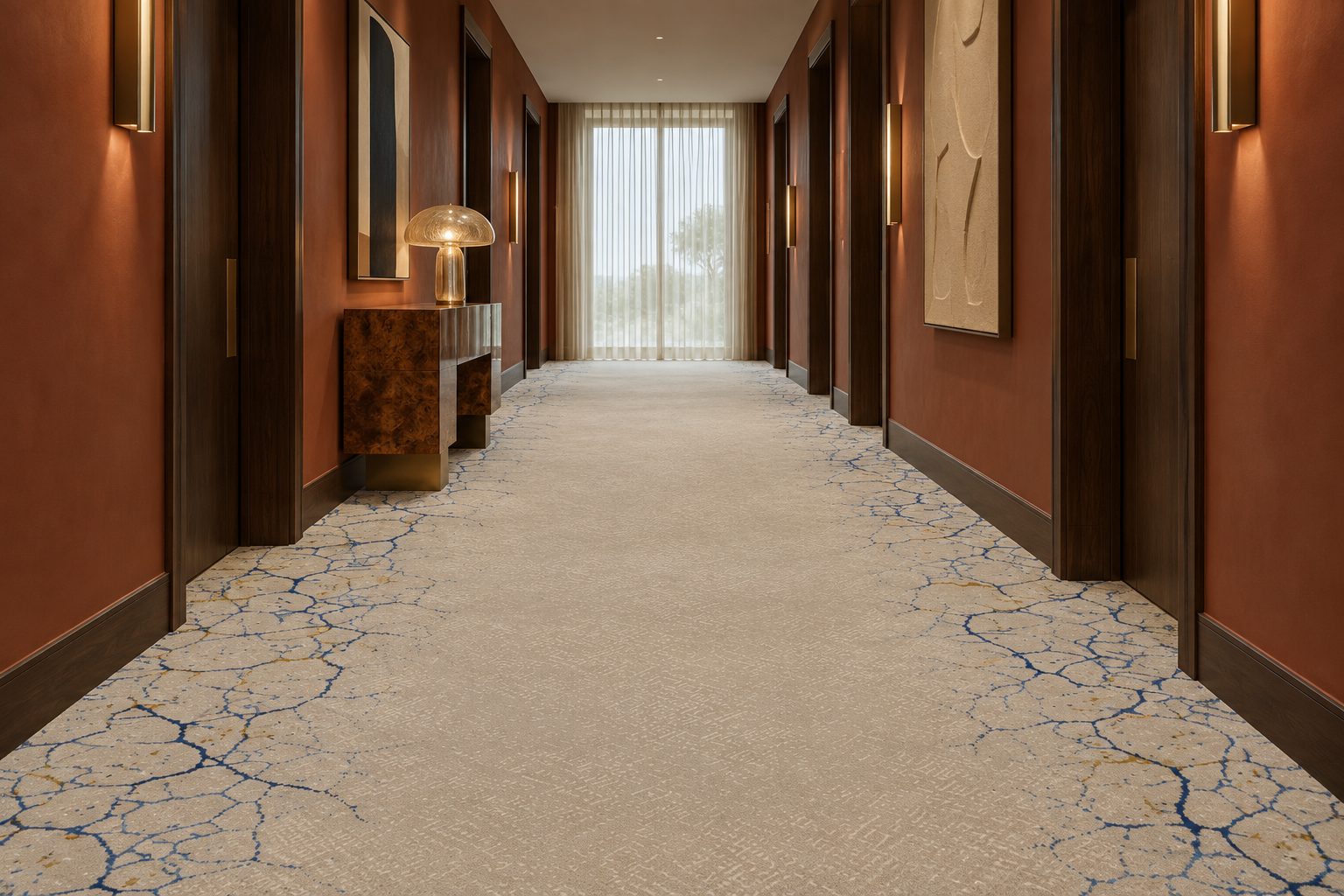
The rooms that pictures of new hotels rarely show have a floor of their own. In ballrooms, meeting rooms and pre-function areas of hotels opened or renovated in 2025 and 2026, almost every visible floor is wall-to-wall carpet, while lobbies, lounges and bars rarely have it. Nearly all of it is patterned, mostly in a large, free repeat that runs over the whole room without border or framed field. The motif is graphic abstraction, marble, water and cloud, ahead of geometry. The colour is calm: the terracotta of the new lobbies stays outside the ballroom door. Corridors are more often zoned as a runner and are darker. The pictures come almost entirely from one hotel group, and most corridor pictures are renderings, so read the corridor part as a direction.
Brand lensWhat the brands put on the floor.
Chains build to standards, so we looked separately at twelve select service and lifestyle brands that open many hotels: at their newest hotels and, where a brand has published one, at its latest prototype or pilot hotel. The paragraphs describe what we saw on the floor. They do not rank the brands.
The base is small, eight to thirteen hotels per brand, counting the hotels of these brands in the other samples. Chains also publish very different pictures: some show meeting rooms and corridors, others mostly guest rooms and lobbies, and several new hotels exist only as renderings so far. Where a paragraph rests on renderings, it says so; statements on prototypes name the source and its date. Hampton by Hilton and Motel One are in the sample with too few hotels for a paragraph of their own.
AC Hotels by Marriott Marriott · 9 hotels
The new AC guest room usually has a wood-look plank floor with a rug at the bed, and the rug is graphic: angular lines and broken grids in grey, black and navy. Lobbies and the library lounges stay on pale stone or stone-look tile, with a grey geometric rug to hold the seating group. In the meeting rooms and ballrooms of three further AC hotels the floor is wall-to-wall carpet with a large, marbled drawing in grey and sand. Marriott has not published a new AC prototype; the latest reference we found is AC Hotel Arlington National Landing (opened July 2025, studio not named), which shows the same plank floor and graphic rug. Several AC pictures, four of them from Arlington, are renderings.
Aloft Marriott · 8 hotels
In most new Aloft guest rooms a rug lies at the foot of the bed on light oak or wood-look planks, in multicolour stripes, dots or triangles: violet and red in Istanbul, confetti dots in Houston, teal and orange in Belfast. The social lounges repeat this at a larger scale on terrazzo or polished concrete; in Surabaya the lounge has patterned wall-to-wall carpet instead. Bars keep the hard floor. Of two corridor pictures, the one from Kunshan shows wall-to-wall carpet, the lift lobby in Shanghai is stone. We found no current Aloft prototype with a statement on the floor.
Canopy by Hilton Hilton · 10 hotels
Hilton designs every Canopy for its place and names no floor standard for the brand. What the new hotels share is a rug in the guest room, mostly on wood and often blue: broad stripes in Nashville, a bordered rug in Deer Valley, a red and white grid in Shanghai, a free organic shape in the rendering for Abha. Lobbies have a large rug, contour lines in Deer Valley, or patterned carpet; restaurants and bars more often stand on patterned tile in black and white. The latest flagship, Canopy Bangkok Sukhumvit (Hilton, August 2026, public areas by AvroKO), is described without any statement on the floor. The pictures of Milan and Abha are renderings.
Courtyard by Marriott Marriott · 11 hotels
The new Courtyard hotels do not follow one floor. Guest rooms have dark or grey wall-to-wall carpet in Guyana and San Diego, blue and sand wave rugs on oak in Okinawa, a small teal rug in Prishtina and a dark wood-look floor in Ghaziabad. Lobbies are mostly stone, lounges add a rug. In five further Courtyard hotels in China, Vietnam and Korea the lift lobbies and corridors are mostly stone; one corridor and the ballroom in Danang have blue patterned carpet. For Europe, Marriott presented the design European Spirit in November 2023 (Living Design Sweden, pilot hotel Courtyard Berlin City Center): the guest room floor is a woven vinyl from recycled material on a coconut-fibre acoustic layer, not carpet; in the pictures it reads light grey, with a deep blue oval or free-form rug. The San Diego pictures are probably renderings.
Four Points by Sheraton Marriott · 10 hotels
For Four Points we saw more corridors and event rooms than guest rooms, because six of its hotels came in through the room-type sample. Corridors and ballrooms there are wall-to-wall carpet in blue with gold or sand line work, waves and star grids. In the new hotels the guest room varies: faded blue rugs on wood in Xi'an, a cream and navy zigzag carpet in College Park, a grey check carpet in the Four Points Flex in Edinburgh. Lobbies have a rug, round and grey in São Vicente. The Four Points Flex concept (Marriott, September 2023, by OCCA for the Marriott Global Design Team) shows in its renderings a grey wood-look floor in the guest room, grey-blue carpet with a wave pattern in the lift lobby and a dark grey rug on light stone in the lobby; the source itself names no materials.
Hilton Garden Inn Hilton · 10 hotels
The new Hilton Garden Inn hotels keep their public rooms on stone: lobbies, restaurants and lounge zones are almost all marble or pale tile, with a rug only here and there. The textile is in the guest room. Mumbai has a blue and gold medallion carpet, Bengaluru a hexagon carpet, Jabalpur a blue-grey patterned rug, Chongqing a small patterned rug on wood; Bali has wood alone. The regional prototype Gen A for Greater China (Hilton, June 2024, no studio named) follows the same line in its renderings: pale marble in lobby and hub, pale wood in the guest room, and a green leaf-shaped inlay at reception whose material the renderings do not show. The pictures of Mexico City, Brussels, Athens and Jinan are renderings.
Holiday Inn Express IHG · 10 hotels
Holiday Inn Express keeps lobbies, lounges and breakfast rooms on hard floor: stone, tile or wood-look planks. The exceptions are a round rug with a radial pattern in the lounge in Taipei and carpet tiles in the work corner in Fernandina Beach. In the guest room we saw both: navy wall-to-wall carpet in Ellwangen and Fernandina Beach, patterned carpet in Sapporo, a navy and tan geometric rug in Vijayawada, a blue-grey angular rug in Taipei, plain wood in Shanghai and in the two new hotels in Spain. IHG's Generation 5 design for Europe, the Middle East, Africa and Asia (January 2025, studio not named) puts area rugs with graphic stripes in blue, red and yellow on a pale hard floor in lounge and bar; the press texts name no floor. The guest room rendering for Krabi shows a plank floor with a blue runner at the bed. The pictures of Bengaluru and Fernandina Beach are renderings.
Hotel Indigo IHG · 9 hotels
Every Hotel Indigo is designed around its neighbourhood, and where the floor carries pattern it often picks up the local theme. Guest rooms have a grey rug or carpet with a drawn line: abstract strokes in Lima and Melbourne, waves in Torquay by the sea, a soft grey-blue carpet in London Clerkenwell. Bars and restaurants vary: hard floor with a pattern of its own in Clerkenwell, a black and white tile runner on herringbone parquet and a mosaic inlay, tile and wood in Melbourne and Auckland, plain carpet in Torquay and Playa del Carmen, patterned carpet in the renderings for Raleigh. The glazed walkway in Gloucester has a patchwork carpet. IHG has no Indigo prototype; it calls Clerkenwell (July 2025) its new flagship, without a statement on the floor.
ibis Styles Accor · 11 hotels
In ibis Styles guest rooms wall-to-wall carpet is common: blue and green water patterns in Munich, a grey line pattern in Katowice, grey carpet in Phuket. Madrid goes the other way, with round rugs in a colourful organic drawing on wood. Lobbies and lounges are mostly terrazzo, wood or tile with a round or free-form rug, and a green carpet zone marks the seating in Munich and Madrid. The corridor in Debrecen has blue carpet tiles with red and light blue squares. Accor has published no room prototype for ibis Styles; the ibis family concepts of January 2023 (Agora by Innocad, Plaza by FGMF, Square by Soda) mention patterned floors only for the Agora lobby.
Moxy Marriott · 13 hotels
All Moxy hotels in this report come from the other samples and opened in 2025 and 2026. Their guest rooms are mostly wood-look planks with no rug or a small one; Dublin, Hamburg and Belfast have grey tonal carpet. The lounges carry the pattern: large rugs in black and white geometry, multicolour pebbles or stripes under mixed seating. Bars stay on hard floor, and corridors range from colourful carpet tiles in Ottawa to polished floors with light lines in Montreal. Marriott's prototype for the Middle East and Africa (date not stated, renderings, studio not named) shows a light wood floor with several organically shaped, patterned rugs in the room and stone in the lobby.
The 2027 palette
The colour families we measured, each with the nearest Pantone TCX reference. Any ligea design can be coloured in these tones; a special colour costs nothing extra.
| Colour family | Hex | Nearest Pantone TCX |
|---|---|---|
| Terracotta and rust | #C2653F #B5573A #8E4A2F | 17-1353 TCX · Apricot Orange 17-1345 TCX · Spice Route 18-1244 TCX · Ginger Bread |
| Olive, sage, bottle green | #8A9A6B #556B2F #1F4D3A | 17-0324 TCX · Epsom 18-0330 TCX · Twist of Lime 19-6050 TCX · Eden |
| Espresso and charcoal | #3A2E28 #2B2320 #1E1E1E | 19-1106 TCX · Mole 19-4008 TCX · Meteorite 19-3911 TCX · Black Beauty |
| Petrol and ink | #1F4D5A #2E4A62 #1F3A5F | 19-4726 TCX · Atlantic Deep 19-4118 TCX · Dark Denim 19-4029 TCX · Navy Peony |
| Oxblood | #6B2A32 #7A2E3A | 19-1930 TCX · Pomegranate 19-1934 TCX · Tibetan Red |
| Blush and coral | #D9B3A6 #E8907A | 14-1311 TCX · Evening Sand 15-1333 TCX · Canyon Sunset |
| Cognac | #A86A3C #B07A45 | 17-1340 TCX · Adobe 16-1438 TCX · Meerkat |
Put a trend into a quotation
Every design in this report can be quoted in your colours and constructions within 24 hours. Send the room, the area and the direction through the specification form or write to lena.hoffmann@ligea.com. More designs are in the collections; answers to practical questions are in the FAQ.